

Oxford Soju Club by Jinwoo Park
Reviewed by Selena Mercuri

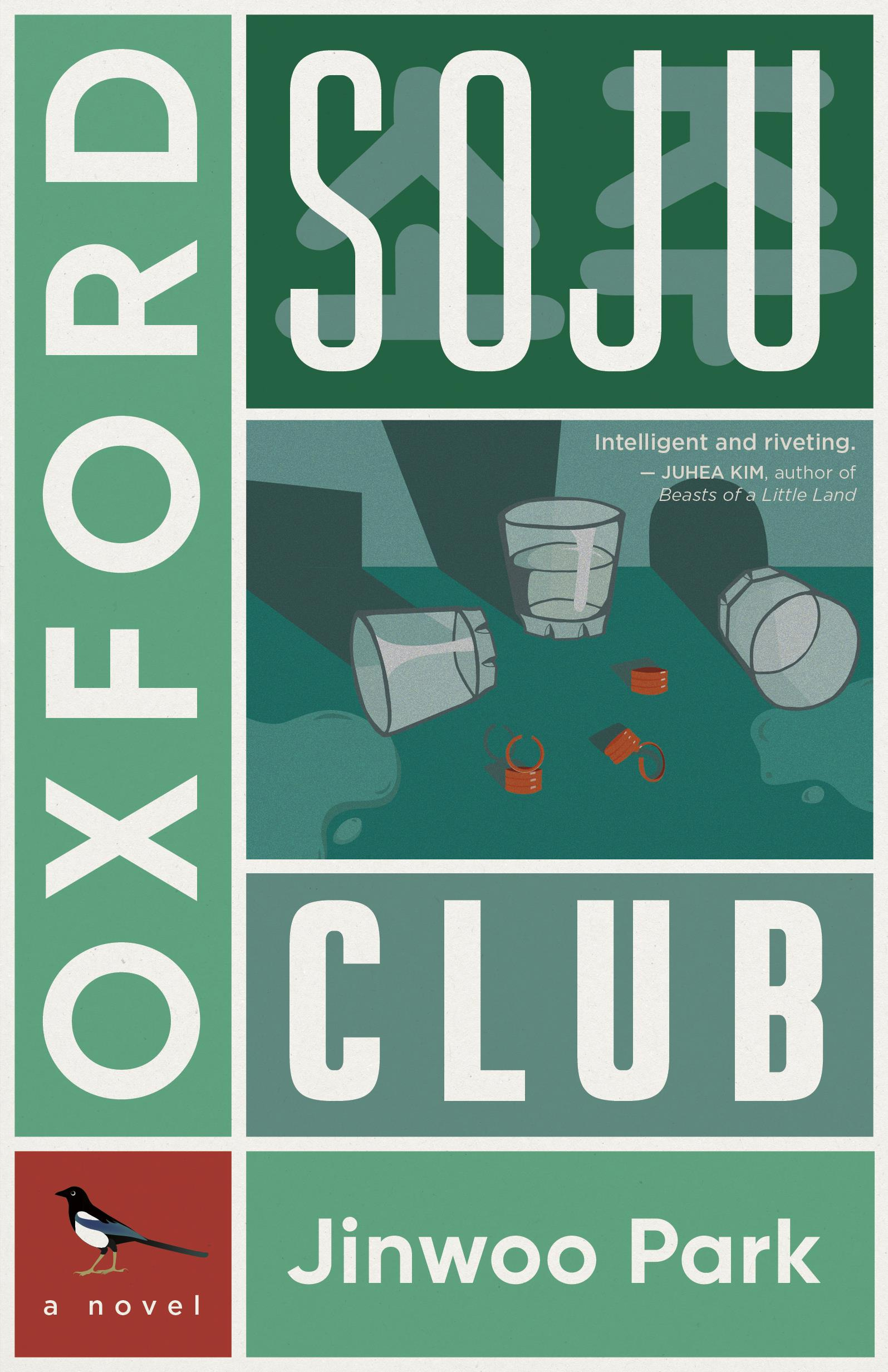
Oxford Soju Club is a spy novel that also operates as an examination of displacement, loyalty, and the relentless effort required to inhabit multiple identities. Set largely in Oxford and anchored in a Korean restaurant, the novel follows three central figures: Yohan, a North Korean agent; Jihoon, a South Korean immigrant; and Yunah, a Korean American CIA officer. Their lives intersect in the aftermath of a political assassination. The espionage plot provides the frame, but the novel’s real subject is the long aftershocks of exile and the cost of survival.
“The espionage plot provides the frame, but the novel’s real subject is the long aftershocks of exile and the cost of survival.”
Yohan’s chapters move through grief and attachment, reflecting a life built entirely on obedience. One of the novel’s most emotional moments occurs shortly after he discovers that his mentor has been murdered: “Yohan tries to say something, a word or two that will honour Doha, perhaps, or a burning question that he didn’t have the chance to ask the commander while he was still alive. Nothing seems appropriate, so he silently brings his shot glass in contact with the glass resting on Doha’s side of the table. He drinks in his memory. That is all Yohan can do for him now.” This gesture crystallizes the novel’s emotional architecture. Yohan’s grief exists outside the boundaries of permitted expression; ritual becomes the only vocabulary available, and survival eclipses mourning. His loyalty, stripped of ideological abstraction, becomes achingly personal and claustrophobically narrow.
Doha, Yohan’s mentor, articulates one of the book’s central philosophical tensions when he tells Yohan that no country offers salvation. No place can be paradise. “There’s something wrong with every place. These people seek better lives by going elsewhere, and it’s futile. They hop over to another place only to find that they’ve traded one kind of misery for another.” This philosophy runs through every storyline. Migration in Oxford Soju Club functions as transaction, loss for loss, constraint for constraint. The novel dispels the mythology that leaving produces clarity or belonging.
Jihoon, the South Korean restaurant owner, spends the early years of his life trying to meet expectations that are set for him. His life takes shape through routine, warmth, and unspoken devotion to his mother rather than through ideology or grand ambition. In one scene, we see him at the threshold of adulthood: “As he walks away and looks back to his smiling mother, he thinks about how he doesn’t particularly want to go to university. He wants to stay with her, in the restaurant, where it’s warm and everything makes sense. But he also knows if he said any of that, it would hurt her. So he keeps his mouth shut and walks home alone under the dim streetlights.” Jihoon’s silence mirrors Yohan’s, but where Yohan’s is mandated by the totalitarian state and a lack of familial ties, Jihoon’s emerges from tenderness and filial obligation.
Yunah’s trajectory offers sharp thematic contrast. As a Korean American CIA agent, she has been professionally rewarded for discipline, achievement, and strategic emotional distance. Her interior world has been constructed around accomplishment as armour: “All her life, Yunah looked to her achievements as her guiding light. When her relationship with her church friends crumbled, she took flight to her exams. When her parents’ marriage floundered, she let herself be blind to everything but her college applications. When she first experienced heartbreak, she could console herself with how her perfect GPA was opening doors unavailable to her classmates.” Yunah’s faith in achievement as protection gradually disintegrates, exposing how success can function as another form of concealment that postpones reckoning rather than preventing it.
These three characters share a fundamental exhaustion. Each is weary of performing, of calibrating the correct version of themselves for survival in systems that demand constant translation. The Soju Club itself becomes charged symbolic terrain: a liminal space where identities briefly loosen their grip, overlap, and fracture, existing neither as home nor as foreign ground.
The novel places emphasis on small moments and observations—such as glances, silences, and the choreography of daily routine—much in the way spies are trained to do. The spy plot provides narrative propulsion and structural tension, but the book’s lasting resonance comes from its attention to suppression, to the vast interior landscapes its characters cannot or will not articulate. Oxford Soju Club is a novel about living with irresolution, about accepting that clarity, belonging, and peace are fleeting, precarious alignments. It understands survival as the unglamorous work of continuation, and treats that continuation with honesty, compassion, and restraint.
A SHELF AWARENESS BEST BOOK OF 2025 • A CBC BOOKS BEST CANADIAN FICTION BOOK OF 2025 • A CRIMEREADS BEST BOOK OF 2025

About the Author
Jinwoo Park is a Korean Canadian writer based in Montreal. He completed a master's degree in creative writing at the University of Oxford, and currently works as a marketer in the tech industry. In 2021, he won the Jim Wong-Chu Emerging Writers Award. Oxford Soju Club is his first novel.
About the Reviewer
Selena Mercuri is a Toronto-based, Italian-Cuban writer and MFA candidate in Creative Writing at the University of Guelph. Her work has appeared in The Fiddlehead, The Literary Review of Canada, Prairie Fire, The Ampersand Review, The Seaboard Review of Books, Room, and other journals. In 2023, Selena received the Norma Epstein Foundation Award for Creative Writing.
Selena serves as reviews editor at The New Quarterly and works across the literary landscape as a publicist with River Street, a social media associate with The Rights Factory, and social media manager for the Vancouver Manuscript Intensive. Smooth Jazz and Other Forms of Torture is her debut novel, and she is represented by Kelvin Kong at K2 Literary. You can find her on Instagram at @selenamercuriwriter.
Book Details
Publisher : Dundurn Press
Publication date : Sep. 2 2025
Language : English
Print length : 232 pages
ISBN-10 : 1459755103
ISBN-13 : 978-1459755109