

Penn Kemp’s ‘Binding Twine’ Forty Years On
Reviewed by Jennifer Wenn for Throwback Thursday

“There is a powerful resonance here, right down to the current day, that renders Binding Twine as relevant and as important as ever.”
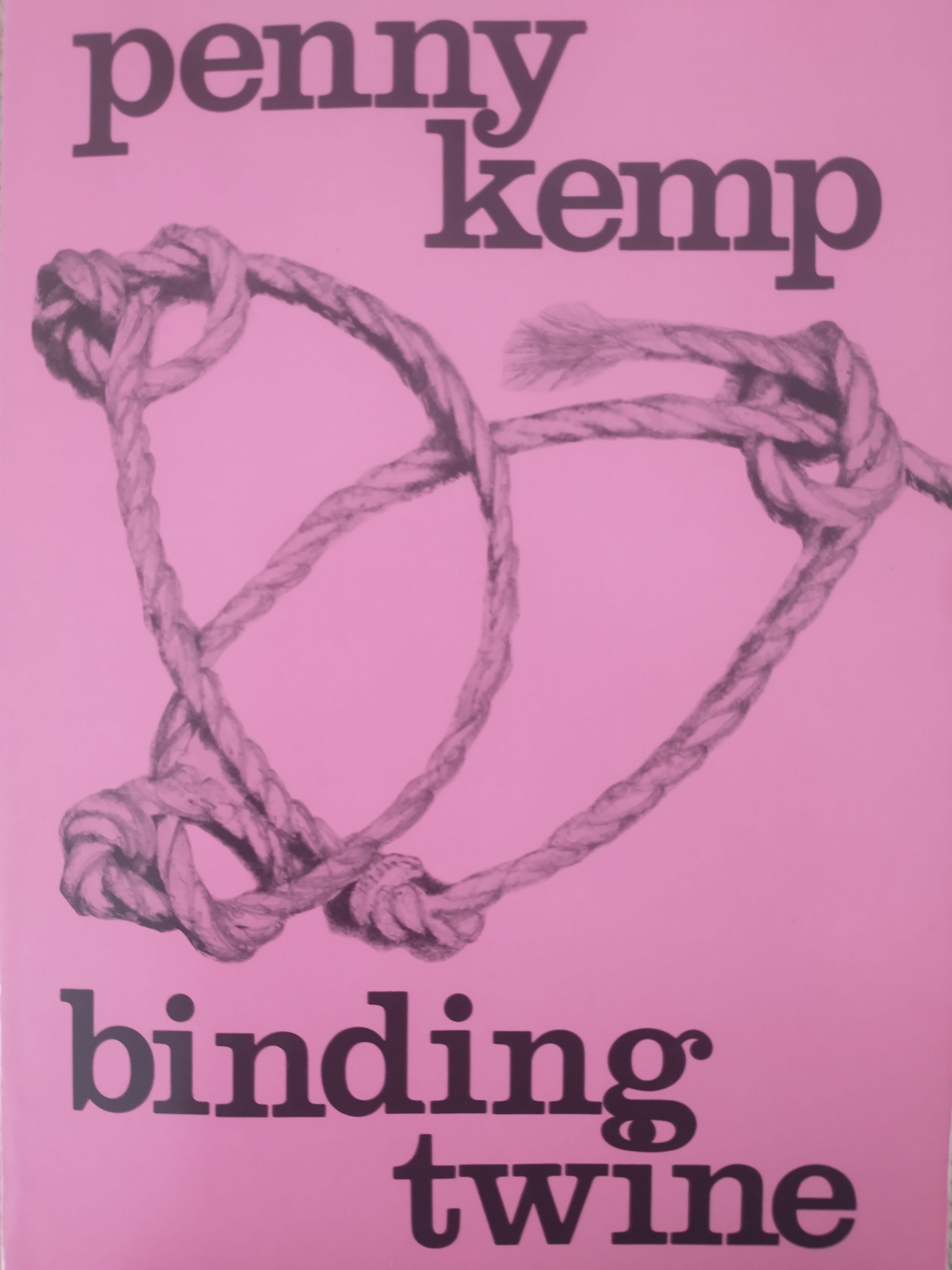
1980 found Penn Kemp embroiled in Canada’s family law system. One outcome was the poetry collection Binding Twine, published in 1984, under the name Penny Kemp (in the introduction she indicates that “It has taken three years to muster the objectivity and courage to write this book”). Kemp, also in the introduction, explains the course of events; it is worth quoting the summary (and it is only a précis of the story) from a review by Libby Scheier (“Body language”, Books in Canada 14.2 [March 1985]):
Binding Twine makes direct use of experience, telling the story of Kemp’s custody fight for her children. After her marriage broke up, she tells us in the introduction, her son and daughter lived with her for six years, their father seeing them infrequently if at all, and not paying any child support until served with a court order. For four of those years Kemp raised her children on welfare.
The father eventually decided to spend some time with his son, and the boy stayed several months with him. When he wanted to return to his mother, Kemp says, he was not allowed. Her ex-husband and his new wife had decided to seek custody. Kemp reacted by taking the children out of the country for several months, then returned to battle to retain custody. She lost. The judge decided for the father, Kemp tells us, on the grounds that the husband and new wife had a better income than her and a more conventional life-style.
Kemp also provides several motivations for writing the book, one being to lay out “testimony the judge did not, could not hear.” Another is to “[reach] others who have been where I have.” This is expanded later on: “It’s my experience that most women going through such a trial think of themselves as utterly alone and indefinably ‘guilty,’ punished by the adversarial nature of the courts. It is those women I want to reach.” It made an impact at the time, judging by nine confirmed contemporary reviews (eight recorded by Canadian Poetry Online, more than any other of Kemp’s books listed there, and one more in the Canadian Book Review Annual), including Brick Magazine, Poetry Canada Review (by the late Barry Dempster) and The Malahat Review.
The poems are split into thirteen more-or-less chronological sections that move through the story. The presence of the introduction obviates the need for too much narration, allowing a focus on reactions, emotions and key snapshots. The earlier portions did not quite connect with me, but as the book moves toward the extended crisis, it becomes, in Scheier’s phrase, “riveting” indeed. It is also brilliant and steeped in pain. The writing is stripped down and direct, the imagery restrained. At the same time, as Bruce Pirie points out, writing in Canadian Literature (“Sympathetic Magic”, issue 105 [Summer 1985]), “Kemp uses poetry as ‘a kind of sympathetic magic’ to review pain and win ‘a gift of awareness.’ This magic, her last strength, sometimes takes the form of incantation, words as witchcraft.” From “The Dogs”:
She asked for my children.
She asked for their things.
She asked for the table
on which sat my typewriter.

She got the children.
She got their things.
She got more writing
than she could have dreamt up.
I kept the table and
the typewriter.
Kemp does indulge here and there in her trademark wordplay. This can be effective (per Pirie, it “[gains] Kemp a distance of pained laughter”) but does risk taking the reader out of the moment of these particular pieces.
By the concluding poem (“Well”), a resolution, acceptance, has been found; it ends with:
We are jars that love
has filled	emptied
     and fills again
There is also much anger along the way, for example in this excerpt from the piece “Invisible Shield”, addressed to her ex-husband’s new partner:
You gloat over your ap/
parent win.  Now live
with the knowledge of
what you have taken.

You are very young and
old beyond cold eyes.
This, in turn, is linked to another of Kemp’s goals, also explained in the introduction: “Binding Twine is about the ‘betrayal’ by those women who saw me as breaching a code they had accepted. As a feminist, one of the more difficult things for me to face was the anger of other women who had committed themselves to patriarchal values.” As if to prove Kemp’s point, Ellen Pilon in the Canadian Book Review Annual 1984 complains that “Page after page [Kemp] writes out her feelings of loss, her difficulty adjusting to the change, her anger at other mothers who turned against her, at her children, at her husband, and especially at the ‘other woman’” and “The anger is too raw and misplaced” and “They remain extremely personal expressions of her ordeal and emotions, of interest perhaps to other angry women but not to everywoman.”
In addition, this is a strange (and distinctly unempathetic) view to take, given that expression of the storm of emotions, including anger (amply justified in the circumstances), and, as mentioned earlier, connecting with women who travelled Kemp’s road, are two of Kemp’s main objectives. For anyone who has made such a journey, the catharsis of experiencing that expression is profound. And those who have not, but who have an open heart, can nonetheless have their spirits expanded.
There is a powerful resonance here, right down to the current day, that renders Binding Twine as relevant and as important as ever. Many are still caught up in the adversarial legal system, and the family law area in particular. Many of the battles women fought four decades ago are still underway, or are being renewed. And the heroine’s journey is timeless.

About the Author
Poet and playwright Penn Kemp has participated in Canadian cultural life for sixty years—writing, editing, and publishing poetry, fiction, and plays. She shares the richness of her experience through a unique use of word, sound, imagery, and symbolism. Her work explores environmental and feminist concerns, though she is best known as a sound poet. Delighting in multimedia, Penn is active across the web.
About the Reviewer
Jennifer Wenn is a trans-identified writer and speaker from London, Ontario. In 2023 she was honoured to be chosen honorary Grand Marshall for London's Pride Parade. Her first poetry chapbook was A Song of Milestones (Harmonia Press). Her first full-size collection was Hear Through the Silence (Cyberwit). Her newest collection is Emergence (Wet Ink Books). And courtesy of Public Reverie is an online chapbook called Ekphrastic Doubles (https://publicreverie.com/ekphrastic-doubles-a-chapbook/). She has also published poetry, reviews and essays in numerous journals and anthologies; has spoken at numerous venues; and is the proud parent of two adult children. Website: https://jenniferwennpoet.wixsite.com/home
Book Details
Publisher : Gynergy Books
Publication date : Jan. 1 1984
Language : English
ISBN-10 : 092030432X
ISBN-13 : 978-0920304327
 | A guest post by
|
How astonishing to read this well-thought out review, forty-two years to the day after its publication! Thank you, Jennifer and James!
It’s disheartening to look back at contemporary critics like Ellen Pilon, who dismissed Penn Kemp's raw honesty as "misplaced anger" meant only for "angry women." In my view, that is a distinctly unempathetic and foolhardy stance. Kemp wasn’t interested in appealing to the "widest possible audience" or the "lowest common denominator." She was writing for the minority, the women trapped in an adversarial system who felt utterly alone and "indefinably guilty." Her anger wasn't a flaw; it was the pristine ingredient that gave the work its authenticity. Thank you for sharing this Jennifer.