

Planet Earth: Stories by Nicholas Ruddock
Reviewed by Robin McGrath

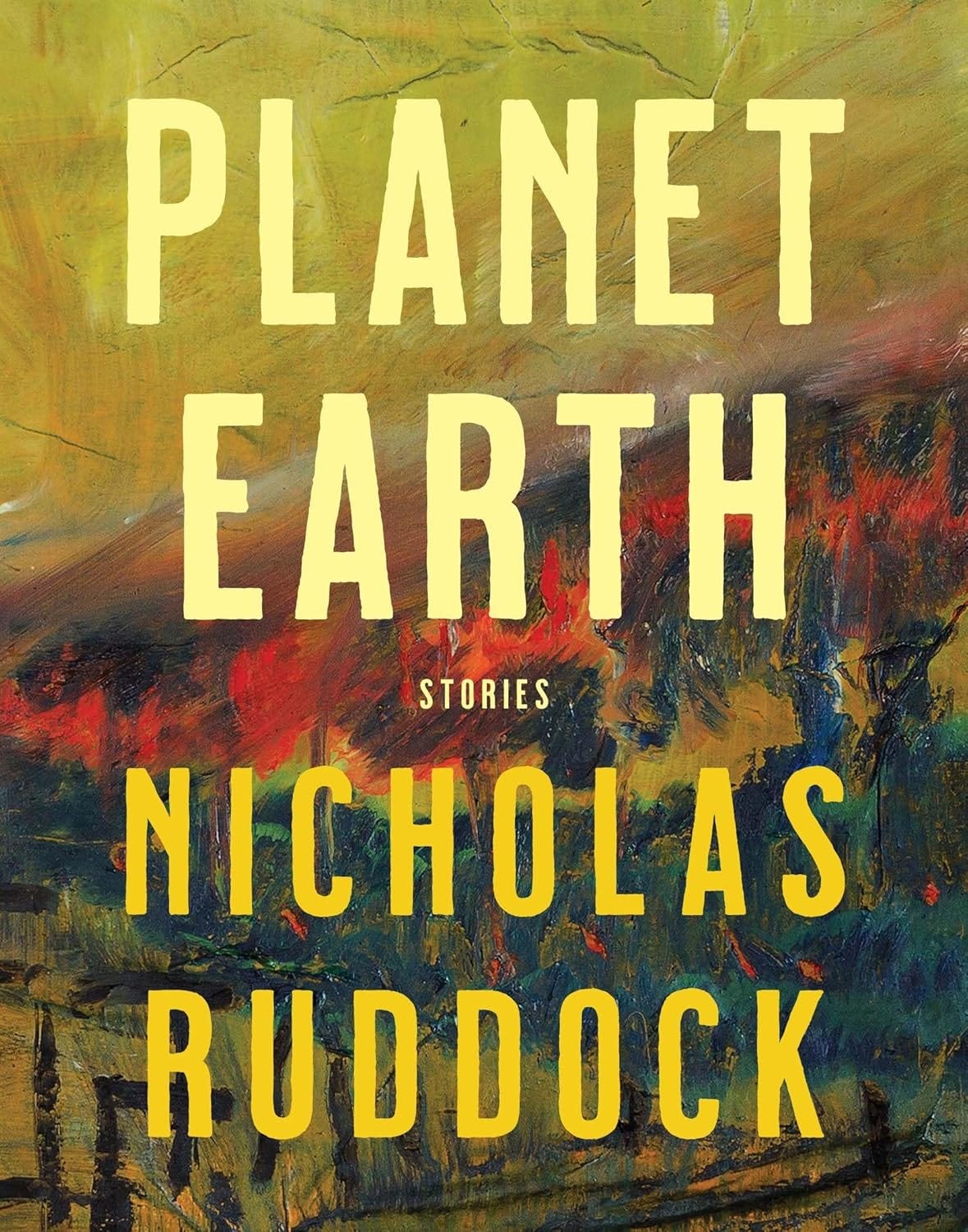
For readers who are tired of wading through four or five-hundred-page novels, but who still like a hit of fiction, Nicholas Ruddock is the relief you have been longing for. His most recent work, Planet Earth: Stories, consists of 18 short stories, every one of which packs a wallop. Six of the stories are very short indeed, less than two pages each, while the others range from ten to thirty-five pages. Only two of the stories are linked. Ruddock is known for his wonderfully long, cascading, cumulative sentences, and you will find plenty of them here. One of the stories, “Grating,” is all one sentence, 261 words long. The next, which runs for ten pages, has hardly a sentence that can boast ten words.
“Planet Earth: Stories, consists of 18 short stories, every one of which packs a wallop.”
In the first story, “Wolverine,” two young Peruvian lovers get involved with student activism that their bourgeoisie parents fear is going to attract political oppression. They try to separate them, sending the boy, Eduardo, to Mexico for the summer to work as an usher in his uncle’s movie theatre. The girl, Estella, is banished to Paraguay. In Mexico, Eduardo is a model employee, learning from life around him and enjoying the films he sees. However, during a film festival of works by Ingmar Bergman, Eduardo witnesses an extraordinary encounter between two famous writers.
One night, before a screening of Cries and Whispers, Mario Vargas Llosa enters the lobby and has a brief but pleasant interchange with Eduardo. During the intermission, Gabriel García Marquez appears and greets Vargas Llosa, who unexpectedly turns and punches him in the face with “a classic stretched-out boxer pose,” knocking him bleeding to the floor. “Strike like a cobra, dear boy of Peru,” Vargas Llosa says to Eduardo; “this is how it is done.”
Back in Lima, Eduardo and Estella reunite, continue their dangerous political activism, marry and have three children, but find it almost impossible to secure work and stability because of their Marxist affiliations. Eventually, they both realize that their activism is dangerous for their children, so they apply to immigrate to Canada. In Toronto, Eduardo cannot find work because of his limited English, so Estella cleans offices and delivers pizzas, until one evening she delivers to a group of bikers who harass and assault her and refuse to pay for the food, claiming untruthfully that it was late. At home, she tells Eduardo what happened, and he remembers Vargas Llosa’s advice: “Strike like a cobra...this is how it is done.”
The rest of the story is how the couple plan and execute their response to the bikers, a most horrific and unexpected revenge. Sounds simple enough, but Ruddock leads you through a long, twisting road to that final act, leaving readers stunned at how oblivious they were to the inevitable results. Only at the end does the title make sense. In the last, brief paragraph, Eduardo says that since coming to Canada, he has learned that like the cobras of Peru, “wolverines have no pity on their prey.” They are “the quickest, most ferocious fighters in the world.”
Ruddock’s stories roam around the world, taking place in Italy, Yukon, France, and elsewhere, but also weaving back and forth in time--floating adrift in Arctic waters with Henry Hudson in 1611, or entombed in a Toronto polio ward in 1953. In one story he might be describing crossing the Yukon River by ferry, in another, he is listing the “stressors north of 60 for caribou,” each done in one long sentence.
In “Knight Errant,” he drags the reader rapidly through centuries of war and chaos, like a sped-up documentary film. The place names alone trigger half-learned, half-remembered scenes of destruction, reminiscent of Billy Joel’s “We Didn’t Start the Fire” or Joel Hynes’s “Manifesto.”
The final, brief story, “Meltdown,” epitomizes Ruddock’s method--in less than two pages, he touches on all the effects of climate change that led to the destruction of the earth, written not as a prediction but as history, something that has already, inevitably happened. Ruddock’s stories demand rereading, not because they are chaotic or confusing, though that may be the case also, but because they are so rich, so crammed full of descriptive detail. They suck from the reader’s brain experiences and memories that have nothing to do with Ruddock’s own life, or even his imagination, and everything to do with the fecund diversity of human experience.

About the Author
NICHOLAS RUDDOCK is a writer and physician whose novels, short stories, and poetry for adults have won multiple prizes in Canada, the UK, and Ireland. His novel The Parabolist was shortlisted for the Toronto Book Award in 2011. Most recently, in 2023, he has won the Nona Heaslip Prize from Exile Quarterly and been shortlisted for the CBC Short Story Award. He lives in Guelph, Ontario.
About the Reviewer
Robin McGrath was born in Newfoundland. She earned a doctorate from the University of Western Ontario, taught at the University of Alberta, and for 25 years did research in the Canadian Arctic on Inuit Literature and culture before returning home to Newfoundland and Labrador. She now lives in Harbour Main and is a full-time writer. Robin has published 26 books and over 700 articles, reviews, introductions, prefaces, teaching aids, essays, conference proceedings and chapbooks. Her most recent book is Labrador, A Reader’s Guide. (2023). She is a columnist for the Northeast Avalon Times and does freelance editing.
Book Details
Publisher: House of Anansi Press
Publication date : Nov. 4 2025
Print length : 184 pages
ISBN-10 : 1487013566
ISBN-13 : 978-1487013561