

Plants of the Pacific Coast by Jim Pojar, Andy MacKinnon, Jamie Fenneman, and Leigh Joseph (Styawat)
From Alaska to Oregon, including British Columbia and Washington

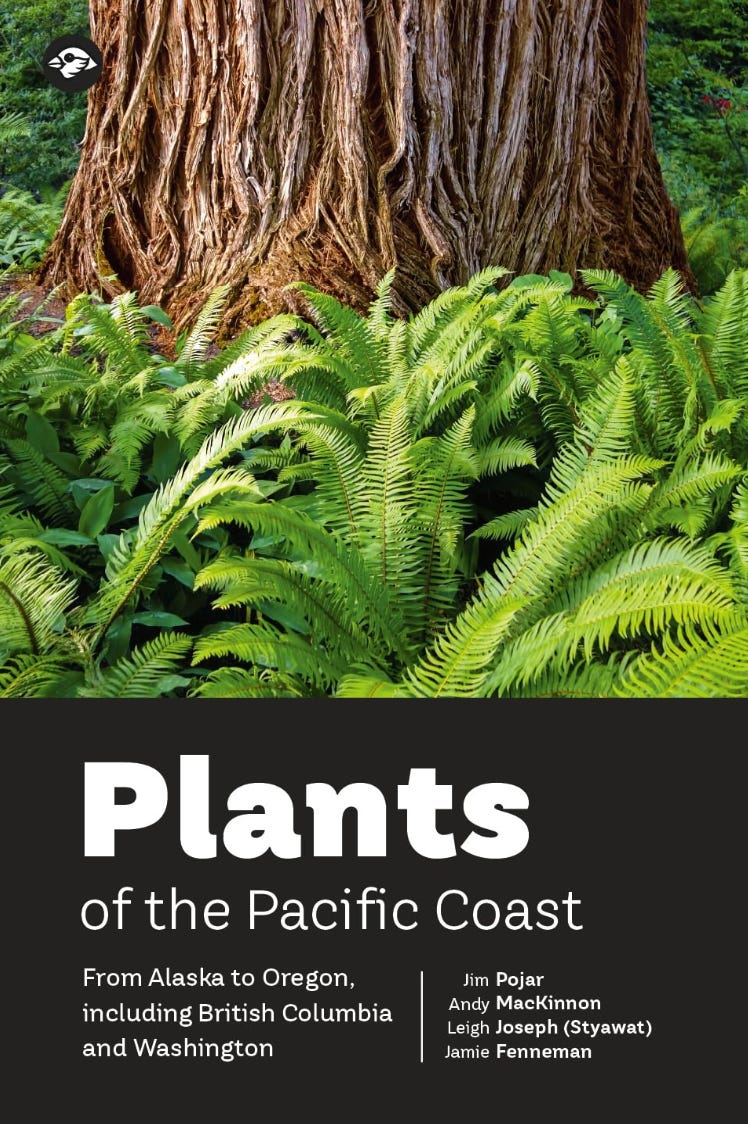
Charles Darwin couldn’t just stop and smell the roses. Or, for that matter, any other plant.
Instead the famed naturalist (1809-1882) would pore, scowling, over plants. With flowers, for example, Darwin was obsessed with the “abominable mystery” of their origin. To colleagues he’d fume that flowers seemed to have sprouted “out of nowhere.”
Perhaps, on strolls through field and forest, you fixate on plants as Darwin did. Or else you enjoy casually pausing to admire them. Either way, Plants of the Pacific Coast: From Alaska to Oregon, including British Columbia and Washington is sure to please you. From wildflowers to trees to shrubs, and more, this comprehensive guide will be helpful both in planning your strolls and as a handy resource to bring along and consult as you encounter intriguing plants.
Note: at 536 pages, we’re talking hefty as well as handy. You’ll want to tuck Plants of the Pacific Coast in a knapsack or sizable bag, as opposed to a side pocket. Otherwise you could consult Plants via cellphone—but don’t glue your nose to the screen and collide with, say, a Sitka spruce.
We’ve alluded to roses, so, for an example of the guide’s useful info, let’s check out what it has to say about them. An interesting surprise awaits. Contrary to Gertrude Stein’s assertion that “a rose is a rose is a rose,” we discover the rose family, or rosaceae, is richly diverse. Rose leaves can be “alternate, simple, or pinnately [feather-like] compound…” Herbs of the rose family can be dwarf-sized, spreading and sprawling, or even shrub-sized. Further, rose herbs may have fruits in ball-like clusters, a.k.a. drupelets.
The guide also provides insights on plants you see every day. Take the above-mentioned British Columbia stalwart, the Sitka spruce. Usually 40 to 55 metres tall, occasionally reaching 70, and with a pillar-like trunk, the Sitka has “many medicinal benefits and applications. [Its sap] is antibacterial and promotes healing topically and is often chewed for pleasure. The inner bark has a long history in some communities as of being eaten as a nutritious spring food, either fresh or dried into cakes and eaten with berries. The Makah were said to eat the young shoots raw, which would have been an excellent source of vitamin C.”
If the day is too inclement for a hike, never fear. It’s also fun to stay in the comfort of home and peruse the vivid, detailed photos accompanying each plant’s info. One Sitka spruce photo takes you practically eyeball-to-needle, with golden-brown Sitka cones nestled just beyond, in the needles’ depths.
As part of their introduction, the authors remind readers about environmental responsibility. Not a finger-wagging, tut-tutting type of reminder; rather an eloquent, poignant one. “Many Indigenous communities have teachings about the connectedness of all living things. Closely related this concept is the teaching of respect. When we are connected with our natural environment, it is much easier to understand the importance of respecting the natural world and easier to see the direct impacts of disrespecting the land and plants.”
Moreover, “when we act in environmentally responsible ways, we contribute to sustainability and to upholding the natural environment environments that we require not only for our survival, and the survival of non-human life, but also to enrich our lives.”
A compelling exhortation. I suspect even grumpy Charles Darwin would be pleased.
About the Authors
Jim Pojar is a botanist, senior ecologist, and forester who has worked for the BC Ecological Reserves Program, the BC Forest Service, and the Canadian Parks and Wilderness Society – Yukon.
Andy MacKinnon is a forest ecologist who lives in Metchosin, British Columbia. Andy was lead BC scientist for Environment Canada’s 2017 ranking of B.C.’s threatened and endangered fungal species.
Jamie Fenneman has 30 years’ experience in collecting and documenting plants and wildlife. Jamie has worked as an ecologist and botanist in Canada and the United States.
An ethnobotanist by training, Leigh Joseph (Styawat) has worked with her home community of Sḵwx̱wú7mesh, and other Indigenous communities, on research, teaching, ecological restoration, and planting projects connected to Indigenous plant knowledge.

About the Reviewer
Melanie Jackson is a Vancouver writer/editor. She’s also the award-winning author of middle-grade/YA suspensers, including Orca Books’ Dinah Galloway Mystery Series, and several chillers set in amusement parks. Visit Melanie at The Writers’ Union of Canada.
Book Details
· Publisher: CanScience Books, August 25, 2026
· Language: English
· Paperback: 536 pages
· ISBN: 9781069158208