
Pushing Hope: An Illustrated Memoir of Survival, By Raymond Santana, illustrated by Keith Henry Brown
Reviewed by Melanie Jackson

On April 19, 1989, a young woman jogged into New York City’s Central Park. Her exit was horrifically different. Medics carried the 28-year-old out on a stretcher, an unknown assailant(s) having raped and beaten her so savagely she almost died.
No surprise that the public reacted with shock and revulsion. Though, as the New York Police Department apparently figured, a quick arrest of the assailant(s) might at least ease the fear.
Knowing Black and Latino teenagers had been running, cavorting, laughing in the park around the time of the attack, the NYPD arrested six of them. In an investigation bereft of evidence, or indeed of legal rights, five of the youths were convicted. Their next stop, lasting years, was a juvie max-security prison.
In 2002, a notorious serial rapist admitted he’d attacked the jogger. DNA evidence supported his confession. Suddenly the Central Park Five, as they’d come to be known, were free. Or as free as they could be after years of living a nightmare.
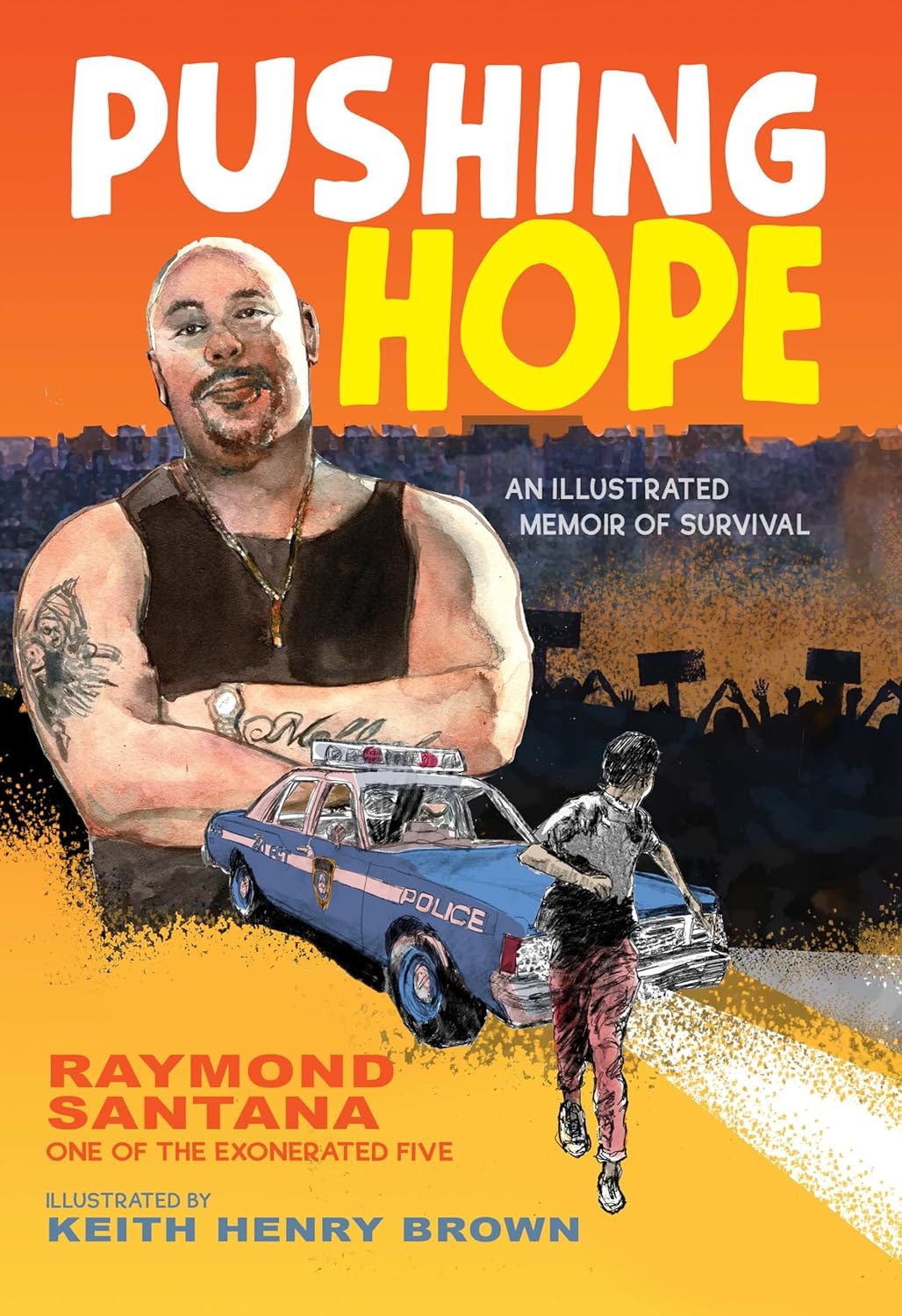
Now one of the Five, Raymond Santana, has recreated that nightmare in the haunting, inspiring, searingly beautiful Pushing Hope: An Illustrated Memoir of Survival.
Santana relates how, at age 14, he moved with his family from the Bronx to Harlem. At first shy, he soon absorbed the vitality of his new ’hood: “cool and fresh, and art is everywhere!” Via Keith Henry Brown’s illustrations, you not only see but feel Raymond’s excitement. Around him, traffic honks and ghetto blasters blare in a clanging, joyous symphony.
“FLY!” Raymond exclaims. And his inner artist indeed takes wing, in drawings, in graffiti, in sheer exuberance. Harlem is “a painting that swirls around me. Booming with beats. Pulsing with colors. …I soak it all up. Harlem is LIVE.”
Also, sometimes, scary. On October 29, 1984, police shoot a woman, as Brown shows in the dark silhouette of a gun pointed at a falling figure against the bright red silhouette of crowds waving protest signs. “It shook the projects,” Santana relates, “and it shook me! I had to be tough.”
His drawing steels him. “With my sketchpad, I travel. …I can command armies, be superhuman, and be on my own.” In art class, Raymond’s teacher encourages him to develop his style, to believe “ART IS ME.”
A belief he’ll need to hold onto. After the rape of the jogger, the police arrest Raymond by slamming a walkie-talkie into the back of his neck. Via Brown’s art, you see and feel this, too: the yellow burst of shock, the white stabbing shards and stars of pain.
The police interrogation lasts hours. “YOU F----D HER. YOU’RE GOING TO PRISON FOR LIFE.” Without sleep, water, or legal counsel, Raymond becomes delirious.
To stop it, anything to stop it, Raymond says he was part of a gang rape. Off he’s taken, in shackles, to a detention centre. You see barbed wire fences towering, almost clawing, against the blue sky beyond. Hopelessly far beyond.
Fast forward. At last freed, the Five—now renamed the Exonerated Five—win a hefty settlement from New York City. Raymond becomes a fashion designer, founding Park Madison NYC. He also starts the Innocence Project, working to, as the website explains, “free the innocent, prevent wrongful convictions, and create fair, compassionate, and equitable systems of justice.”
Viewing Pushing Hope’s prison scenes, you cheer Raymond on. The system can take away his freedom, but not his art, not his soul. Back in the 1700s poet Richard Lovelace pretty much nailed it: “Stone walls do not a prison make, nor iron bars a cage.”


About the Author
Raymond Santana is an author, designer, and activist. He travels around the country telling his story of hope and overcoming obstacles as he continues to fight against the inequities of the American justice system. Santana also owns the clothing company Park Madison NYC. He lives in Harlem and is running for a New York City Council seat representing District 8.
About the Illustrator
Keith Henry Brown began his artistic career in comics, pursued painting, and later became creative director for Jazz at Lincoln Center. He has illustrated many award-winning children’s books and album covers for prominent jazz musicians as well as created posters for Jazz Appreciation Month for the Museum of American History. He lives in Brooklyn.
About the Reviewer
Melanie Jackson is a Vancouver writer/editor. She’s also the award-winning author of middle-grade/YA suspensers, including Orca Books’ Dinah Galloway Mystery Series, and several chillers set in amusement parks. Visit Melanie at The Writers’ Union of Canada.
Book Details
Publisher: Calkins Creek (Astra Publishing House)
October 28, 2025
Language: English; genre, YA
Hardcover: 288 pages
ISBN: 9781662680397