


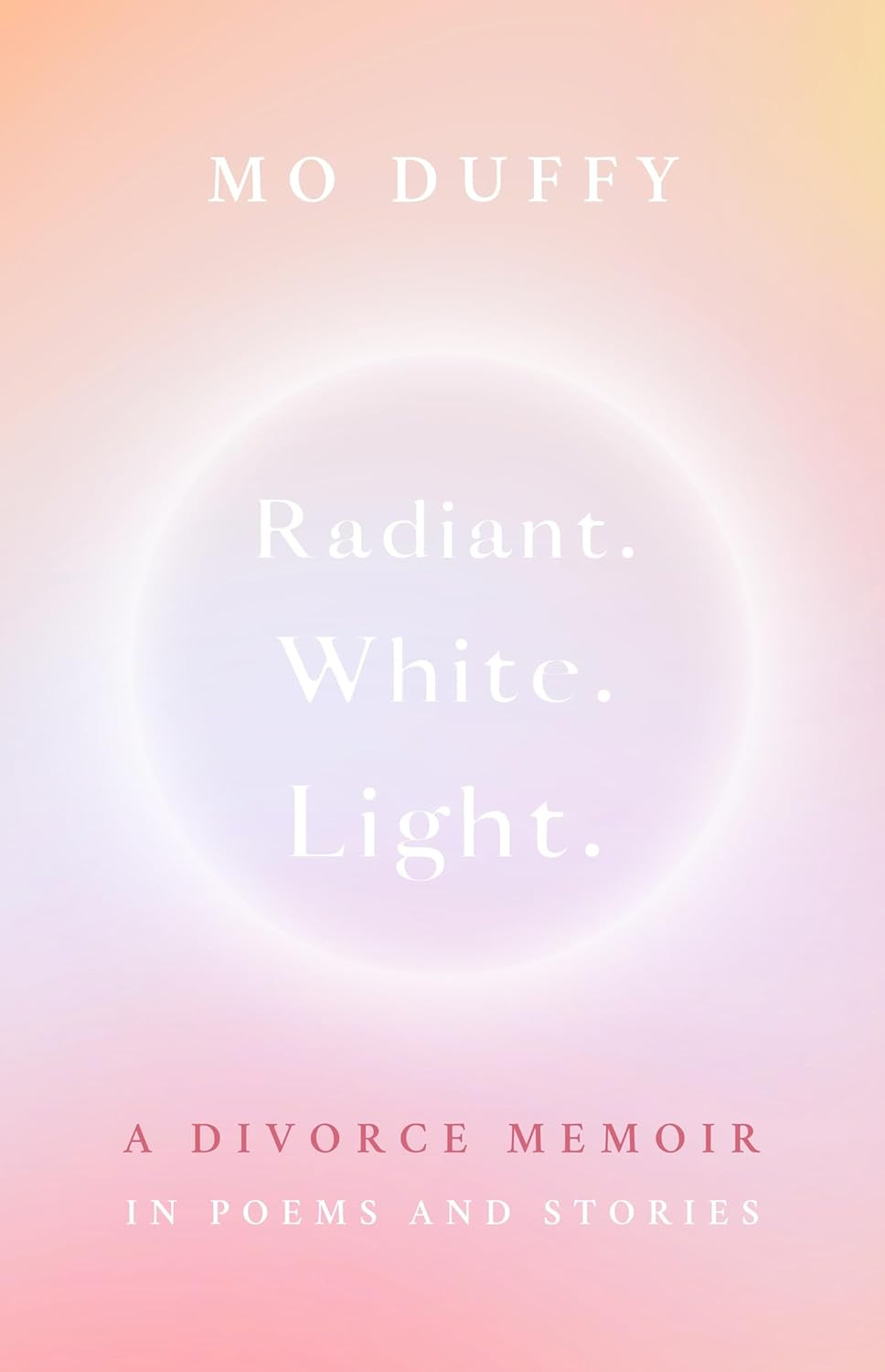
Radiant. White. Light.: A Divorce Memoir is a poetic, post-separation and divorce memoir by Mo Duffy. The speaker invokes the ‘radiant white light’ of the book’s title to riff on the words’ many varied meanings — those that correspond to a painful separation from a spouse, and those that connote the dissolving of identity after 16 years of an otherwise happy, productive partnership. There is also the radiant white light of anger and frustration that captures the protagonist’s difficulty coping, now as a single mother of three children, while others judge her entire marriage and the divorce from outside. Later, the radiant white light becomes the grace, forgiveness, and acceptance that’s needed to move forward in friendship with a husband who finds a more suitable partner — this time, another man.
Duffy starts her Memoir in Poems and Stories with “Act One: Exploding Stars” and its divisions between heaven and earth, the materialistic and the spiritual. White light, she informs readers, is what remains because “energy is transformed, not removed.” Divorce can have an upside in the long run; it offers the possibility of rebirth, self-reinvention. However, the early part of divorce is invariably disorienting and distressing. I believe that Duffy’s descriptions of the sudden strangeness of ordinary tasks, those that pertain to children’s activities, and any others one has grown accustomed to doing with a partner, will speak to readers who are going through a separation or divorce.
Overwhelmed, always anxious, Duffy suffers a seizure for reasons she herself can’t quite account for:
	Whether it was stress, or a interruption in meds, or the anniversary, I

	Can’t explain away the things that I am holding right now.

	Space | the reigns | the kids | the grief | a business | a house | my sanity |

	Dysfunction | recompense
Some part of her either wants to or feels like she is disappearing: “I’m not here, / I’m radiant white light.”
Yet the author (admirably) clings to the notion that despite the ‘explosion’ that ended her marriage and set her and her ex, Mitch, adrift, she has survived, albeit transformed, as “radiant white light.” A lovely meditation on transformation and the benefits of being convertible/adaptable appears at the start of the second section, “Act Two: Deep Space,” in a poem titled “When you’re a light wave.” A few of its stanzas appear below:
	When you’re a light wave

	you can bend and shift,  you can be long or be short

	you’re just you

	livin’ the light wave life

	…….

	You diffract

	hide under beds

	sneak through tiny passages

	even when you get lost from your group

	you never feel less than whole

	…….

	no existential crises

	no judgement

	just exiting where you are

	but if you need to go

	all parties agree that

	you can go out fast

	299,792,458 metres per second

	the universal constant

	the speed of light
In the same emotional vein, Duffy pictures the love she shared with Mitch as changing instead of disappearing. In “re-train,” she describes her response to a session with a mediator, where she rejects the idea that she and Mitch are no longer a unit.
“There is no we, [the mediator] says. There is only you, and there’s him…. A mediator with sweet intentions,” Duffy thinks. She continues:
We’ve worked together, for each other.
We know each other’s plays. Committee work, dance drop-off,
taco nights, yoga and the gym.
Does that need to change now? Just because we’re sleeping in separate rooms, in separate houses, on separate roads?…
……..
We may not be the old we,
But we are not broken.
Maybe we can look different.
….No one can tell us there’s no we. We can create our own point systems, clarity and boxes going forward.
……..
I witnessed the break-up of a friend’s marriage seventeen years ago. The reasons were the same: the husband finally confronted his sexual orientation, and confessed his love for another man. His ‘coming out,’ after some 18 years of marriage and two children, was a shock and a painful blow to his wife, children, and relations on both sides. Almost everyone in my friend’s circle saw it as a betrayal. Everyone assumed that the man hadn’t been honest with my friend from the very start.
Duffy confronts these types of judgments, but takes a much more empathetic and optimistic approach to her divorce, Mitch’s course correction, and the relationship with him she hopes to salvage. She manages in part because she has family willing to help her navigate her new life and remind her of obligations she has to herself first and foremost. She has a therapist she trusts who shows her how to reconnect with the person she was before marriage, before she began suspecting she wasn’t enough.
Duffy is also fortunate to have quality friends. They’re there for her when she needs assurance or just to be held. These poems about needing support, and having friends and family show up to offer it, are ones I find most touching, though throughout the collection Duffy doesn’t avoid revealing herself in her least self-possessed moments. In “saint john michael,” she says:
…when you are vulnerable you need protectors
gorillas in the mist
it’s a different space for a woman to be
extracted from a marriage, taken out like an FBI operative
there is the sudden urge for others to protect me
and many of the bros in my life swooped in
the look in their eyes
either pity or shame
or just that they wanted to hold me….
The poem “soggy fries” continues Duffy’s deep appreciation for the friends who sheltered her during her crisis. When she looks back, she sees that —
You put meals in front of my kids
Cared for them like they were your own
Emptied the dishwasher at the end of the night
I couldn’t have lived without you.
Dismantled our relationships at the same time
Carried each other through the dark
Wine glasses, craft nights, and grief books
I couldn’t have lived without you.
……..
Line up to take sides, the allies divide
No one but us left in the room
With the laughter of ghosts
I couldn’t have lived without him.
…..
The middle of a divorce is its most chaotic phase. Duffy writes honestly about her unraveling, as well as about moments ameliorated by a newly-glimpsed equilibrium. The reflection, “in the balance,” gives us this observation: “Momentum builds, and I gain equilibrium. There are moments of personal growth the chaos, steadiness. I’m feeling things I haven’t felt in years. I want something new, now, something I never had before. What is the currency, and what is the change….Breathe in the change..”
In the book’s final section, “act three: fusion” (there is also an afterword), Duffy finally takes stock of the damage her divorce has wrought. In “damages,” Duffy surveys the landscape of failed marriages while on trip to Quebec with a friend (she refers to him only as “D”).
Confession hour with D. Tell me what you want. Tell me now.
Quebec City brings the serum of truth.
……..
Slow moments and the fast pace of critical care.
The ICU of relationships
Everyone’s been shot —
I’ve been shot. You’ve been shot.
He has, she has.
………
The poetics here, as elsewhere in the book, are clever and affecting. This is the type of damage anyone who has lived through a broken marriage or separation is subjected to. The degree of pain may vary, as may the size of the social circle to which the divorcing couple belongs; the damage, however, is inescapable. Even new relationships are vitiated by past relationship failures.
Throughout the book, every poem and prose piece is followed by a two-line variation on radiant white light. In the third section, the mood Duffy conveys with these snapshots of her inner life is suffused with greater self-assurance and more optimism about the future, which includes a close friendship with Mitch and his new male partner “J”. She writes: “refracted but unbroken / I’m radiant white light.” This is followed by the query, “am i a new star, if / i’m radiant white light?” Finally, after the prose piece, “double rainbow,” describing a joyful coastal road trip with children and Mitch, Duffy comments triumphantly on her personal transmutation: “i am the sun / i am radiant white light.”
Duffy’s memoir poetics, or poetics of divorce (yes, there is such a thing), or of a journey of self-reconstitution/self-reclamation initiated by a partner’s sexual re-orientation, will be welcomed by readers living through their own uncoupling. Anyone looking for a bit of catharsis, should know, however, that this treatment of divorce is as generous or as gentle it gets. This is not the confessional, stinging poetry about imploding marriage and fear of infidelity we see in Anne Sexton’s, Sylvia Plath’s, or Sharon Olds’s collections. There’s no effigy of the ex being burned or buried alive in this book. Consequently, it’s less intense and emotionally draining. This book is much more of a how-to for moving forward, in which writing (like journaling) is part of the healing process, and part of the conversion or redirection of personal light and energy. For this reason, and for the very appealing figurative use in the memoir of imagery related to stellar phenomena, energy, light, and transformation, I’m happy to recommend Radiant. White. Light.: A Divorce Memoir.

About the Author
Mo Duffy is the Founder and Editorial Director of Pownal Street Press. With an MFA from the Vermont College of Fine Arts in Creative Nonfiction, Mo is the author of four books: Unpacked: from PEI to Palawan (2017), The Chemistry of Innovation: Regis Duffy and the Story of DCL (2021), Crescent Moon Friends (2022), and A is for Anne (2023). Mo lives in Charlottetown, Prince Edward Island. Visit her online at https://moduffy.com/
About the Reviewer
Olga Stein is an academic, writer, editor, and university and college instructor. She was born in Moscow, the capital city of the former Soviet Union. She immigrated to Canada with her parents as a child, and has lived in Toronto her entire adult life. Stein earned her BA and MA at the University of Toronto. She studied philosophy, political science, literature, and languages. After serving for two decades in medical and literary publishing, including as chief editor of the literary book review magazine, Books in Canada, she returned to academe, and completed a PhD in contemporary Canadian literature and cultural institutions.
Stein has been writing literary essays and cultural commentary for nearly two decades. Since completing her PhD, she has also been writing short fiction and poetry. She has three children. Love Songs: Prayers to gods, not men is her debut collection of poems.
Book Details
Publisher : Pownal Street Press
Publication date : Feb. 10 2026
Language : English
Print length : 168 pages
ISBN-10 : 199812973X
ISBN-13 : 978-1998129737
