

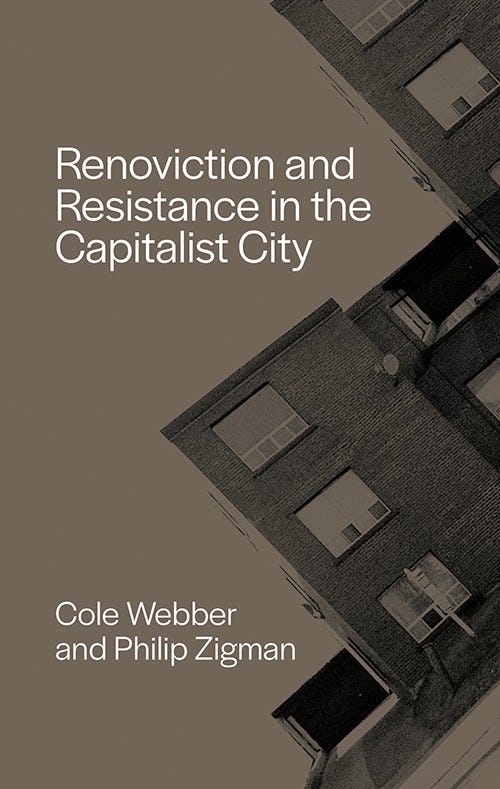
Renoviction and Resistance in the Capitalist City by Cole Webber and Philip Zigman
Reviewed by Dawn Macdonald

Some years ago, one of our local political candidates posted an article about renovictions to their social media, declaring themselves shocked—shocked!—to learn of this practice. Personally, I was a bit shocked that any political hopeful would not have heard of renovictions, though to be fair, the term wasn’t really applicable in our jurisdiction at the time because the Yukon still had “no cause” evictions, obviating the necessity for renovation theatre when removing a tenant.
““Renoviction” refers to the practice of serving a tenant with an eviction notice for the ostensible purpose of renovating their rental unit.”
For the record, “renoviction” refers to the practice of serving a tenant with an eviction notice for the ostensible purpose of renovating their rental unit. In Ontario at least, there is a provision that the tenant is supposed to have “right of first refusal” to move back into the unit at the conclusion of renovations with no increase in their rent. In practice, it’s tough to find a place to live for the unknown amount of time that renovations are going to take, and having moved in the interim it’s relatively rare for tenants to attempt to move back. Even if they do, the courts have not consistently upheld their rights in the matter.
Cole Webber and Philip Zigman have undertaken an intensive study of renovictions in the city of Toronto, which forms the basis of their book Renoviction and Resistance in the Capitalist City. While the details of Toronto renovictions may hinge on specifics like N-13 notices, the mechanics of the practice are the same across the country. Webber and Zigman provide documentation that renoviction is rarely about renovations, and is primarily a means to raising rents.
This is made crystal clear in the prospectus provided to investors by some of the real estate companies that specialize in renoviction. In Ontario, rental increases for sitting tenants are capped, but there is no limit on the amount that rent can be increased for new, incoming tenants, so the fastest way to raise rents is to turn over the unit. Even in Québec, where rental increases are theoretically capped for the unit regardless of changes in tenancy, Webber and Zigman note that “average asking rents for vacant units in Montreal … increased 71 percent” based on 2019 data.
It’s very difficult for prospective tenants to challenge rental rates based on information they don’t typically have about the amount paid by the previous occupant. Under conditions of rental scarcity, few are likely to raise arguments about the terms of a lease they haven’t yet signed.
Many of the tenants interviewed by Webber and Zigman reported that their landlords neglected routine maintenance in the run-up to renoviction. The corresponding decline in the safety and comfort of the residence was one factor spurring tenants to depart “voluntarily.” Some tenants reported various forms of harassment such as receiving frequent inspection notices, being approached repeatedly to ask about their plans to move out, or having disruptions in their utilities such as electrical or water supply. Multi-unit buildings may be turned into a construction site, with attendant noise and safety issues for remaining residents. All in all, the stress of feeling unwelcome in one’s home can be enough to pressure renters into leaving, rather than trying to stay and fight the eviction. These tactics also make it less likely that the tenants will seek to return once renovations are complete.
The strategy that Webber and Zigman recommend for tenants facing renoviction is to organize; that is, “talk to their neighbours at their building, share information, and begin to make decisions together how to act as a group to improve their conditions.” Where the purpose of renovictions is effectively to empty the building of its current occupants as a means to realizing substantially higher rents across the board, landlords may reconsider. If it becomes clear that a large proportion of tenants will resist departure. Webber and Zigman present cases where organized tenants have successfully stopped renovictions from happening in their buildings, usually at an early stage in the process before things have gone to a hearing at the Landlord and Tenant Board.
Webber and Zigman conclude with a blistering critique of governmental policy responses to renoviction, finding these to have been largely ineffective in protecting tenants. In fact, they would argue “that the social democratic approach to the state is inadequate for understanding how the state responds to class struggles over housing. Historically, the Canadian state has accommodated its interventions in the housing field to the imperative of rent extraction.” The authors also hold NGOs accountable for diverting social energy into lobbying for policy reforms that have ultimately proven unhelpful, and thereby shoring up a rigged system.
Having been a renter myself for much of my adult life, I’d say the most difficult aspect is the uncertainty—never being sure that your home won’t be pulled out from under you through no fault of your own. Renoviction and Resistance in the Capitalist City speaks to a particular set of mechanisms that operate to generate housing instability. Within its 140 pages, it provides renters with confirmation that they are not alone in their difficulties, and offers a plan for how they might collectively hold their ground.

About the Author
Philip Zigman is a co-creator of RenovictionsTO.
Cole Webber is a community legal worker at Parkdale Community Legal Services in Toronto.
About the Reviewer
Dawn Macdonald lives in Whitehorse, Yukon, where she grew up without electricity or running water. She won the 2025 Canadian First Book Prize for her poetry collection Northerny. She posts weekly on Reviews of Books I Got for Free or Cheap (on Substack), as well as reviews for journals and The Seaboard Review of Books.
Book Details
Publisher : Between the Lines
Publication date : June 16 2026
Language : English
Print length : 176 pages
ISBN-10 : 1771136995
ISBN-13 : 978-1771136990
 | A guest post by
|