

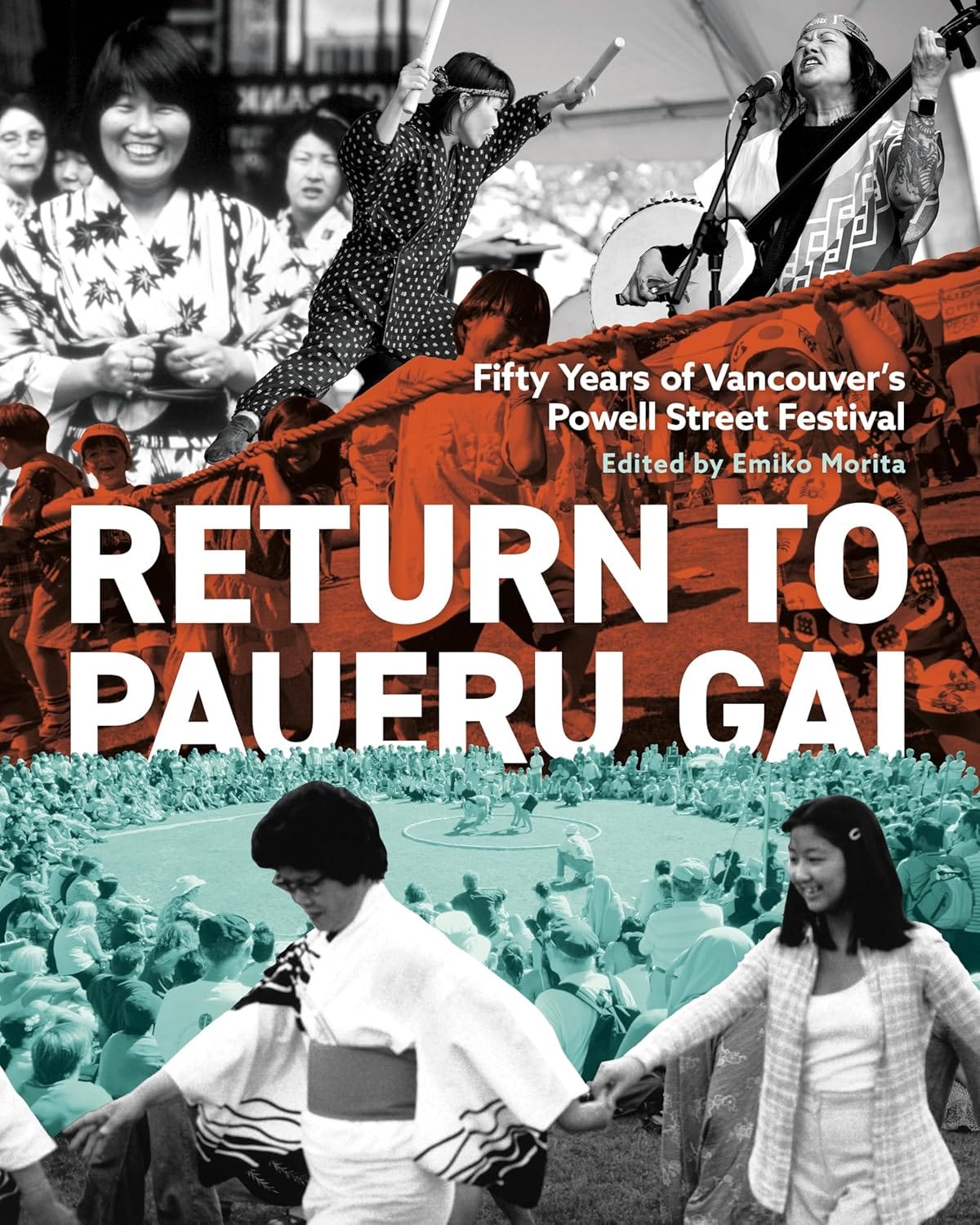
Return to Paueru Gai: Fifty Years of Vancouver’s Powell Street Festival
Edited by Emiko Morita

here and there
upon scorched fields
wild violets
—Arii Shokyu-Ni (1714-1781)
For my friend Johanna Hickey, a longtime supporter of Vancouver’s arts scene, a particular highlight of the year is the Powell Street Festival. Held on the first weekend in August or, in West Coast speak, the B.C. Day long weekend, the festival celebrates Japanese-Canadian culture with lively, fun activities—while also commemorating World War II internees.
Says Hickey, “To me, the Powell Street, or Paueru Gai, Festival enhances the multicultural life of our city. Each year this historic Japanese neighbourhood, now part of the Downtown Eastside, is transformed into a little Japan. The festive atmosphere, the colourful booths, the delicious food, the beautiful traditional clothing, the music, the powerful performances of the Taiko drummers—and, always, the historical import—draw me back year after year.”
To mark the festival’s first half-century, editor Emiko Morita and seven other contributors have created Return to Paueru Gai: Fifty Years of Vancouver’s Powell Street Festival. In her introduction to this collection of vivid essays and photos, Morita says, “At the festival, people from diverse backgrounds come together to produce, participate in, and experience a unique blend of traditional Japanese practices and contemporary arts. This neighbourhood was a vibrant Japanese cultural and economic hub prior to the community’s forced relocation and dispossession during World War II. As a result, the annual event is a poignant, living expression of continuity, resilience, and cultural exchange.”
The resilience shines off the book’s pages, showing the energy and vitality of the festival, from its workshops and crafts, to dances and theatre, to the yummy range of food in trucks and booths. Or, as Matt Miwa puts it, “The festival is a happy chaos! Everyone is integrating on some level; there isn’t a hierarchy. It is more like ‘And now this happens, now we do this...’ It is such an important immersion, I am forever bound to community-building. Powell Street Festival has taught me this.”
For the 2011 festival, Miwa and Julie Tamiko Manning wrote the 2011 play Tashme Project, inspired by oral histories of those who survived internment and resettlement.
To give you some background, the Canadian government’s 1942 War Measures Act prompted the forcible removal of more than 22,000 Japanese Canadians from their West Coast homes. If that weren’t mind-numbing enough, the government then waited until 1949, four years after war’s end, to restore Japanese Canadians’ rights, including citizenship and the right to vote. It took another 39 years for the Japanese Canadians’ Redress Movement to garner a federal government apology and a $300 million compensation package.
The shadows of mistreatment stretch back even further. By 1901, almost 5,000 Japanese had come to British Columbia. Anti-Asian racism, embodied by a group called the Asiatic Exclusion League, fuelled mob attacks on the immigrants’ businesses, many of these in the Paueru Gai neighbourhood.
However, as the great Japanese poet Arii Shokyu-Ni observed, even in scorched fields violets can grow. Out of that sad history, the Powell Street Festival bloomed. As Morita relates, Michiko Sakata, initiator of the photographic exhibition A Dream of Riches: The Japanese Canadians, 1877-1977, proposed a Japanese-style street festival as part of a Japanese Canadian Centennial Project. The Japanese Community Volunteers Association, or Tonari Gumi, raised funds, leading to the first festival.
At the time no one thought of it as the first, notes Morita. But “the confluence of circumstances and the mix of people and energy that emerged helped propel the festival into future iterations.”
Now, back to my friend Johanna Hickey, who has just avidly read Return to Paueru Gai. Her comment: “See you there!”

About the Editor
Emiko Morita (she/her), a third-generation mixed-heritage Japanese Canadian arts administrator, was the executive director of Powell Street Festival from 2015 to 2024. Previously, she worked in the publishing industry as marketing director at Douglas & McIntyre, leading marketing campaigns for national bestsellers; as special sales manager at Raincoast Books; and as the BC rep for the Canadian Children’s Book Centre.
About the Reviewer
A Vancouver writer/editor, Melanie Jackson is the award-winning author of middle-grade/YA suspensers, including Orca Books’ Dinah Galloway Mystery Series, and several chillers set in amusement parks.
Book Details
Publisher: Arsenal Pulp Press, April 7, 2026
Language: English
Paperback: 208 pages
ISBN: 978-1834050249