

Revolutionary Science by Bruce H. Jennings
Reviewed by Lisa Timpf

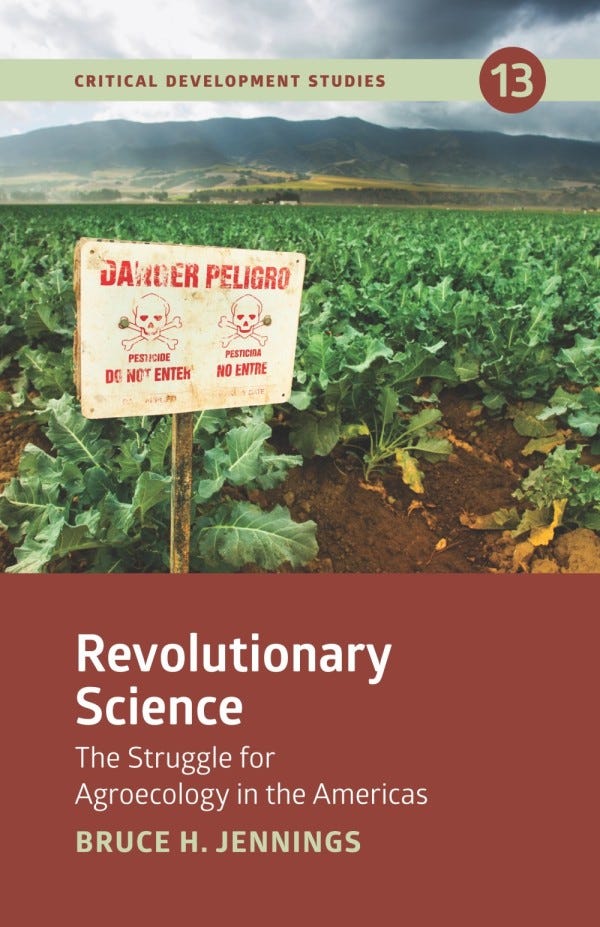
For centuries, small farmers in Latin America grew plants for food and medicine sustainably, working in concert with the environment and cultivating strains of plants that had been evolved to suit the particular locale in which they were grown. They were using a technique that could come to be called “agroecology.” This traditional approach would, in the 1900s, come into conflict with industrial agriculture.
As Bruce H. Jennings discusses in Revolutionary Science: The Struggle for Agroecology in the Americas, in the 1940s U.S. scientists sponsored by the Rockefeller Foundation came to Mexico “with a mission to revolutionize agricultural production.” Despite warnings about the potential socioeconomic impacts and loss of ecological knowledge, the team pressed forward, extolling the merits of industrial agriculture while ignoring the benefits of the traditional approach.
While agroecology maintains soil fertility, requires few external inputs as a result of using closed loop systems, and is a more sustainable and integrated approach, industrial agriculture focuses on crop genetics, the use of synthetic chemicals, and monoculture (the growing of one particular type of crop, sometimes on the same fields year after year).
Industrial agriculture practices led to “resource depletion, air, land and water pollution, and greenhouse gas emissions,” Jennings notes, while also concentrating “power over food systems in the hands of a few large corporations.” Many Mexican farmers were “displaced by the Green Revolution and forced to seek work as field labourers.”
Scientists at universities who bought into the Green Revolution commanded greater salaries, access to government agencies, and influence, suppressing the voices of those who advocated for a more sustainable approach. Meanwhile, in Mexico and other Latin American countries in which the practices of industrial agriculture were spread, many members of marginalized communities began to “doubt, and even feel ashamed of, their traditional knowledge.”
Since the scientists promoting industrial agriculture used production levels as their sole level for measuring success, the “consideration of a broader set of nutritional, public health, ecological or other social consequences were largely, if not entirely, absent from its own progress reports,” says Jennings.
Revolutionary Science illustrates the political clout of agribusiness, and its efforts to quash any resistance to the touted approach. Jennings argues that the rise of industrial agriculture is less about scientific approaches and “more the consequence of its linkage to growing a capitalist economy.” He describes the legacy of industrial agriculture as “depleted aquifers and poisoned waterways, massive soil loss, highly processed foods, species extinction, and production practices that worsen climates and ecologies on a global scale.”
But the book isn’t all doom and gloom. Jennings profiles individuals who historically challenged the industrial agriculture model. Though their voices were ignored or suppressed, some persisted. In the 1990s, conferences about alternative methods of production were held and numerous courses in disciplines related to agroecology were offered.
Researchers who championed agroecology “demonstrated repeatedly that agroecologically managed systems provided stable levels of production, economically favourable rates of return, enhanced biodiversity and soil health, as well as a stable livelihood for small farmers and their families.”
There is now a resurgence of interest in agroecology and its benefits. Jennings says that “over a few short decades, Latin America’s agroecologists have made impressive strides.” An integral element of their approach is forging alliances between scientists and small farmers, including members of various Indigenous groups. By respecting traditional knowledge about what truly works in different landscapes, “contemporary agroecological projects are now energizing a generation of students, activists, and rural workers across the Americas.”
Revolutionary Science is Book 13 in the Critical Development Studies series published by Fernwood. Readers who are interested learning more about the historical impacts of industrial agriculture in Latin America, the sway and political clout of agribusiness, and agroecology’s potential for contributing to a more sustainable world should find Revolutionary Science of interest.

About the Author
Bruce H. Jennings is a political scientist and former senior environmental policy advisor with the California Legislature. He received his undergraduate degree from the University of California, Berkeley, and earned his M.A. and Ph.D. in political science from the University of Hawai’i. Jennings began his career researching the role of powerful philanthropic institutions—such as the Rockefeller Foundation—in reshaping agricultural systems across the Americas. His doctoral research examined the politics of science and agricultural transformation and was published by Westview Press. Jennings’s writing and public speaking reflect decades of commitment to ecological sustainability and equity for rural communities across the hemisphere.
About the Reviewer
Ontario resident Lisa Timpf writes poetry, book reviews, short stories, and creative nonfiction. Her speculative poetry collections Cats and Dogs in Space (2025) and In Days to Come (2022) are available from Hiraeth Publishing in print and electronic formats. You can find out more about Lisa’s writing projects at http://lisatimpf.blogspot.com/. Lisa is also on Bluesky, @lisatimpf.bsky.social, and her author Facebook page is @lisa.timpf.author.
Book Details
Publisher: Fernwood Publishing
Publication date: March 24, 2026
Language: English
Print length: 156 pages
ISBN-10: 1773638068
ISBN-13: 978-1773638065
Thanks for your comment, Nigel. In Revolutionary Science, Jennings talks about the importance of grassroots movements and of involving the "small farmers" themselves in developing plans. It does sound like there are efforts to push back against industrial agriculture, which is encouraging. Those who live on the land and in the communities affected have a vested interest in treating it with respect and preserving it for future generations.
I do hope the pendulum has started to swing back against 'industrial agriculture.' While I know nothing of agriculture (my grandparents were the last ones on the land (in Suffolk, England), and on the sea (herring boats out of Great Yarmouth), in my travels in Mexico and Africa I have heard nothing but concern from locals about the 'industrialization' of farming with small plots disappearing and large corporations forcing major changes...it just can't be good to have big changes.