

Throwback Thursday: River Revery by Penn Kemp
A Michael Greenstein Review

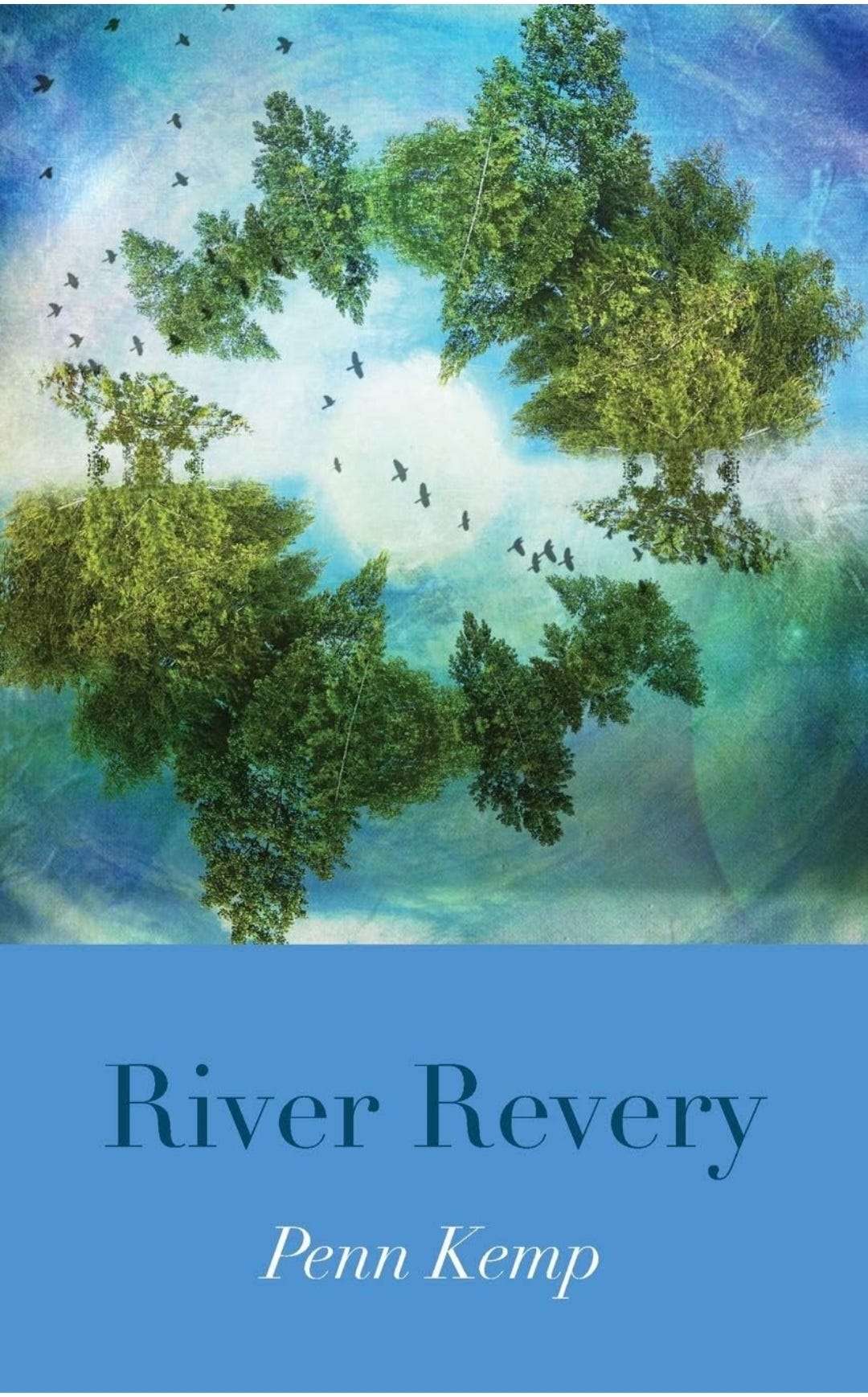
Thames Tempos
Penn Kemp concludes her “Foreword” to River Revery with an immersion in sound that prepares for most of her verse: “I live in the house I grew up in, on land I revere for its long history, and I am grateful to be here.” In this prose tercet a clutch of monosyllables feeds into revere and history with their elongated e’s to rhyme with “here.” She reveres and revels in rivers and reveries, geography and dreams, ecology and etymology in the flow of water, metaphor, and generations. She traces the river Thames through her city of London, Ontario: since it forks into two streams, it was originally named “the antlered river” by its Algonquin inhabitants. Not only is her landscape antlered (“A buck rubs his antlers against the maple”), but also her poetry which bifurcates sound and sense, attuned in different directions, and resisting any temptation to be tamed by the Thames. Her revery is also a wake-up call, a reveille to environmental ethics. She antlers beyond sounds of poetry to other genres of drama, photography, painting, videos, and political activism.
Her eponymous poem, “River Revery,” antlers her experience in tercets and quatrains of sound and vision, bearing in mind the origin of “antler” as in front of the eyes. The poet’s antennae absorb the river’s antler. Each line carries the sleeved, folded, or enveloped title in it; that is, the sound, sight, and sense of “river revery” is a sleeved phrase embracing an abundance of signifiers: “Water abounds here, with this river.” The r’s in this opening line arrest the river before releasing it in its enjambment to the next line, “five times normal width for winter.” The arresting rhyme in winter river turns to spring in a couplet at the bottom of the page where w’s of water, width, and winter land on “Weird how all reverts, reverberates in / spring clarity as old detritus is dredged.” Kemp sleeves her cyclical seasons at the river’s selvedge.
The antler’s optical illusions connect with Kemp’s trompe l’oreille – those hearing tricks sleeved in river revery, reverts reverberates, and tranceform – a Joycean play of phonemes and double entendres. This combination of antlered and antennaed sound and sight leads to the delight of metaphor and meaning – the trompe le cerveau that tricks the mind with its radiant abundance and ambiguity. “Five times” swells tenfold to “Yellow willows drop fifty-year / -old boughs in high winds.” In addition to the rhyme of yellow willows, these trees exhibit and almost palindromic spell mirroring their own undoing. Their drop highlights horizontal and vertical tensions and dimensions within climate change. Horizontals appear through enjambed stanzas that reflect the river’s flow: “The swell / carries whole trees along stampeding // currents.” Swell and stampeding get arrested in the following sentence: “Standing / waves cover our usual walking path.” That oxymoron underscores stasis and motion with climate crisis.
Numbers from five to fifty return “from eleven below to eleven above in / hours, sinking back below freezing.” Stampeding and standing lead to sinking in a downward trend, as below heads underground “to bury the remnants / of flood.” Kemp’s antlers and antennae nudge the ground and seasons to clarify climate. Over the page she continues in stanzas of varying lengths as her “rant runs along the river.” Her warblers’ trill enters a sonic and scoped labyrinth that tricks ear and eye: “unknown we cannot now locate / since sound is not where sight is / and the willows are leafing out.” They leaf out by spreading, but they are also running out of leaves.
The next stanza deflects that leafing out by sleeving leaf and echoing the earlier weird:
Leaving out the paw-tracked mud,
the grocery cart obliterated by winter
storm back to origin, a mess of
twisted rust like an old fishing weir.
That metaphor gently jogs the mind in a trompe le cerveau, while the ear adjusts to twisted rust and weird weir. The concluding stanza returns to standing waves which have gathered momentum throughout the poem. “The current courses by standing waves, / standing in momentary eddies against / momentum.” Kemp’s Thames differs from Edmund Spenser’s sweet river that runs softly, and T. S. Eliot’s river’s tent that is broken; but in her tributary she hears a cold blast with its “rattle of the bones, and chuckle spread from ear to ear.” Her antlers detect the trompe l’oreille between ears, her rant contrasting with warblers’ trill. She dreams and dredges the sweating oil and tar of her precursors.
“Riparian” delights in auditory trickery between rip and repair for the tear: “Left alone. Let the word itself slide along / a corridor of flood plain // – riparian – ” Lines glide not just through enjambment, but also through liquid l’s and long vowels that channel n’s against pausing double r’s. That flow halts in the accentuated double-dashed riparian and final word of the stanza – “Interface” (which itself contains the burial of inter as well as turf on banks). The second stanza picks up the first through rhyme of surface with interface as f’s accumulate to complement the initial “Left,” while onomatopoeia augments the synaesthetic experience: “A bobble-filtered bottle bobs along the surface / above overflow from sanitary and storm.” In tandem with “above,” repetition of the preposition “along” situates the rhythm of the river, while banking “alone.”
The next stanza plays with the vernacular and doubles meanings in the Thames’s trompe l’oreille: “A word in the mouth sidles in wet rushes over / the tongue to burst upon banks of the Thames.” A linguistic overflow enters this couplet. Mouth of river and poet sounds and tastes the twist of slides to sidles, bulrushes to speed. The rest of the poem oscillates between bird and bush: woodcocks, mallard, osprey, swallows, meadows, marsh, ash, groves, sedge. This interchange between ecosystem and echo-system appears in “Let alone” which repeats the opening “Left alone.” “Let word of mouth ripple (water ways) and ripen” looks back to “word in the mouth,” as the poet meanders along the river in tempo of Thames: “Without us, the river would repair (itself) in time.” Kemp speaks and hears the river’s rumours; she begins in dream and ends downstream.
If “Riparian” (like most of Kemp’s poems) sleeves sight and sound, then “Mutative Metaphors” exhibits the sleeving of tenor and vehicle in a trompe le cerveau where hammock and canoe interchange along her river. The opening sentence conveys a hypnotic rhythm and dreamscape: “My lazy hammock dips and sways, paddled / with silver, dappled in sun yard, belying any / need for action beyond its own rhythm.” Imitative harmony in lazy sways balances paddled and dappled in the belying illusion of metaphor. With hammock in air and canoe in water, the poet “could / be brewing Earl Grey,” but her tea rhymes with rosemary and immunity in the second stanza. “Or I could make Bach Flower Remedies from impatience, chicory, clematis to ward off moods.” Impatiens plays into moods while Bach Flower fugues in a similar vein within her incredible edible garden.
But she leaves all that activity for other years. “Leave / valerian and foxglove growing unadulterated.” Just as hammock derives from fish net or stretch of cloth, so foxglove sleeves into Kemp’s abundant garden and body of poetry. “This garden I am lazily pleased to watch / parade its season and fall as though my gaze / were enough to bestow medicinal property // by osmosis, direct / through vision.” She will have to rely on her mind’s eye for these optical illusions and trompe l’oeil effect. Exotic names such as “dittany of Crete” and “Jacob’s ladder” play on the tongue to rhyme with litany. “A river / of words on the Thames, floating downstream.” Metaphor mutates in the final stanza as part of the mind’s eye’s trickery: “Bubbles arise when the hammock turns into / an old canoe.” The poet heads home with her antlered head transformed. With her prolific pen, Kemp paddles and gardens through all seasons and times in the depths of deception along a dark river or mind’s ditch – la tranche or la trompe. She rolls up her pants like Huck Finn and her sleeve like James Joyce on the Liffey: “A way a lone a last a loved a long the riverrun.”

About the Author
Penn Kemp is a poet, playwright, and performer who lives in London ON. Her most recent collection is Colour Fielding (2026), https://www.silverbowpublishing.com/colour-fielding.html. The League of Canadian Poets honored her with their Inaugural Lifetime Achievement Award, 2025-6. Check out www.riverrevery.ca for poetry films based on her text.
About the Reviewer
Michael Greenstein is a retired professor of English (Université de Sherbrooke). He is the author of Third Solitudes: Tradition and Discontinuity in Jewish-Canadian Literature and has published extensively on Victorian, Canadian, and American Jewish literature.
He has published 250 essays and reviews in books and journals across Canada, the United States, and Europe.
Book Details
Publisher : Insomniac Press
Publication date : Nov. 15 2019
Edition : Illustrated
Language : English
Print length : 114 pages
ISBN-10 : 1554832381
ISBN-13 : 978-1554832385


 | A guest post by
|
Thanks, Sheila. I had never used the sleeve metaphor before, but I think it works in the case of even the title “river revery” where the sound and sight of the phrase slips into itself, as if a current of vowels and consonants were flowing and getting sleeved in concealment as well as revelation. Not sure if that helps.
Here I am reading “River Revery”, 13:00-15:45 in “Poet Laureate Presents: River of Words”, Words Festival, Museum London, https://www.youtube.com/watch?v=QpUgZLi4f4s&t=11s.