


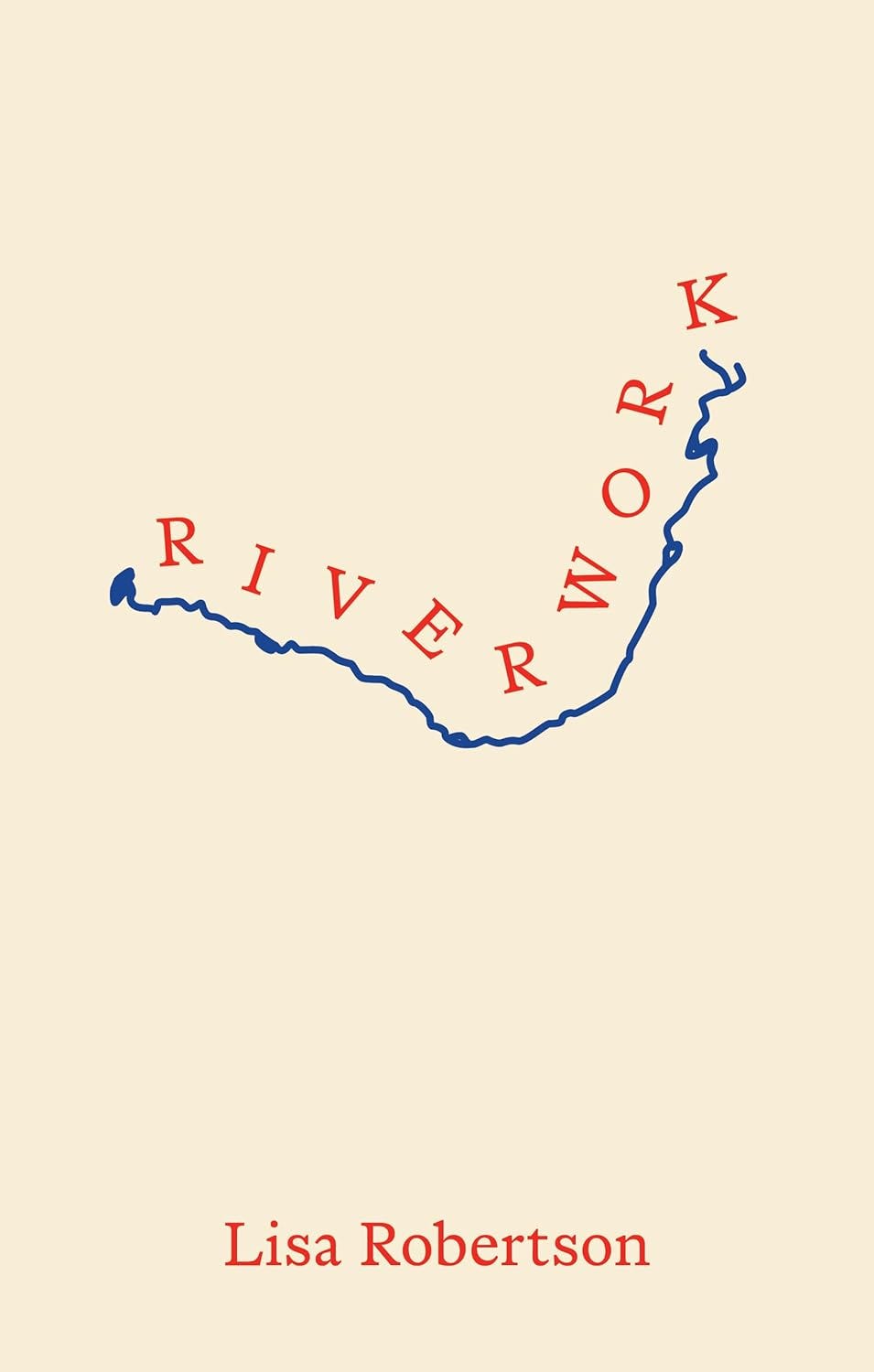
Lisa Robertson’s Riverwork is a book of commas, twenty-three of them on the first page alone, a book of sentences that twist and pivot about these tiny sandbars, thoughts that meander and return. Lisa Robertson’s numerous poetry publications are characterized by their challenging syntax and stylistic experimentation; Riverwork is her second venture into the form we call the novel, although it seems like there really ought to be a different word for this kind of book. It’s not so much fiction as it is non-non-fiction. We’re not looking at what you’d call a plot-driven narrative here. The central first-person character rides a bus, takes a bath, cleans an apartment, has a few conversations, visits a nightclub but doesn’t go inside, reads a book and thinks a great deal. Ostensibly she’s following up on notes prepared by a mysteriously vanished great-aunt who’d been researching a strain of hidden histories, but there’s no moment where it all comes together and the fate of the great-aunt is revealed to be part of some secret cabal still operating in the city or anything like that—the revelations are rather more abstract in nature.
“Riverwork is her second venture into the form we call the novel, although it seems like there really ought to be a different word for this kind of book. It’s not so much fiction as it is non-non-fiction.”
Riverwork builds upon Robertson’s earlier novel, The Baudelaire Fractal, inasmuch as both feature a female protagonist who’s come to Paris to pursue a Bohemian life inspired by the flâneurs and dandies of an earlier era. Riverwork picks up with this character type as she’s aged and settled into an existence that’s as marginal to Bohemia as it is to suburbia. She’s long since realized that her erstwhile compatriots were mostly backed by family money of a kind she doesn’t have, and while they’ve gone on to high-flying cultural and academic careers, she’s found a niche cleaning their homes and offices. Lucy Frost is both cleaning lady and philosopher; her presence in others’ spaces provides her with access to their libraries, as well as a way to pay her rent. She’s reading a lot of Chateaubriand (whose Memoirs from the Beyond the Grave, incidentally, have come out in a newly translated edition just last year from NYRB Classics). She’s also obsessed with Paris’s buried river, the Bièvre, which previously ran through the city but has since been sent underground through culverts and sewers.
Historically, the Bièvre was heavily used by local industry and also by laundresses for their poorly paid professional labour. “Like any form of work, riverwork was gendered, and labourers fared accordingly.” The river is itself susceptible of gendered interpretation, a suppressed subterranean flow often running red with effluent from the textile factories. Frost, at age 63, is distinctly post-menopausal and yet clearly continuous with her younger self who’d sought truth utilizing promiscuity, whose physical and intellectual desires were tightly entwined. Now as an older woman, upon falling down one day in the street, she asks:
Had I only ever stumbled? Did I fall from life into life? This clumsiness was my calling. I hadn’t grown out of it. Always a shin was bruised. Always my hips were oddly marked by the furniture I passed. My shirt tail would catch on the architecture and tear. The water and the wine would splash across whatever table I joined. But love: there I did not fall. I had drifted into it, rather than fallen. The drifting then had felt wavelike and sumptuous …. I regretted none of them, not a single caress. Each glance still feels like a specific life, a form that rhythmically abides, emerging and receding.
Riverwork, then, is about a river, but it’s also about history, mortality, gender, culture, labour, sexuality, dust, decadence, documents, and (in a few asides) Chantal Akerman’s 1975 film Jeanne Dielman, 23 quai du Commerce, 1080 Bruxelles. If you already like any combination of Lisa Robertson or Chantal Akerman or François-René de Chateaubriand, you’re going to enjoy reading this book. If this is the first you’ve heard of any of the above, here is your chance to dip a toe into these waters that run so often unseen.

About the Author
Lisa Robertson is a Canadian poet, essayist, and novelist who lives in France. Born in Toronto in 1961, she was a long-time resident of Vancouver. Her novel The Baudelaire Fractal was shortlisted for the 2021 Governor General's Award for Fiction and has been published in French, Swedish, and Turkish translations.
About the Reviewer
Dawn Macdonald lives in Whitehorse, Yukon, where she grew up without electricity or running water. She won the 2025 Canadian First Book Prize for her poetry collection Northerny. She posts weekly on Reviews of Books I Got for Free or Cheap (on Substack), as well as reviews for journals and The Seaboard Review of Books.
Book Details
Publisher : Coach House Books
Publication date : May 4 2026
Language : English
Print length : 240 pages
ISBN-10 : 1552455173
ISBN-13 : 978-1552455173
