


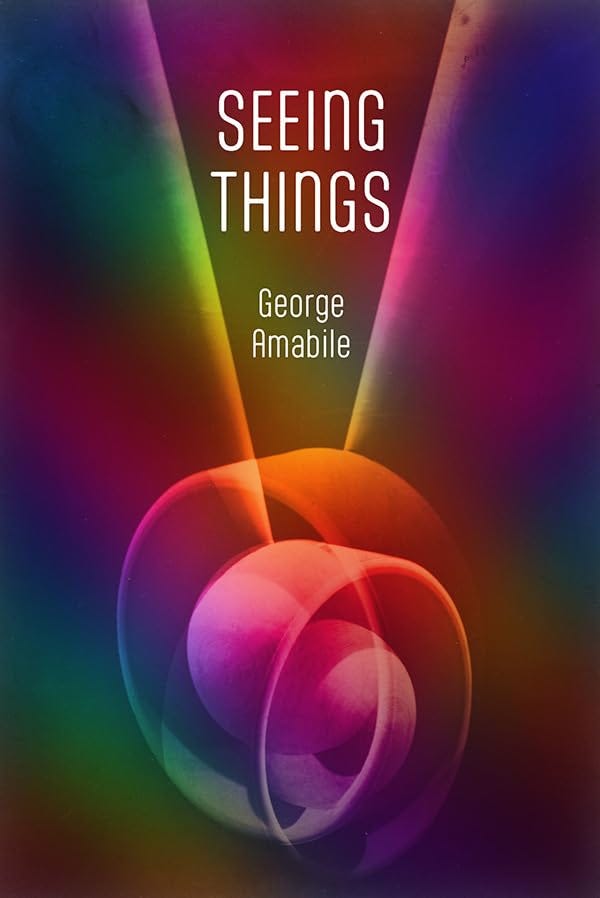
“Thing” is one of the least poetic words in the English language; its plural form becomes slightly more poetic, and by the time George Amabile chooses Seeing Things for the title of his fourteenth collection of poetry, possibilities spread to include multiple meanings. “The Ice Thing” begins as a slender entity and broadens to galaxy or amber moons in its sky, its stringy fingers and hand signs holding infinity in the palm of a child. “This Thing of Ours” begins with nothingness, crosses bridges, and ends with the need to reinvent things and ourselves. The book is divided into three sections of modes of perception — “As They Are, Or Might Be,” “With Surrealist / Abstract Expressionist Eyes,” and “With Glasses, Dark, Then Clear.” Each of these visual modes provides insights into Amabile’s creative process that balances vision, voice, and pleasurable surprises of rhyme, rhythm, wit, and wisdom. Hallucinations of the real and surreal oscillate between demotic Imagism and hidden depths.
Rhyming couplets in the opening poem, “Learning to Read,” are instructive on listening to the ear within “learning” through jaunty enjambment within a couplet and an overflow between couplets:
Start with something simple, a thin
red comet’s tail streaking the skin
Sibilance dominates to advance simplicity toward the complexity of a comet’s tail which sticks to the surface of an apple (delayed until the second stanza). Just as “something” is echoed in comet, so the short i’s at the end of each line reverberate through the first half of the poem, which also teaches us to read the colour on the book’s cover – a crimson comet, apple, orbits in an atom, or “A stipple / on the sunset lake” that “grows to a bull’s-eye ripple.” Amabile gets the most out of his monosyllables – “Watch a trout rise” ties the angler’s line to the poet’s and hooks apple to stipple and ripple, sounds carrying on the mirroring lake effect.
“Watch” gets picked up by “Look up” in the sun’s visual field as “bull’s-eye” turns to “bird’s eyelid” in these skipping stanzas, where something, things, and nothing are controlled by surprising trout rising. These fine rhymes hold all in check in this worldly book of still waters and endline wonders. In “A Raft of Lilies” the poet crosses and criss-crosses a large lake “like a composer, developing the strains” of floral and musical patterns that end in Wallace Stevens’s line “across wide water, without sound.” Amabile begins in the narrows of granular sand before widening to universal resonance.
Those faces that slip through train windows take on a different shape in “Passenger” with stamping end stops replacing earlier enjambment: “The world drifts by.” Insistent monosyllables create a hypnotic spell so that even longer words halt in a drift of “Cadillac, patrol car,” where the sound of luxury is almost a palindrome in a parade of nouns and adjectives arrayed in the field of sight of the single verb “drifts.” Drifting assonance accompanies vision – world, patrol, courts, hot dog, vendor, hospital, stones, oak doors / open, conscience, shore, radio, and telephone poles. Mist and whimper become grounded in graveyard, gravel, and garage. With hindsight, foresight, and keen insight, the poet is in the driver’s seat returning to his one-car garage, a coffin after Cadillac hearse.
“Five Bells” achieves a five-by-five symmetry with its five stanzas, each with five lines of five syllables in a single sentence of multiple sounds. The title is echoed in the opening line, “The glass rain crackles,” an onomatopoeia that carries through the stanza in “wind whistles” and “steel zither.” Rhythm is established not only by the chorus of monosyllables, but also by alternating long and short vowels, and the pendulum of a bridge with its own traffic. Like Hart Crane’s bridge, Amabile’s connects poet to place, bridges the distance between metaphor’s tenor and vehicle, and perches anatomically between seeing eyes. Strings that keep the bridge “tuned up and afloat” contrast with an undertow of “bunched tug,” pleasure craft, deep-sea-freighters, and oil tankers. Rain and strings meet up again in the final stanza: “strung / with hard rain.” The “licensed pleasure / craft” are seen through Amabile’s poetic craft that instructs and delights. His fivefold vision traps and releases not only the external world but also the sound of each syllable. In “Hullabaloo” laughter sounds like boots crossing a bridge. In “Green Light” everything flows “like water / under the bridge,” towards the crossroads that slip by, “smooth as intestinal muscle.”
“Frost” divides one sentence into two stanzas with monosyllables doing much of the heavy lifting of sound and sense. The title is picked up at the beginning (“crisp”) and again at the end (“fast”). The interface of frost requires the division of two stanzas. “This crisp bloom of diamond-tipped white / lichen looks like something that might have been / photographed through a space telescope:” Initial sibilance resurfaces in space telescope where the precise image spreads from photo to telescope. (In “La Forza del Destino” he stretches the image to “tell-escope” that measures narrative, visual, and lyrical impulses.) Short and long “i’s” oscillate along the rime while the second line plays on the simile to liken the image to a photograph further exposed by a telescope. Long o’s in the third line open to the colon, which is developed in the second stanza:
bright swathes and washes, comet tails,
swirled galaxies laced with dark
matter, and all of it going nowhere fast.
Just as bright returns to white, so the short a’s in swathes, washes, galaxies, dark, matter, and fast alternate with long a’s in tails and laced to give a sense of wonderment of emotion in stasis. In turn, these comet tails return to the first poem’s “comet’s tail” to swirl Seeing Things from precision’s glow and grain towards universal afterglow.
And back to couplets in “Zen and the Art of Cross-Country Skiing,” each couplet imitating the parallel lines etched in snow and cross-hatched in a soundscape of extending metrics. (Amabile criss-crosses the firmament in “The End of History.”) The poem is grounded in “Health” – not just of body but also of pristine landscape. That stamp of health comes to an abrupt stop before the next sentence elaborates the state of health: “A matrix / of jewelled afternoons, // hard shadows on glazed snow, / the sun, splintering, through evergreens.” To invoke Dr. William Carlos Williams’s red wheelbarrow glazed with rain is to comment on health and a potter’s design of shadows on snow elongated further by alliterated and stretched splintering. “Such definition” opens the third stanza and prepares for the extended breathing of the next sentence which carries on until the end of the poem. That sentence runs on in imitation of skiing motion.
The poem artfully defines itself from the exhalation of “Exhilaration” through alternating long and short i’s and liquid l’s which propel the skier forward, and hard k’s that grasp snow’s tread and tract. A “quick lick of blue light” activates the tongue of sound before the wind enters deeper into the body that courses through the rest of the poem. The poet scopes through simile and onomatopoeia: “like raw silk in the lungs,” and drifts to “or gliding over the rhythmic slither-hiss and glass / clicks where waxed edges plough the small ice.” Earlier tetrameters go beyond pentameters in a rhythm that achieves its fullest measure in the next couplet: “lace, and bunched, roughed up snow goes by like the white rush / in a speedboat’s wake and the breath is pulled in or measured out.” Body heat nests and layers with language “until the everyday word-chains clear // off and I can see that language is an architect.” Amabile sees the mundane moment before turning it into the Zen of meditation and metaphysics.
Jewelled matrix and dark matter cluster Amabile’s material, all of which derive etymologically from “mother,” the Muse of invention in everyday word-chains. In “Travel Advisory” the sun is “a ghost of itself behind a cloud / of unidentified grey matter.” “Song to Myself” proceeds from childhood to river to Freudian nightmares: “And why should they / matter?” “Country Road” is dedicated to his son “after the sun goes down” when “it hardly matters where / we came from.” “The Mother Tongue” speaks for itself, while the “elephant matriarch plays dead” down the road of the poet’s revised childhood in “The Happy Hunting Ground.”
The second section of this collection turns from an Imagist impulse towards abstraction. “Green Light” doesn’t explore colours, but rather the stop-and-go of time. Idioms like “water / under the bridge” become “trans-dimensional.” Amabile’s nimble wit enjambs idioms into unexpected shifts of sense: “Opportunity will knock / the socks off chivalry.” Meaning dances between cliché and surprise or surge of lines, “while the band plays on / and the ends will continue to stuff / the means with pillow talk.” And the poem ends with a surreal slide into anatomy: “and the crossroads, the glitches, will slip / by, smooth as intestinal muscle.” Elastic and flexible, Amabile’s verse pauses at the amber crossroads.
“Cycle” begins prosaically: “We thought it could never happen again,” and ends mysteriously:
Whatever it was that failed,
its echo haunts us
with a sound like shed skins
blown through abandoned corridors.
What echoes is the “matrix” at the poem’s centre, which recalls the matrix of jewelled afternoons in the mothering family of words.
“The Mother Tongue” enters the matrix of formal rhyme:
There is a language that transforms
culture and politics, that storms
across time zones: Kuala Lumpur
to Decatur, Churchill to Zanzibar,
through all norms and digital platforms.
The third stanza spells out that transformational language:
And there’s no better way to weigh or see
the exact value of your life-on-the run
than to have it written down, in the mother tongue,
in the Great Ledger after you’re dead:
forty-two thousand six-hundred and eighty-one.
Exact or arbitrary, the sum total or bottom line of the lingua franca is coloured in the poem’s concluding couplet of debit and credit: “Unimpressive, but not without dignity. / You ended your days in the black, not the red.” This tally is a measure of life and line.
The seer crosses his bridge, and soars.

About the Author
George Amabile is a poet and writer from Winnipeg. His poetry collection The Presence of Fire won the CAA award and his novel Operation Stealth Seed won the Michael Van Rooy Award for Genre Fiction. His short story collection Small Change and his poetry collections Martial Music and Dancing, with Mirrors were all awarded the Bressani Literary Prize. His poetry, fiction and non-fiction have also appeared in over a hundred anthologies, magazines, journals and periodicals in the USA, Canada, Europe, England, Wales, South America, Australia, and New Zealand.
About the Reviewer
Michael Greenstein is a retired professor of English (Université de Sherbrooke). He is the author of Third Solitudes: Tradition and Discontinuity in Jewish-Canadian Literature and has published widely on Victorian, Canadian, and American-Jewish literature. He has published 250 essays and reviews in books and journals across Canada, the United States, and Europe.
Book Details
Publisher : Signature Editions
Publication date : Sept. 30 2025
Print length : 104 pages
ISBN-10 : 1773241672
ISBN-13 : 978-1773241678
