

Shallow River of Tears: Canada’s Stalled Paths to Reconciliation by Andrew R. Basso and Andrea M.L. Perrella
Reviewed by Dawn Macdonald

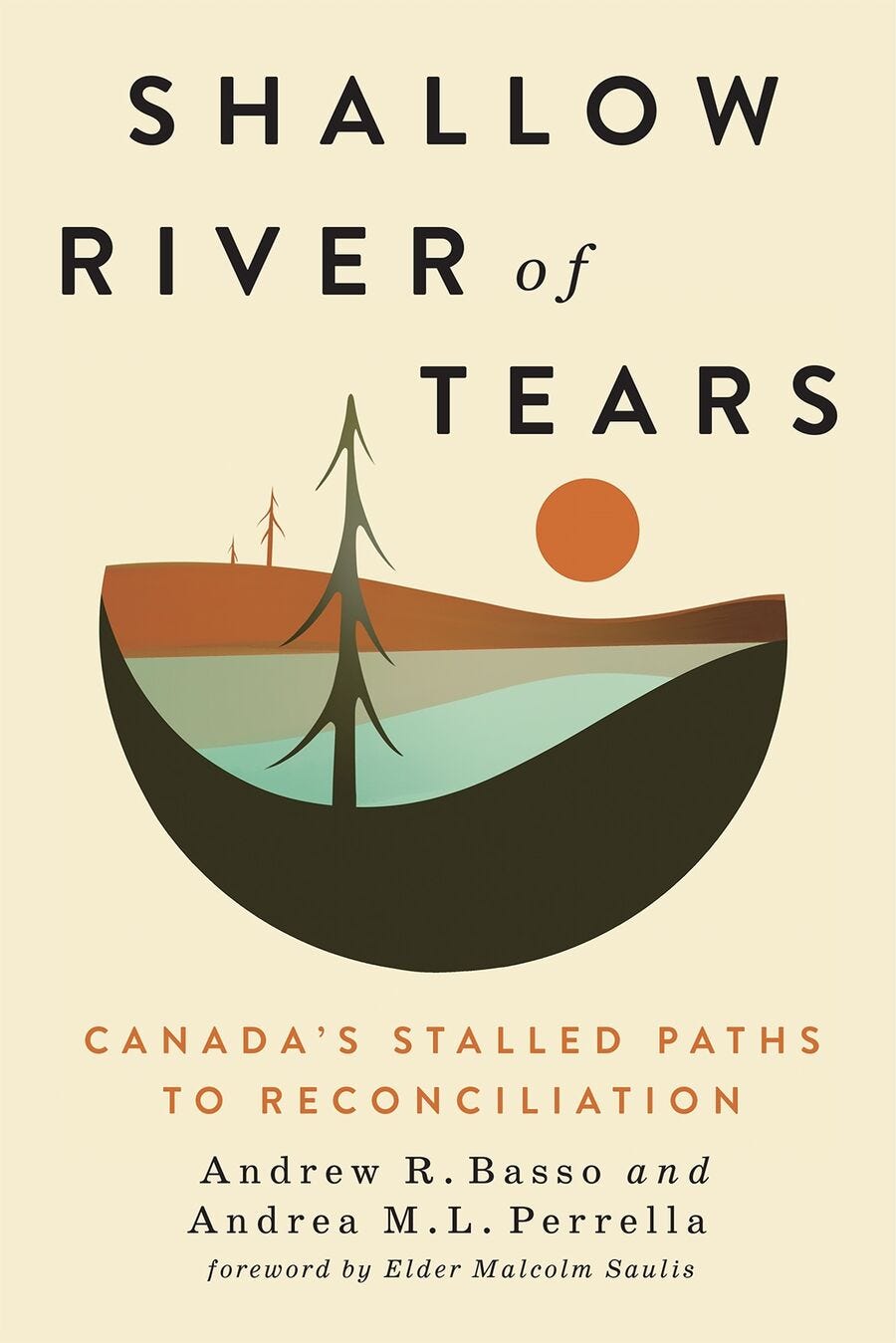
It’s been over a decade since the Truth and Reconciliation Commission of Canada released its ninety-four calls to action, and so far we’ve done thirteen. At this rate it’ll take a lifetime, so what’s up with that? Why has reconciliation stalled?
Andrew R. Basso and Andrea M.L. Perrella are both political scientists of settler origin affiliated with Wilfred Laurier University. Together they’ve undertaken a large-scale study of Canadian settler attitudes to better understand the sources of resistance, and keys to unlocking widespread support for meaningful action. Between August 2021 and May 2023, they fielded three national online surveys reaching a total of nearly 4,500 respondents. They offer an impressively robust quantitative analysis, replete with mathematical models and associated coefficients. The tabular presentation of results is complemented by sprightly prose outlining the contradictions and conclusions that spring from this wealth of data. Their approach is multi-dimensional, deeply considered, and thoughtful about the many factors shaping settler opinion in multicultural Canada. They laser in on the persisting gap between opinion and action, and the propensity for settler contribution to stall at the level of symbolic action (like land acknowledgements) which signal right opinion without giving up anything in particular.
“Giving up” isn’t quite the right framing, though, because Basso and Perrella would urge us to move beyond a zero-sum orientation that casts reconciliation as a loss for settler populations. They find that the prevalence of zero-sum attitudes remains a significant barrier to translating reconciliation into meaningful change.
Through batteries of related survey questions, Basso and Perrella have devised measures of four basic constructs: denialism, recognition, “thin” or cognitive sympathy, and empathy. They posit a model in which individuals move through these mindsets in order, conquering denial before developing recognition of colonial harms, then moving to a cognitive stance of sympathy with Indigenous peoples in Canada, before developing a “feeling” dimension of empathy. They further posit that the final stage, empathy, is necessary to move a person to action. At the same time, they caution that empathy can be something of a double-edged sword. The pleasures of empathizing may become so great that one seeks to keep the other as perpetual victim and source of emptional supply. If the dangers of “dark” empathy can be averted, though, it’s a powerful driver at an individual level.
“They find that even people with overall favourable opinions extend strictly limited support towards the more concrete and meaningful actions that would cost money or take time, beyond the thirty seconds given to a land acknowledgement at the start of a meeting or the unit of curriculum to be delivered in elementary school classrooms.”
For all that this appears to be true, at least in light of their statistical interpretation of the survey results, they find that shifts in the attitudes of settler Canadians are likely insufficient to achieve the aims of reconciliation. They find that even people with overall favourable opinions extend strictly limited support towards the more concrete and meaningful actions that would cost money or take time, beyond the thirty seconds given to a land acknowledgement at the start of a meeting or the unit of curriculum to be delivered in elementary school classrooms. They term this “empty sympathy” or “the shallow river of tears.” Ultimately, they call upon our political leaders to demonstrate true leadership in forwarding reconciliation, with or without grassroots pressure from settler constituents to do so.
As they frame it,
“Our study has uncovered a hard behavioural core of the Settler colonial paradigm. This paradigm is marked by a widespread lack of denial but also by modest recognition of past wrongs, thin sympahy, and empathy. The empty sympathy that currently defines Reconciliation is the direct result of leaving transitional justice in the enigmatic hands of public opinion, helping to insulate the lack of action. Put bluntly, public opinion alone will fail to move the needle and advance justice from below. In a sense, public opinion may simply be mirroring elite postures. Given these realities of Settler public opinion and institutional configurations, we believe that the only way forward is to forgo slow, uncertain, and tedious grassroots justice and for leaders to drag from the front. If leaders are taking meek, ambivalent, ambiguous, or contradictory stands, we do not expect public opinion to straighten that out; instead, the public will mimic and reproduce the meekness, ambivalence, ambiguities, and contradictions.”
In terms of their survey research, I could quibble with some details of their question wording. A couple of the “denialism” items, for example, appear to be trick questions. Survey respondents aren’t usually on the lookout for these, and may tend to answer the more ambiguously or oddly phrased questions as if they had said whatever it seems they ought to have meant within the context. Quirks like this could tend to complicate the analysis, and indeed the authors obtained some contradictory results from the denialism module. Survey work is difficult, and question wording is really hard to get right. I don’t think these quibbles cast any serious doubt on their overall findings. The work is quite robust, extensive, and well conceived.
Their conclusion is really a rather positive one. We don’t have to cry more tears; we just need to galvanize our political leadership. In that spirit, one can only wonder—is Mark Carney reading The Seaboard Review?

About the Author
Andrew R. Basso is an adjunct faculty member at Wilfrid Laurier University.
Andrea M.L. Perrella is associate professor of political science at Wilfrid Laurier University.
About the Reviewer
Dawn Macdonald lives in Whitehorse, Yukon, where she grew up without electricity or running water. She won the 2025 Canadian First Book Prize for her poetry collection Northerny. She posts weekly on Reviews of Books I Got for Free or Cheap (on Substack), as well as reviews for journals and The Seaboard Review of Books.
Book Details
Publisher : McGill-Queen’s University Press
Publication date : March 17 2026
Language : English
Print length : 448 pages
ISBN-10 : 0228026695
ISBN-13 : 978-0228026693