


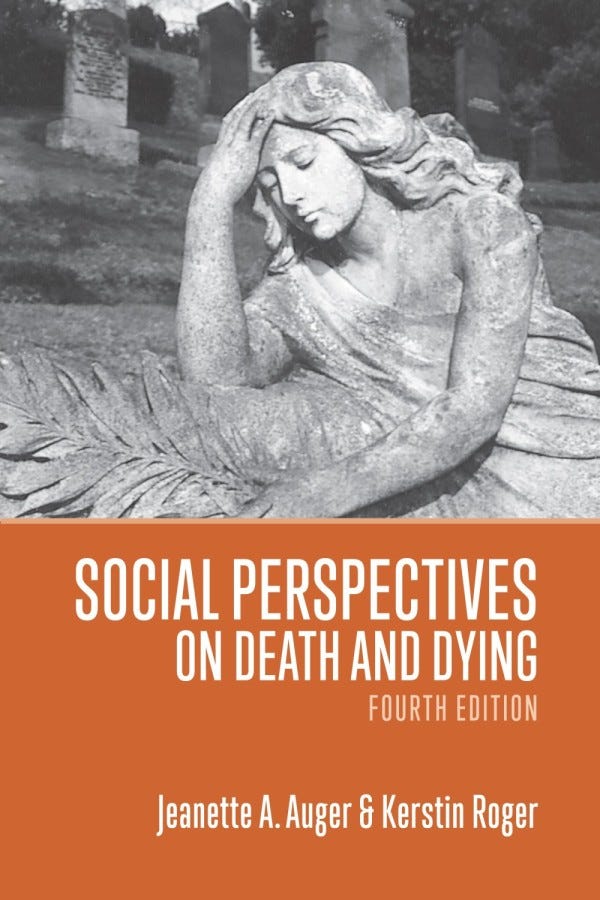
Many of us aren’t comfortable talking about death and dying. It’s a subject we’d rather not think about, much less discuss. But as Social Perspectives on Death and Dying (Fourth Edition) notes, discussions about these topics can be important, and may even reduce our discomfort.
Written by Jeanette A. Auger and Kerstin Roger, with contributions from Zohreh BayatRizi, Rita Giancola, Audrey Medwayosh, and Catherine White, Social Perspectives on Death and Dying provides information about a number of topics related to death and dying as well as questions to prompt personal reflection.
As the designation “Fourth Edition” indicates, this book is an updated version of a previous volume. The first edition of the book came out in 2000, and subsequent versions were published in 2007 and 2019. New legislation and social changes have prompted updates over the years. For example, death doulas, death dinners, grief walks, and other phenomena weren’t around when the previous three editions were published.
“Social Perspectives on Death and Dying has a number of potential audiences. As the book’s authors note, over the years there has been an increase in the number of courses related to thanatology, or the study of death.”
The Fourth Edition includes “the latest information and regulations around issues like cremation, suicide, the media and drug-induced death.” There are new sections including cross-cultural perspectives on death and dying, MAID (Medical Assistance in Dying), and Indigenous perspectives on death and dying.
Social Perspectives on Death and Dying has a number of potential audiences. As the book’s authors note, over the years there has been an increase in the number of courses related to thanatology, or the study of death. Each chapter of the book includes suggested assignments and exercises, making it a potential fit for some of these courses. Secondly, people in professions that interface with people who are dying, such as medical professionals, spiritual advisors, funeral directors, and so on, might find this book useful.
And finally, individuals who are curious to learn more, and maybe think more, about the various legal and sociological issues around death and dying may find the book of interest. For example, there are sections on ethical wills, organ donations, and preparing a “death plan,” on grief and bereavement, on burial options, and other topics. There is even a chapter on Death Education and the Arts, exploring how death has been explored and depicted in visual arts such as painting, photography, and sculpture, in music, and in media like film, television, and literature.
Social Perspectives on Death and Dying discusses drug and opioid deaths in Canada, as well as historical attitudes toward death and dying. The final chapter includes information about the search for immortality, with topics like cryonic suspension, bionic limbs, and deathbots. The latter can take the form of digital avatars designed to mimic those who have died, whether through writing or speech, in order to comfort the bereaved.
As I’ve aged, I’ve had to confront the fact that my body has an expiration date, albeit one that is not clearly spelled out. The loss of family members, friends, and co-workers serves as a reminder that, much as we don’t like to think about it, mortality is a fact of life. Social Perspectives on Death and Dying provides helpful information and resources. In particular, I was interested in the sections on grief and bereavement, historical perspectives on death, palliative care, burial options, and legal planning around death-related issues. Though I skimmed through the “Self-Reflection and Thoughtful Conversations” prompts on my first read-through, I plan to return to some of these later.
As the authors point out, “we have much more information about the physical, psychological, spiritual and social consequences of death in our many global cultures than ever before in our history. Yet despite all this information, we have relatively less knowledge, understanding or ease about our own mortality, or what it is like to die, than we ever had.”
They add, “It is as if the more we know about who dies, the causes of death, where and how people die, the less likely we are to think about our own death. We remain a death-denying and a death-defying culture.” For those who wish to buck the trend and explore the topics of death and dying more deeply, Social Perspectives on Death and Dying offers an up-to-date and thought-provoking resource.

About the Author
Jeanette Auger is a professor emeritus of sociology at Acadia University, where she taught full-time for more than forty years and still teaches two online courses. She has written or co-authored nine books, most in the field of gerontology/aging and queer studies. As well as her teaching and research experience, she has also worked in a variety of capacities as a community development researcher and volunteer, specifically in organizations which provide services and programs to older people and their important ones.
Kerstin Roger is a professor at the College of Community and Global Health, Rady Faculty of Health Sciences, University of Manitoba. Her social science research focuses on the family, caregiving, aging and end of life; global health and wellness across the lifespan, including abuse of older adults; and chronicity and interface with health care systems.
About the Reviewer
Ontario resident Lisa Timpf writes poetry, book reviews, short stories, and creative nonfiction. Her speculative poetry collections Cats and Dogs in Space (2025) and In Days to Come (2022) are available from Hiraeth Publishing in print and electronic formats. You can find out more about Lisa’s writing projects at http://lisatimpf.blogspot.com/. Lisa is also on Bluesky, @lisatimpf.bsky.social, and her author Facebook page is @lisa.timpf.author.
Book Details
Publisher: Fernwood Publishing
Language: English
Publication date: March 17, 2026
Edition: 4th
Print length: 270 pages
ISBN-10: 1773638076
ISBN-13: 978-1773638072