
Son of Nobody by Yann Martel
Reviewed by Michael Greenstein

Epic Levels
Yann Martel’s inventive tour de force and force of detours, Son of Nobody, reimagines an ancient Greek epic, The Psoad, and celebrates an anti-hero whose word is mightier than his sword. Unlike Homer’s The Iliad, which focusses on the battles of gods and heroes, Martel’s postmodern epic lowers its sights to commoners in the Trojan War. This leveling of the walls of Troy is matched by a textual leveling whereby the epic appears on the upper half of the page, while commentary or counternarrative unfolds on the bottom half.
“With its pastoral touches, Son of Nobody is as much eclogue as epic.”
If Psoas of Midea, the son of nobody, is the protagonist of his epic, then Harlow Donne is the narrator of his own recovery of the earlier tale, his commentary, and his contemporary domestic and academic adventures. Just as Psoas’s name relates to the Portuguese poet Fernando Pessoa (which means person), so Donne relates to poet John Donne, while Harlow relates to Clarissa Harlowe in Samuel Richardon’s eighteenth-century novel, but also calls attention to low laughter in a mock-epic. Martel mixes genres in Son of Nobody even as he levels with his reader.
The “Author’s Note” begins with “Once there was a clay pot and it fell and broke. Once there was a man and he too fell.” Telling and felling, Martel lowers heroics and fills in shards with his golden threads, much like the style of Japanese kintsugi. Donne reconstructs his pot and plot not only in repeated “once” upon a time, but also in his epic first: “Let’s start with the first, Helen.” Whereas Helen of Troy is the initial inspiration, Donne’s daughter Helen is the one to whom he addresses his story, and the two are conflated in the domestic troubles Donne endures. He recounts how he came upon the jagged remains of a clay pot while doing research at Oxford University. While his ears are attuned to the oral nature of Greek epics, his eyes focus on shards from the Archaic period – ostraca origins “when clay was starting to capture the living breath of words, the first instance of writing.” Equally astonishing is Donne’s discovery of “boustrophedon,” a reversing pattern inscribed on these tablets. “This way of writing is called boustrophedon, one of the loveliest words in the English language, from the Greek for ‘turning like the ox, when ploughing,’ that is, with the text, including the spelling, alternating directions.”
With its pastoral touches, Son of Nobody is as much eclogue as epic, the reader’s eye splitting top and bottom halves of the page in shifting directions, “the page an acre of arable land being worked.” The translation from the Greek reads:
CEBEREHMAI
AUSEOFPSOASOF
NOSAEDIM
OFNOBODY
Which gets translated as:
I AM HERE BEC
AUSE OF PSOAS OF
MIDEA SON
OF NOBODY.
Martel’s treasure trove contains this lost epic, as well as Donne’s domestic drama with his wife Gail and their daughter Helen, to whom Harlow addresses his feelings.
In Martel’s story of a story the “son of nobody lay buried in ancient papyri and faded codices, even in broken cuneiform tablets, discovered hither and yon, the majority untranslated from their original language, his name often corrupted, as happens with unusual names, but he was there, he was there, with his story to tell.” In the here and yonder, Martel corrupts his unusual name to repeat presence. Staking out his own voice and identity within the oral epic tradition, he imagines an academic description of his work: “The Canadian scholar Harlow Donne attempted to hear and tease out from the ancient past the song of a lost Trojan War tradition.” In his modern confession Donne admits that “I failed you as a father, Helen, and I failed your mother as a husband.” He weaves into his narrative the occasional metafictional note: “We all live lives that are footnotes to a greater story,” with the reader’s eye lowering to the bottom half of the page. Hellenistic Harlow continues to adjust his tone towards his daughter and his reader: “I will speak in the pages that follow in my own voice, that I-voice that has always loved you, my darling Helen.”
After these confessions that include his grandfather’s traumatic experience in the Vietnam War, Donne offers the “Abstract” of his Ph.D. dissertation: “A Man and His Mistakes. The Psoad: A Reconstruction of a Lost Trojan War Tradition.” This “Abstract” contains its own leveling from the “high hopes” of the men who arrived at a foreign shore to the “commoners who raise their voices” in The Psoad. In his dissertation he offers a long list of ironic faults within the mock-epic tradition: “with me lies the blame for all errors, defects, misinterpretations, outrageous distortions, incredible leaps, dubious sounding-offs, flat-out inventions, and any other accusations that might be leveled at an explorer of the remote past foolish enough to attempt to see through faded ink, interrupted sentences, lost connections, and the other ravaging effects of time.” In this ravage of the clock, Donne levels, flattens, and exposes the ever-continuing song with its Aegean grain of salt.
The “Prologue” begins with a customary epic invocation: “Muse, have you forgotten him?” If these words belong to the bard of long ago, the footnote to this question focusses on Donne’s relationship to his own Helen who stands at the top of the stairs and is unwilling to go to sleep until her father tells her a story. Often, he “would riff on a Greek myth” or spin a tale out of nothing. He gets an email informing him that he has been accepted at Oxford for one year, all expenses paid: “I was the delighted, unexpected recipient of a scholarship that plucked me from my academic Pluto on the Canadian Prairies, and sent me, comet-like, to the dazzling sun that is Oxford University.” From flat Canada to the ivory tower, Donne scales heights only to be levelled again in hierarchies of irony in text and footnotes. At Oxford he is supervised by ancient Franklin Cubitt, who offers a third dimension to the book’s satire.
The “Prologue” names Psoas and asks if he is to remain in Hades “where unhappy creatures move about like shadows.” An ancient character comments on Donne’s domestic situation with its family feud. Arguing with Gail, Harlow condemns his wife’s “tone” in front of their daughter, and the tone of The Psoad is crucial to its understanding. Gail’s accusation is couched in odyssean terms: “The good dad thinks sailing off to Troy will solve our problems? How did that work out for the Greeks?” To which he replies, “it’s the tone, the tone.” The Trojan tone on the prairies spins out of control from pinpoint to pinpoint of mock-epic quarrel: “We urged each other on, harder and deeper, loading our words with as much malice as they could carry, digging into each other’s weaknesses, mocking each other’s strengths, adding new twists, more fire, further venom, revived outrage, what you want, to the old story.” Harlow disdains household squabbles in ancient epics, even as he is embroiled in his current state of affairs. “That is how Greek epic works, on a grand scale with outsize characters and enthralling scenes,” whereas “Domestic quarrels, because so petty and personal … don’t fit well in public song.” Addressing his own daughter Helen in the next room, he concludes: “In Greek epic, no one listens and no one gets along.” Son of nobody listens and sings.
After the “Prologue” Donne inserts “The Layout of the Ships,” which is technically out of place since it should follow two “Arrival” fragments, but the mock-epic plays freely with chronology and other senses of order. His gloss to this section interweaves comments about Homer with considerations about leaving home in Canada. The first explanation of “lying in wait like a lion about to pounce” begins with dialogue between husband and wife, followed by orderly arrangements: “forms were signed, flights were booked, and suitcases were packed.” If Gail is the pouncing lion who rejects him in this first footnote, then Franklin Cubitt is the lion in waiting in the second footnote. Framed by Oxford’s Gothic stone walls and pointy windows, Cubitt pounces with “piercing eyeballs that fixed me like an eagle set to land its talons on a prey.” Postcolonial comedy ensues as Cubitt refers to Donne’s Canadian institution as the “University of Unpronounceable.” Martel lies in wait, pounces, and levels: “Oh, the bejewelled accent, the haughty mien. My plain accent and I, commoners both, sat on the sofa he had pointed to.” Just as Saskatchewan may be unpronounceable, so Donne mispronounces Magdalen.
Footnotes offer an opportunity for self-reflexive fiction: “A story is a never-ending invention” from oral epics to postmodernist footnotes. Of the walls of Troy, “so high, so bright, so fixed,” he adds “And so fictitious. It’s a common trick of storytellers, to lay it on thick.” An uncommon mason, Martel thickens the plot with his metafictional sidebars: “This seminal event of antiquity, along with the other foundational stories of the great past – Gilgamesh, the Bible, the Gospels, and the like – all belong to the verdant realm of fiction (hence their power), with only a few, thread-like tendrils reaching out to verifiable facts.” On the way, he offers a lesson on dactylic hexameter in Greek epic poetry: “And that’s vintage songplay, anyway. Today is today, for today.” Martel wears his learning lightly, and his tongue-in-cheek song of Psoas sails the Aegean smoothly. (And all that learning prevents the novel from becoming a farce that launches a thousand quips.)
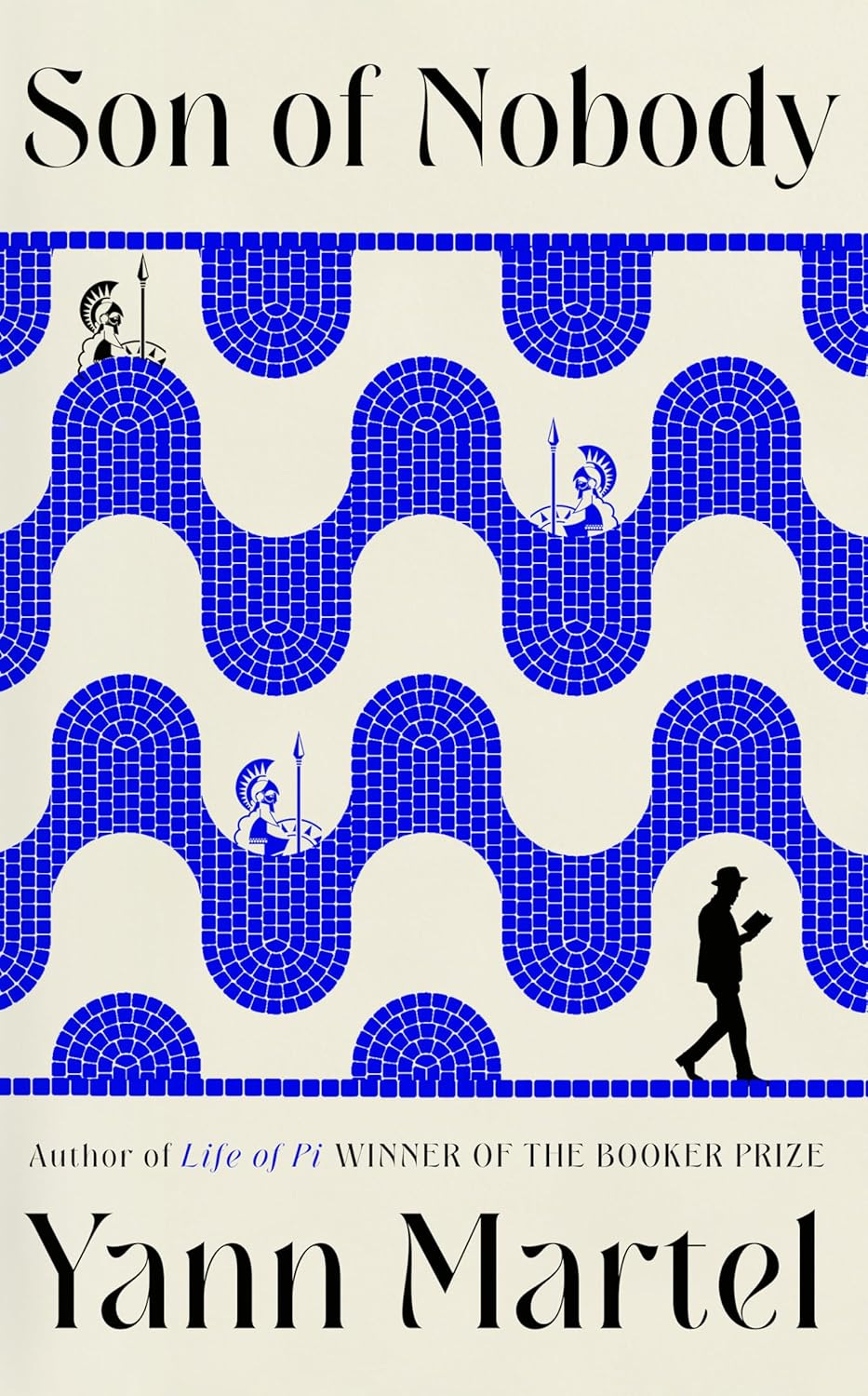
In the end, Donne’s daughter Helen dies, and he retrieves her from Hades with a story about a broken pot (and repaired plot). On the book’s layered cover, female warriors ride waves and mosaic walls, while a common reader of filial fiction marches at a lower level.

About the Author
Yann Martel is the author of Life of Pi, the global bestseller that won the 2002 Man Booker Prize and was adapted to the screen in the Oscar-winning film by Ang Lee. He lives in Saskatoon, Canada.
About the Reviewer
Michael Greenstein is a retired professor of English (Université de Sherbrooke). He is the author of Third Solitudes: Tradition and Discontinuity in Jewish-Canadian Literature and has published extensively on Victorian, Canadian, and American Jewish literature.
He has published 250 essays and reviews in books and journals across Canada, the United States, and Europe.
Book Details
Publisher : Knopf Canada
Publication date : March 31 2026
Language : English
Print length : 352 pages
ISBN-10 : 1039001505
ISBN-13 : 978-1039001503
 | A guest post by
|
Such an enticing review lures you into reading Martel’s new book: thank you!