

Song of the Seasons by Michael Otis
Reviewed by Ezra Anderson

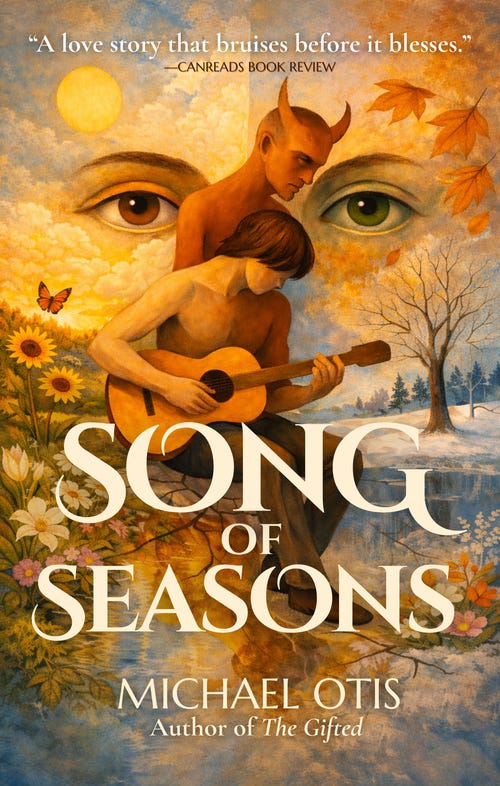
What does it mean to be authentic, not just in love but in art? In Song of the Seasons, Michael Otis poses that question through an inspired conceit: a teenage musician who trades his soul to the devil for fame, only to discover that sincerity is far harder to manufacture than success. Otis’s sophomore YA novel is a wise, warmly observant look at adolescent longing, ambition, and the perils of mistaking intensity for truth.
At first glance, it is a familiar fable—heartbreak, a Faustian bargain, a meteoric rise. What distinguishes Otis’s book is how confidently it pushes the narrative past its own hook. Song of Seasons is less interested in spectacle than in the interior weather of adolescence: the ache to be seen, the urge to turn suffering into meaning, and the seductive belief that one perfect song might clarify a confused self.
“Song of the Seasons highlights the uncertainties that shadow the creative process, especially during adolescence, when emotion often outweighs insight.”
Mitchell, the novel’s protagonist, is a lonely teenager with bipolar disorder who falls hard for Summer, a socially adept, status-conscious girl whose love of glamour far outweighs her interest in Mitchell himself. Otis captures the imbalance of adolescent longing—the way infatuation can elevate another person into an idea and desire into a fantasy of reinvention. Mitchell endows Summer with the power to remake him.
When she leaves for Queen’s University, he makes a bargain with the devil. In exchange for musical fame, Mitchell gives Satan his soul, with one chance to reclaim it: write the most authentic love song ever composed. The premise arrives at full volume, but Otis handles it with a pleasing lightness of touch. The novel preserves its comic momentum even as it opens onto broader questions about ambition, self-knowledge, and the uneasy distance between feeling intensely and understanding honestly.
Song of the Seasons highlights the uncertainties that shadow the creative process, especially during adolescence, when emotion often outweighs insight. Mitchell’s journey captures the common temptations of early artistry: the urge to confuse suffering with depth, the hope that one defining work might resolve a fragmented self, and the difficulty of separating genuine expression from performance. In this sense, Otis’s novel is less about fame than about the ethical challenge of making art without hiding inside it.
As Mitchell’s career accelerates, Otis deftly skewers the absurdities of image-making and romantic aspiration. Summer reappears, newly attentive now that fame has turned Mitchell into someone worth noticing, and Otis neatly exposes the overlap between attraction and status. The novel is sharp about glamour without tipping into cynicism. It understands how fiercely young people want to be seen and how readily love, like art, becomes entwined with the desire for admiration.
Mitchell’s mental health challenges are woven into the fabric of the story. Bipolar disorder shapes the novel’s emotional weather and Mitchell’s experience of the world. His ambition, vulnerability, grandiosity, and self-doubt feel grounded in a mind perpetually negotiating with itself. Otis writes with notable sensitivity about longing and collapse, and that psychological attentiveness extends, strikingly, to the novel’s Satan.
Rather than a cartoon villain, this devil is witty, watchful, and insinuatingly companionable. The philosophical and theological exchanges between Satan and Mitchell are among the book’s freshest pleasures, generating moral pressure rather than horror-movie menace. The restraint largely pays off, though it carries a mild cost: the stakes occasionally feel more atmospheric than urgent, and one sometimes wishes Mitchell himself felt more fear at what he stands to lose.
A lightly handled seasonal motif provides the novel with a graceful architecture. Summer embodies heat, appetite, glamour, illusion; Autumn, who appears later, offers something steadier and less performative. The symbolism is clear without being heavy-handed, giving Mitchell’s emotional education a satisfying and legible shape.
The devil may drive the plot, but the novel’s deeper concern is altogether more human: how to tell the truth when fantasy is so seductive. Otis renders the fraught inner life of a young artist with compassion and grace. Song of the Seasons reminds us that authenticity – in art, in love and in life – emerges from a struggle with our private demons.

About the Author
Michael Otis is a novelist for young readers. Proudly drawing on his mental health struggles, The Gifted was hailed as “a gripping debut that positions Otis as a bold new voice in YA speculative fiction” by CANREADS Book Reviews. Songs of Seasons is his second novel. Otis lives in Toronto.
About the Reviewer
Ezra Anderson is a writer and bookseller living in Toronto.
Book Details
Publisher: RE Books
Publication date: April 14, 2026
Format: Paperback
Pages: 253
ISBN: 978-1998206612