


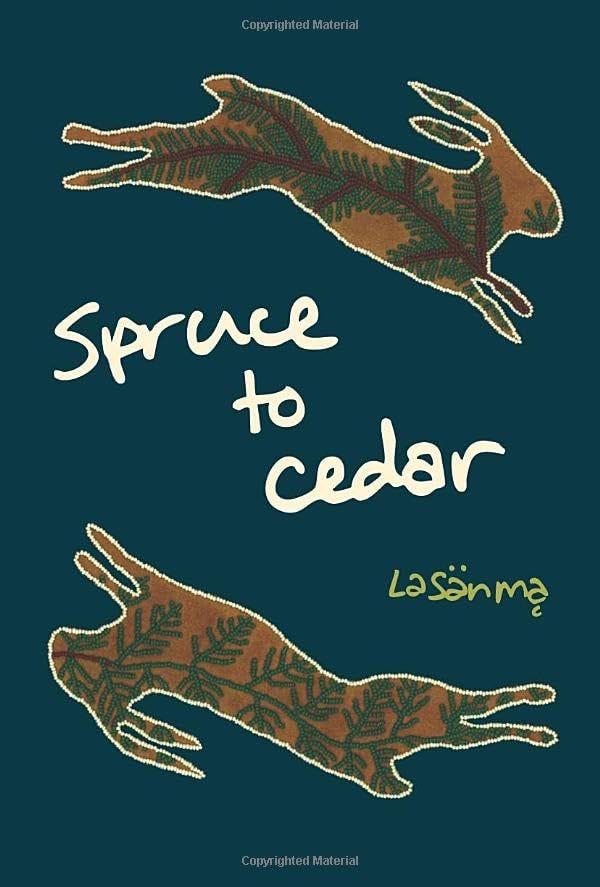
From the spruce of Dakwäkäda (Haines Junction, Yukon) to the cedar of British Columbia’s Lower Mainland and back again, Lasänmą charts her passage in a series of delicately drawn poetic observations. The poems are untitled; instead each piece is given geographical location in the form of a thumbnail image: a mountain peak in Southern Yukon for the pieces situated in Dakwäkäda or in Kwänlin (Whitehorse), the Deh Cho bridge for journeys into the Northwest Territories to see her mother’s Dene people, or the urban shore of Vancouver where the poet has relocated for her university studies. To make sense of the shifts and changes in leaving home, family and culture, Lasänmą enters into dialogue with her child self.
“I’m thrilled to hear a fresh voice coming out of the Yukon, talking about what it’s like to be from this place.”
Her poems, like the thumbnail images that mark them, are able to conjure a location in geographical and familial space with just a small amount of ink. Some are haiku-like, not in syllabic structure but in their trick of saying more with less—giving a picture of a scene that implies an underlying emotion. Other times she speaks her feelings directly, in a mode that addresses the intensity of youth. In a series of longer prose poems she writes back to the teenager she was five years ago, and ten years ago, reflecting on difficult moments in hindsight: “i’m not going to say the pain goes away, but it gets easier to live with.”
Lasänmą is a citizen of the Champagne and Aishihik First Nations, whose traditional territory overlaps with Kluane National Park. Her home community of Haines Junction is a village of about a thousand people, a couple of hours up the highway from the larger centre of Whitehorse. It’s a place of spectacular beauty and limited opportunity. Yukon University (where I should note that I am employed in a number-crunching capacity) has a campus there in a building that’s shared with the library and the government liquor store; it also offers a variety of courses and programs via distance learning for students in rural communities as well as several degrees that can be completed at the main campus in Whitehorse, but a large proportion of Yukon students still need to leave the territory to pursue programs not available locally. (As a YukonU staff member I’ll emphasize that we’re working on that—but we’re small and just can’t offer the range of programming of a UBC or even a UVic. I should also note that all views expressed here are my own, and do not represent those of my employer, as I’m writing this off the clock.) The transition to urban life can be quite jarring; I well remember the culture shock I experienced in going out for university in my day, and I’m not even First Nations. It isn’t just missing the natural landscape, it’s the whole feel of home, which Lasänmą evokes in a few lines with stanzas like this one:
“is home found in an unfinished basement
covered floor to ceiling with memories
pictures stapled to the walls
beer bottles lined up onto shelves
proudly displayed to the drywall”
She brings up memories of community events at the convention centre, of moose meat curing in strips, of berry picking and of the beat-up cookstove. Home is missed, but is not entirely a place of ease and comfort—quite a lot has gone down, and there are reasons to forge a separate path. As she says in a line sitting by itself, “every time i come home it feels like a relapse”.
The tension between home-and-away is mirrored in Lasänmą’s extensive use of symmetry. One piece where this mirroring is explicit has paired lines spread across facing pages; the line “i tell myself i’ll be happier in the city” paired with “i tell myself i’ll be happier back home” and so forth. Other poems use symmetry to establish a cyclical pattern, as in a piece that opens with the stanza, “wood dust floats / in the air / layering gravel dirt / like a blanket of snow” and closes with the parallel stanza, “wood dust floats / in the air / layering mossy ground / like a blanket of snow”.
Symmetries are also used to illustrate changes over time, as when she contrasts her remembered childhood bedroom (“blue walls blue carpet / puppy stickers & thumbtack holes”) with its present state (“cigarette-staned walls cigarette-scented carpet / sun-faded puppy stickers & thumbtack holes”). And of course “spruce to cedar” also goes the other way—“from / cedar to spruce / rain to snow / skyscrapers to mountains / i’m heading home”.
These pieces very gently and tenderly explore the different facets of home, of what it means to be from a place and to leave it, what it means to return when you’ve grown. Family offers a mix of warmth and co-dependency, cultural belonging and sometimes not getting along. Spruce to Cedar is a book I wish I’d had when I was away, and a book that I’d suggest should be recommended reading for faculty and staff at postsecondary schools where Northern and Indigenous students find themselves challenged to adapt.
Speaking personally here, if you know my views and biases you’re aware that I have a whole “thing” about needing more Northern literature written by people who’ve grown up in, and been shaped by, the North—for whom the North is the baseline, not the adventure. I’m thrilled to hear a fresh voice coming out of the Yukon, talking about what it’s like to be from this place. That she’s able to speak in her Indigenous language (and provides a glossary) is truly powerful. I approached the book with eagerness and am fully gratified by what it has delivered—a book I want to thrust into people’s hands, saying, “Here, read this. This is what it’s like.”

About the Author
Lasänmą (she/her) was raised in Haines Junction, Yukon and is a member of the Champagne and Aishihik First Nation. Her English name is Mariah MacDonald, and she is a part of the Wolf Clan. Mariah lived in Haines Junction and Whitehorse before moving to Vancouver at the age of twenty-one, where she studied at the University of British Columbia (located on the unceded Territories of the Musqueam, Squamish and Tsleil-Waututh First Nations). Spruce to Cedar is Lasänmą’s first published work as an author.
About the Reviewer
Dawn Macdonald lives in Whitehorse, Yukon, where she grew up without electricity or running water. She won the 2025 Canadian First Book Prize for her poetry collection Northerny. She posts weekly on Reviews of Books I Got for Free or Cheap (on Substack), as well as reviews for journals and The Seaboard Review of Books.
Book Details
Publisher : Brick Books
Publication date : March 31 2026
Language : English
Print length : 112 pages
ISBN-10 : 1771316705
ISBN-13 : 978-1771316705
