

Spying on America by Bill Gaston
Reviewed by Anne Smith-Nochasak

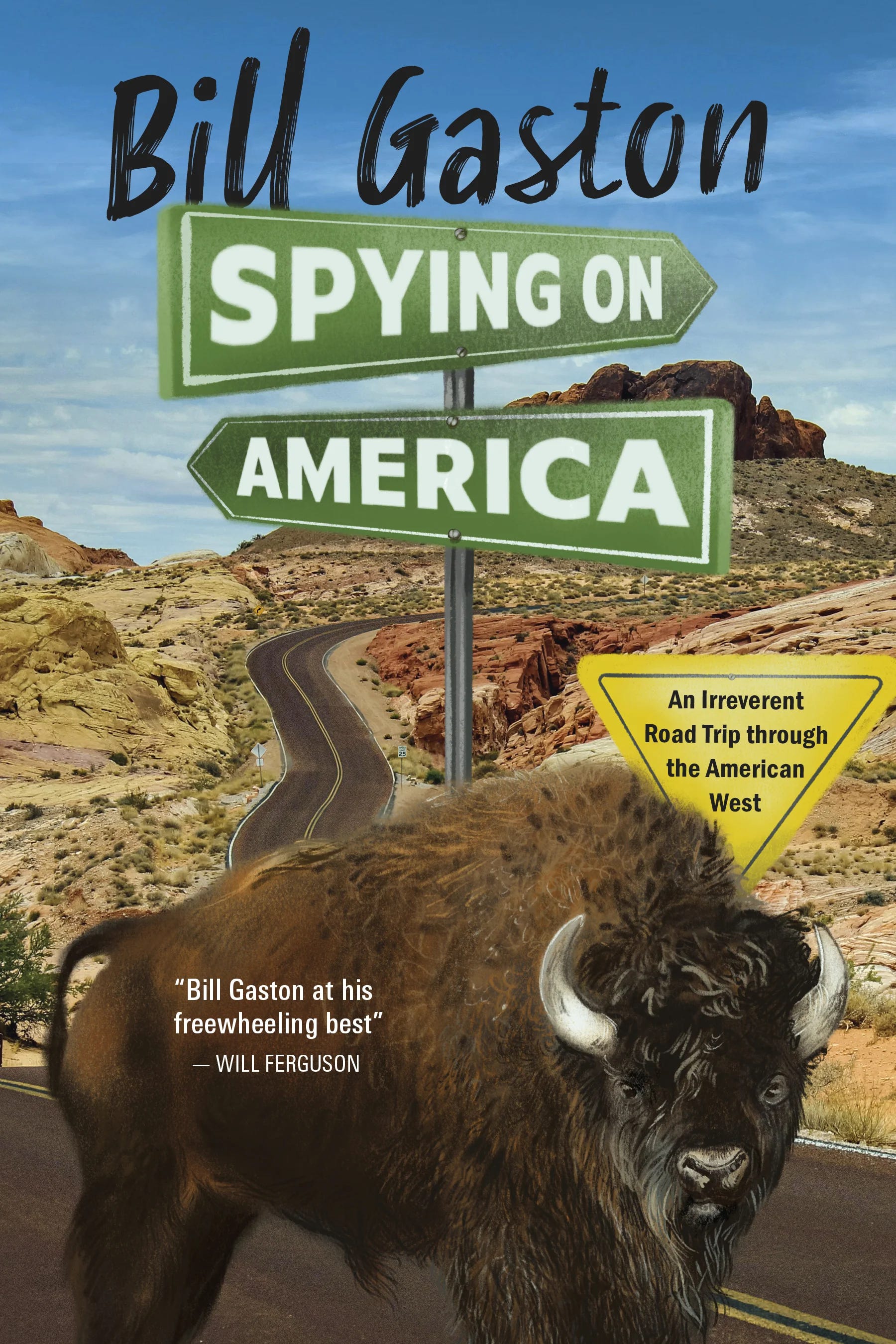
In Spying on America, Bill Gaston takes the reader on a road trip that begins as a genealogical journey but goes much further. Travelling with his two adult sons in a Dodge Charger (the only rental vehicle available) to the town of Tabor, Iowa, he reflects on the bonds that he and his wife and their four children have formed over their shared time and also on family as a cultural value. In the end, we learn that it is more accurately a pilgrimage toward family—not so much those in the distant past, but those who surround him in the present. As he travels through the States, he reflects as well on the way family is celebrated there as an American value. Family, the author notes, is cherished in all cultures, but he notices an American tendency to celebrate it as a national value special to them.
“… a warm and satisfying read.”
Throughout the text, details of his personal and professional past are revealed. Bill Gaston was born in the States and has family there, but he grew up in Canada and is distinctly Canadian. During the narrative, he reflects on his American relatives and the ways their patriotism is shaped, and describes how he has, during his career, named other places as his birthplace. And thus, the reader will learn how the author became an honorary citizen of Flin Flon, Manitoba.
Some road trip narratives follow a packed itinerary, every moment filled with detailed descriptions and observations. That is not the case here—We learn not about tourist highlights or popular sites, but the very real human interactions within the car and with the people they encounter at diners or state parks, the people who are part of the little moments that define a road trip. We roll along the open road with Bill Gaston and his sons as they chat, watch the landscape roll by, seek out obscure eating places, drive through a herd of bison with a recording of The Mormon Tabernacle Choir’s O Holy Night blasting from the speakers, or perhaps spend a 4th of July evening in a karaoke bar with a patriotic host where they clap “not so much because we were polite Canadians but because it might have been dangerous not to.”(230)
The plan is to travel to the town founded by his ancestors George and Maria Gaston, avoiding major centres, “never taking the same road twice,” and invoking “ya-gotta-stop” as needed. It is a spontaneous trip with a loose itinerary—There will be casual stops along the way, but without reservations and agendas. After driving late on the first night and having to take an extremely expensive hotel while restaurants are closing, however, they come to accept more planning.
As they travel, they observe American life in action. In one place, some people watch the news while others listen to Purple Haze. Elsewhere, an older man drives a truck with a huge flag trailing behind, its message somewhat anti-Biden. Then there is that uncomfortable last night in the Karaoke bar where they witness depths of bigotry. But they encounter waitresses who treat them more like family than customers, and they discover in the most politically rigid areas many warm and wonderful people. America has many expressions.
They fall into the rhythm of the trip, watching the landscape roll by as Bill remembers the past he and his sons have shared, the ways in which they have changed, the ways in which they have grown into the persons they are today. The night before they are due to arrive in Tabor, his sons want to prolong the trip, so they detour north into South Dakota instead. Here he observes the way their interactions have evolved: “We’d gone through the phases of feeling we had to talk, then of deep conversation, then of silly randomness, then periods of withdrawing, where just two would talk while the other went to a private place.” (147)
There are many stops, experiences, and adventures, and the author lets the story unfold naturally, with insight and dry humour. Just a few examples: On the first morning, in the hotel breakfast room, he watches the confident way a man changes the channel to news and adjusts the volume. “His lack of hesitation made me feel Canadian.” (35) Or the time they do not want to offend the proprietor and bundle the untouched hot salsa into a bag and stash it in a briefcase, and he imagines it burning through the bag, the briefcase, the floor—and all the way to the earth’s core. Elsewhere, he reflects on initially planning this trip with his brother: “Saying stupid things was inevitable, and the thought of saying them in the land of farmer- Republicans with guns gave us real pause.” (101) Or my personal favourite, on his sons’ hope to spend the 4th of July among the “real people”: “I could easily see myself having one beer too many and, standing in a high school field, amidst the beer coolers, beneath the bombs bursting in air, saying the wrong thing to the wrong person.” (22) Suffice it to say, he tells a story well.
On the way to Tabor, he reveals that the setting of Marilynne Robinson’s novel Gilead was based on the town of Tabor, and the characters are drawn from his ancestral family.
As they drive at last into the town of Tabor, he reflects on his ancestors’ position in the civil war, the stance against slavery that led one son of the founder to fight in the civil war and the other to adopt a pacifist stance. He wonders how his ancestors would feel looking down on the current state of things in America. And we learn how his ancestor played a significant role in triggering the civil war through his association with John Brown.
Their visit to the museum is edifying, and the time in the cemetery is moving. They discover many ancestors are buried here, and the author reflects on how these have meaning in his imagination; the love he feels goes forward and outward into his living family.
Along the way, they visit the Buddhist centre where Bill met his wife, and on the way back they visit his friend, the writer Thomas McGuane. One senses that these are more significant highlights than their time at Mount Rushmore, where it is the people from everywhere, not the monument, who hold the attention.
Ironically, as they travel, the main shoot mass shooting takes place in Victoria BC.
The book is essentially about family. The goal is to learn about and honour his ancestors, but it is especially a celebration of that family heading down the road together in the present. Ultimately it is about family going forward—in the generations to come. Told with wit, wisdom, and depth, the author “spies” on America, noting and observing, learning and teaching. It is a warm and satisfying read, and I am grateful to Bill Gaston, Goose Lane Editions, and The Seaboard Review of Books for the experience.

About the Author
Bill Gaston was born in Tacoma, Washington, and grew up in Canada, becoming a Canadian citizen as a teenager to avoid being drafted into the Vietnam War. He has lived and worked, mostly as an itinerant scholar, all across Canada, in Nova Scotia, New Brunswick, Toronto, Vancouver and, finally, Victoria. Gaston is the author of numerous books of fiction, non-fiction, and poetry, including The World, winner of the Ethel Wilson Prize for Fiction; Gargoyles, winner of the Victoria Book Prize and finalist for a Governor General’s Award; Mount Appetite, finalist for the Giller Prize; and the memoir Just Let Me Look at You, finalist for the RBC Taylor Prize. He lives, grows food, and writes, with the writer Dede Crane, on Gabriola Island, in the Salish Sea.
About the Reviewer
Anne M. Smith-Nochasak grew up in rural western Nova Scotia, where she currently teaches part-time after years in northern communities. She has self-published four novels with Friesen Press: A Canoer of Shorelines (2021), The Ice Widow (2022), and two books in the Taggak Journey trilogy: River Faces North (2024) and River Becomes Shadow (2025). A member of the Writers’ Federation of Nova Scotia, Anne enjoys incorporating local settings into her writing. In her spare time, she likes reading, kayaking, gardening, renovating, and exploring the woods with her golden dog, Shay, while her cat, Kit Marlowe, oversees the house. Anne can be contacted through her website. https://www.acanoerofshorelines.com/
Book Details
Publisher : Goose Lane Editions
Publication date : April 7 2026
Language : English
Print length : 100 pages
ISBN-10 : 1773104659
ISBN-13 : 978-1773104652
 | A guest post by
|