


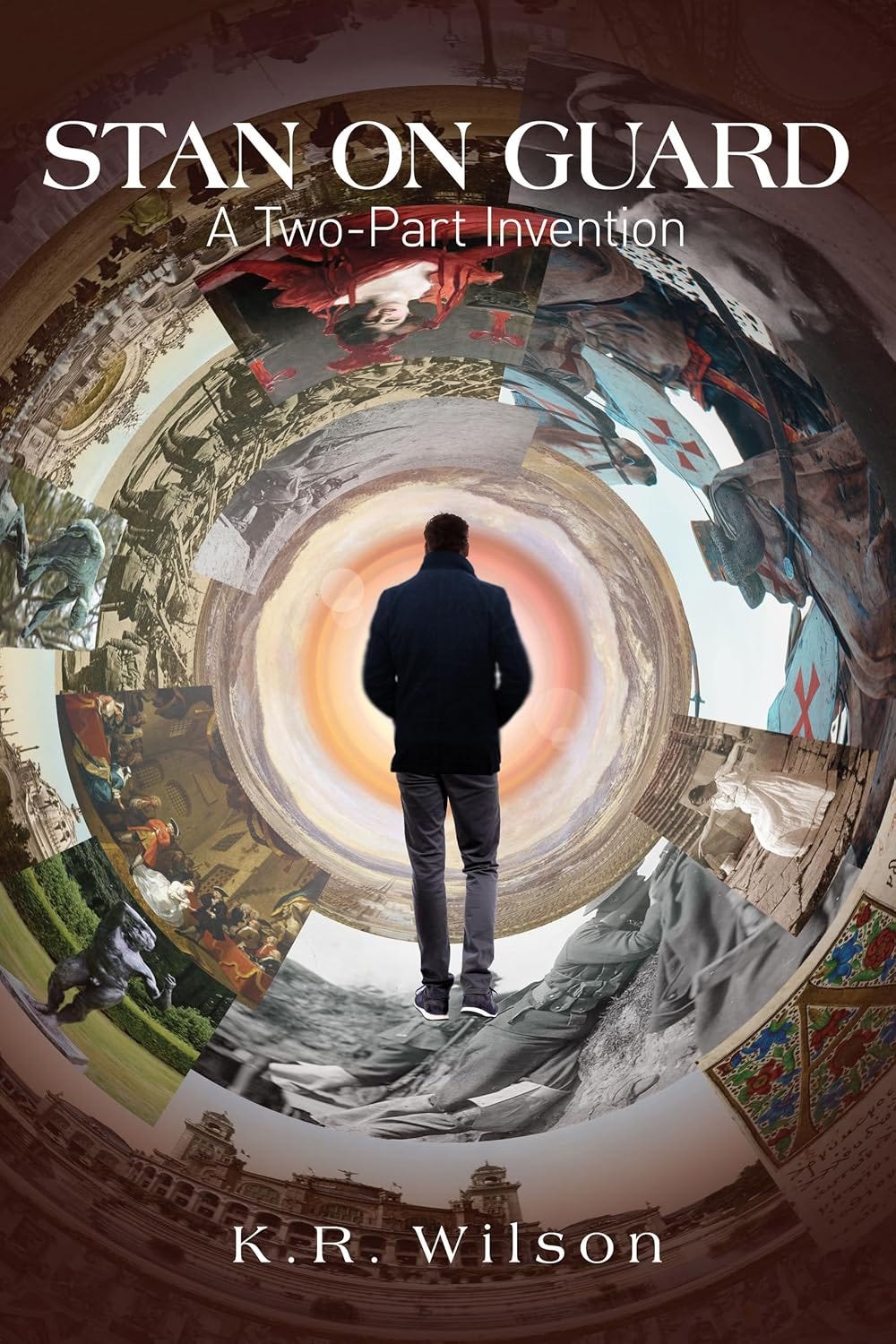
An “invention,” as it appears in the title of K. R. Wilson’s new novel Stan on Guard: A Two-Part Invention (Guernica Editions, 2026), can pertain to a piece of music usually made up of two-part counterpoint, as well as to a work of the imagination. Both definitions apply to Wilson’s highly compelling book.
The novel itself – a sequel to Wilson’s previous book Call Me Stan: A Tragedy in Three Millenia (Guernica Editions, 2021), which was longlisted for the 2022 Leacock Medal for Humour – consists of dual first-person narratives by Ishtanu (Stan), a Hittite immortal, and Tróán, an immortal Trojan princess, who is searching for Stan across time and history to avenge the death of her son.
Although immortal, Stan can technically die and Tróán thought she had done the job in post-war Berlin. Upon discovering that she hasn’t (after Wilson’s account of Stan’s story went public) the chase is back on.
To return to the musical definition of “invention,” the two-part counterpoint might refer to how this genre-bending novel bounces between being historical and science fiction. It can also refer to the characters themselves and their distinctive voices. Stan often opts for an ironic tone, lapsing into modern idioms no matter which historical era he finds himself in. Describing the popularity of castrati in music during the late 17th century in the central German state of Thuringia he says, “I never knew a more debauched crew. Not until the rock scene of the seventies. The nineteen-seventies, that is. At my age I have to specify.”
Later on, in 1889 in the German university town of Jena after a suicide attempt, he decides to commit himself to a mental institution (where he later meets fellow inmate Friedrich Nietzsche). He ends up opting for an expensive private room, reasoning that: “I was going to be there a while. I had money. It was kind of a no-brainer. Which was handy. My brain wasn’t at its best.”
Tróán, on the other hand, is much more serious and business-like. Her first-hand account of meeting Odysseus (with whom she also had a bone to pick for sacking her home) begins, “I’ve told this story before, the way it happened, over hearths and campfires across the Greek speaking world. People ate it up. I’m a good storyteller. But the men who retold it over the following centuries didn’t care for it as it was. By the time someone wrote their retellings down, the thug had become wise Odysseus, great-hearted Odysseus, Odysseus the kingly man. Crap. Let me set the story straight.”
But Tróán is also capable of a wry sense of humour, in evidence when she relates her time in Paris during La Belle Epoque. There she meets many of the era’s luminaries, including the celebrated sculptor Auguste Rodin, to whom she finds herself attracted. About one of his most famous works she says: “You’ll have seen Le Baiser translated into English as The Kiss. Which is perfectly correct. But the French term, at least at the time, also had more erotic connotations. Which was perfectly correct. I mentioned before that my body knew when it was time for something else. Now that something became more specific. I took control. ‘Do you have a room nearby?’ He did. Men are so easy.”
Meanwhile, in present-day Toronto, Stan is collaborating with a top geneticist on some secret project as Tróán strives to track him down online.
Adding to the contrasting elements of the two narratives is a typographical distinction in the book’s design. Each character’s section has its own font. While I could not find any definite information as to the exact styles, Stan’s seems to be something akin to Times New Roman, while Tróán’s has the plainer look of Arial.
But another layer of the novel’s two-part invention that I found most interesting was the contrasting themes of culture and war as a way of looking at the broad sweep of history that this saga encompasses. Aside from the eras named earlier, Tróán relates her time as a translator in pagan Lithuania during the native resistance against Papal crusaders, while Stan reveals that he fought in the German army during World War I and how he bluffed his way to Toronto disguised as a brain-injured Canadian vet.
The war that culture wages on society’s stubborn mores at any given time. The culture that insinuates itself in the men and women who are caught up in the horrors of war. While Stan and Tróán experience these in different ways, it is the interchangeable natures of culture and war (like twin serpents swallowing each other’s tails) that perceptibly take their toll on the humanity of our two immortals as they search for meaning where there is none. As Nietzsche, in his clear-eyed madness, says, “In fact, now that God has abdicated, I’ll be ruling the world.”
It’s always been my opinion that the driving force behind literature isn’t so much the what as it is the why. The why, without a doubt, is a personal passion for science, the arts and for history that K. R. Wilson has invested in Stan on Guard: A Two-Part Invention. But most of all he brings a determination to expose how our impulses – those that are destructive and those that are uplifting – mesh, if not seamlessly, then relentlessly to inspire both hope and despair in equal measure.

About the Author
K. R. Wilson’s novel An Idea About My Dead Uncle won the inaugural Guernica Prize in 2018, and his novel Call Me Stan was long-listed for the 2022 Leacock Medal. His work has appeared in various literary journals and the flash fiction anthology This Will Only Take a Minute.
About the Reviewer
Steven Mayoff (he/him/we)* was born and raised in Tiohtià ke/Montreal and has made Epekwitk/Prince Edward Island his home since 2001. His fiction and poetry have appeared in journals across Canada and the US, as well as in Ireland, Algeria, France, the UK and Croatia.He has had four books published: the story collection Fatted Calf Blues (Turnstone Press, 2009), which won a 2010 PEI Book Award, the novel Our Lady Of Steerage (B&B, 2015, ) and the poetry chapbook Leonard’s Flat (Grey Borders Books, 2018), and the full-length poetry collection Swinging Between Water And Stone (Guernica Editions, 2019; revised edition, Galleon Books 2025). Steven has also written lyrics, librettos and collaborated on scripts for radio and the stage.
Book Details
Publisher : Guernica Editions
Publication date : March 1 2026
Language : English
Print length : 200 pages
ISBN-10 : 1778490123
ISBN-13 : 978-1778490125