


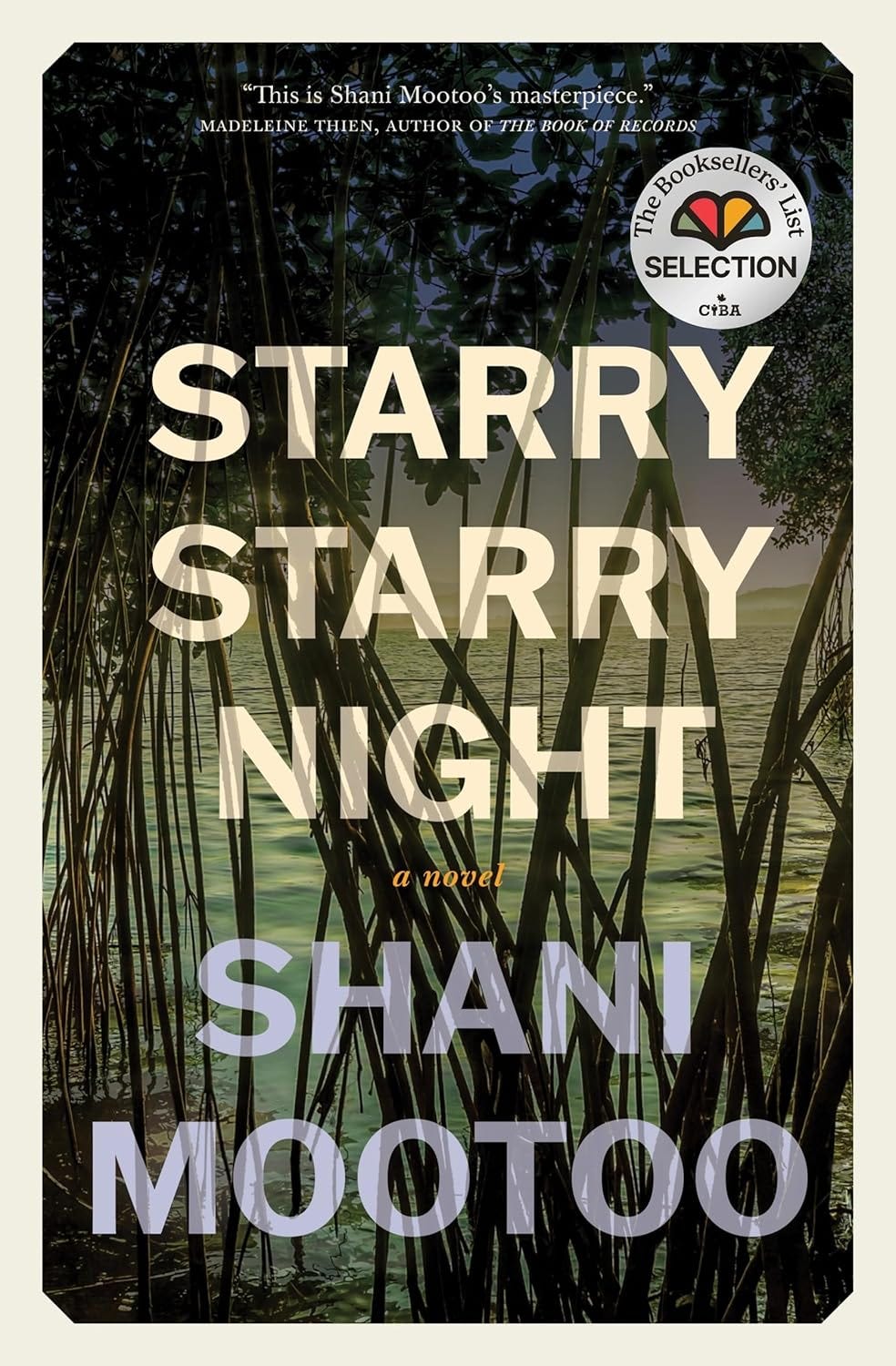
In Shani Mootoo’s Starry Starry Night, six-year-old Anjula Ghoshal lives with Ma and Pa in their house on Selvon Street in Trinidad. She is happy. She does not understand why she must go live with strangers she must call Mummy and Daddy, with Tara and Anil, whom she is told are her brother and sister. In fact, she resists leaving Ma and Pa and must be tricked. An overnight stay yields to a weekend away, and then a week, after which Anju is told that Ma is sick and she cannot go back. It will be six years before she finally relinquishes hope, and then, she must because there is no alternative. While she grows attached to the family she did not know she had, particularly Daddy, she never feels for them the unconditional love and duty of care she feels for Ma and Pa.
“Mootoo masters the stream of consciousness of a child as we follow Anju through a series of personal upheavals against the backdrop of Trinidad’s political evolution toward independence.”
Mootoo masters the stream of consciousness of a child as we follow Anju through a series of personal upheavals against the backdrop of Trinidad’s political evolution toward independence. The narration veers, with its young protagonist’s attention, from people to sudden sounds or smells to … anything at all. It’s an intensely deep point of view and invites the reader to make sense of the world along with Anju.
Anju, who much prefers Andru, please, becomes an artist, an actor (in school plays), and eventually, a stage magician. Through these creative experiences, she begins to negotiate her relationship with gender and sexuality but is continually thrust back into the box labelled “girl” by her conventional family, especially Mummy.
As Anju grows older, her inner monologue matures as well. When she is six, she instinctively keeps silent, out of fear and uncertainty. Later, she gains enough self-awareness to think it is wiser to remain silent. Later still, she begins to articulate the reasons she should refrain from comment. Finally, when a family situation triggers her past trauma, and she speaks without thinking, Anju learns a painful lesson and recommits to her stoic ways. Anju also lives through her senses and is often overwhelmed, particularly in her earliest years. She quickly learns to mask her meltdowns.
More than anything else, Anju is a keen observer of her world and people. As the novel progresses and Anju grows older, she becomes increasingly critical of Mummy’s mental health challenges and her sister Tara’s blind acceptance of all things girlie. She admires Daddy and his desire to legalize abortion. He is a doctor and a politician, and Anju aspires to be like him.
Each section of the novel is named for the street on which each successive house Anju lives in through the six years covered by the novel. Selvon Street is home. It is Ma and Pa, and Anju longs to return to this idyllic state throughout the novel. Marabella is the first home where she lives with her birth family. It is close to an industrial area and the pollution assaults Anju’s senses. She plots escape to Selvon street but can never put her plans into action. Marabella is a place of learned helplessness, the place she first encounters death and the effect it has on her family. Lever du Soleil East is the house Daddy builds on land that Pa helps him select. It is the place she is objectively the happiest in, second only to Selvon Street. Anju still clings to the hope of returning to Selvon Street and Pa, but now it is to take care of him, as she watches his slow decline and worries. Lever du Soleil East is the last house Anju lives in in this novel and carries her to the cusp of adolescence.
Throughout, Anju gazes at the sky and the stars as she tries to make sense of her world.
Starry Starry Night is a work of autofiction and a compelling coming-of-age story of love and loss and disillusionment, which leaves the reader wondering, along with Anju, “If everything dies, why does it have to go through the whole of living to get to dying?”

About the Author
SHANI MOOTOO is the author of six novels, three collections of poetry, and one short story collection. She is a four-time Giller Prize nominee, and her work has been long and shortlisted for the Booker Prize, the Lambda Literary Prize, and the IMPAC Dublin Literary Award. She has been awarded the Doctor of Letters honoris causa degree from Western University, is a recipient of Lambda Literary’s James Duggins Outstanding Mid-Career Novelist Prize, the Writers’ Trust Engel Findley Award, and Library and Archives Canada Scholar Award. Mootoo was born in Ireland, raised in Trinidad, and lives in Southern Ontario, Canada.
About the Reviewer
Melanie Marttila (she/her) is an #ActuallyAutistic SFF author-in-progress, writing poetry and tales of hope in the face of adversity. Her poetry has appeared in The /tƐmz/ Review, Polar Starlight, Sulphur, and her debut poetry collection, The Art of Floating, was published in 2024 by Latitude 46. Her short fiction has appeared in Through the Portal, Pulp Literature, and On Spec. She is a settler writing in Sudbury, or ‘N’Swakamok, on Robinson-Huron Treaty territory, home of the Atikameksheng Anishnawbek and the Wahnapitae First Nation, in the house where three generations of her family have lived, on the street that bears her surname, with her spouse and their dog.
Book Details
Literary Fiction / Autofiction
Book*Hug Press
Publication Date: September 23, 2025
372 pages
ISBN 9781771669566

This looks beautiful.