


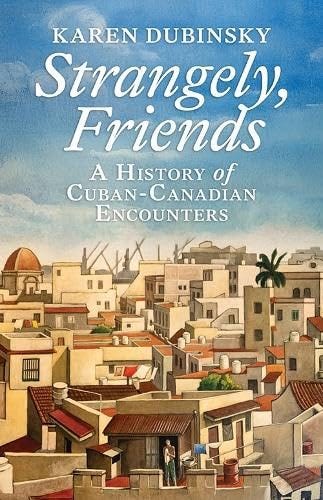
Canada, along with Mexico, was one of the few countries in the Northern Hemisphere that did not cut ties with Cuba after Fidel Castro came to power in 1959, maintaining diplomatic and economic relations. Despite that, as Karen Dubinsky notes in the introduction to Strangely, Friends: A History of Cuban-Canadian Encounters, there has not been much formal study and research on the relationship between Canadians and Cubans.
Strangely, Friends aims to help redress that lack, though Dubinsky acknowledges that the book is not all-inclusive. Some aspects, such as relationships made through sport, for example, remain to be explored in other volumes, perhaps by other authors.
“As someone who has never been to Cuba, I found the book informative, and felt it gave me a broader appreciation for Cuban culture.”
While Strangely, Friends explores many links between Canadians and Cubans focusing on development projects, education, and musical ties, it does so mainly at the person-to-person level. As a result of extensive interviews, deep dives into various archives in Canada and Cuba, and researching the personal papers of some of the individuals profiled, Dubinsky is able to provide a nuanced flavour for the ways Canadians and Cubans have connected over the years. Strangely, Friends includes a number of photos to support the text.
Among those profiled are engineering professors, Canadians who worked in Cuba for organizations like CUSO (Canadian University Service Overseas), musicians, and artists. Strangely, Friends explores the story of Bella and Paul Skup, educators, researchers, and tour operators who lived in Cuba intermittently from 1962 on. Dubinsky also discusses the life of Harry Tanner, who was born in Cuba while his father was a Bank of Nova Scotia manager and stayed after the revolution to become a filmmaker and painter in Havana before returning to Canada in the 1980s.
Strangely, Friends discusses agricultural collaborations between Canada and Cuba. These included, among other projects, efforts to facilitate the development of a crossbred cow (Canadian Holstein crossed with Cuban Cebu) suited to Cuba’s climate and conditions. Beyond CUSO, Dubinsky explores the contributions made by other Non-Governmental Organizations (NGOs) such as Oxfam Canada, as well as the person-to-person donations of medicine, sports equipment, musical instruments, and other items.
Strangely, Friends provides insight into what it was like for Canadians to live in Cuba at various points in history. Dubinsky also gives the perspective of Cubans who have relocated to Canada, for short or long periods of time.
The part of the book I found most engaging was the extensive discussion of music. This section highlighted many Cuban and Canadian musicians, exploring their impact on one another, as well as providing plenty of first-person discussion of experiences.
In her depictions, Dubinsky is even-handed, pointing out where Canada has made positive contributions while also resisting the temptation to paint everything as good. She includes the viewpoints of Cubans as well as Canadians, providing a well-rounded picture. As someone who has never been to Cuba, I found the book informative, and felt it gave me a broader appreciation for Cuban culture.
Dubinsky is well suited to write a book of this nature. She is a Canadian historian who co-taught a Queen’s University course in collaboration with the University of Havana for fifteen years. This course involved annual travel to Havana with thirty-plus students. Dubinsky has also hosted Cuban academics, artists, and musicians, as well as teaching Cuban graduate students. In all, she has a forty-year history with Cuba, including two sabbatical terms spent there.
Strangely, Friends notes that since the 1990s, Cuba has been the fifth-most-popular travel destination for Canadians. As a result, there is a lot of interest in Cuba here. Canadian readers who have travelled to Cuba and wish to explore the relationship between our countries more deeply, or those who have never been and are simply seeking to get a flavour for that relationship, should find this book of interest.

About the Author
Karen Dubinsky is a historian at Queen’s University. Between 2008 and 2023, she co-taught and coordinated a university exchange program on Cuban culture which brought Canadian students to the University of Havana and Cuban artists and academics to Canada. She is co-host of Cuban Serenade, a podcast about Cuban musicians in Canada and hosts the CFRC radio program Cuban Sounds in Canada. Her previous books include studies of transnational adoption, Canadian cultural history, and Canadian-Global South relations. She lives in Kingston, Ontario.
About the Reviewer
Ontario resident Lisa Timpf writes poetry, book reviews, short stories, and creative nonfiction. Her speculative poetry collections Cats and Dogs in Space (2025) and In Days to Come (2022) are available from Hiraeth Publishing in print and electronic formats. You can find out more about Lisa’s writing projects at http://lisatimpf.blogspot.com/. Lisa is also on Bluesky, @lisatimpf.bsky.social, and her author Facebook page is @lisa.timpf.author.
Book Details
Publisher: Between the Lines
Publication date: Sept. 23 2025
Language: English
Print length: 292 pages
ISBN-10: 1771136871
ISBN-13: 978-1771136877