


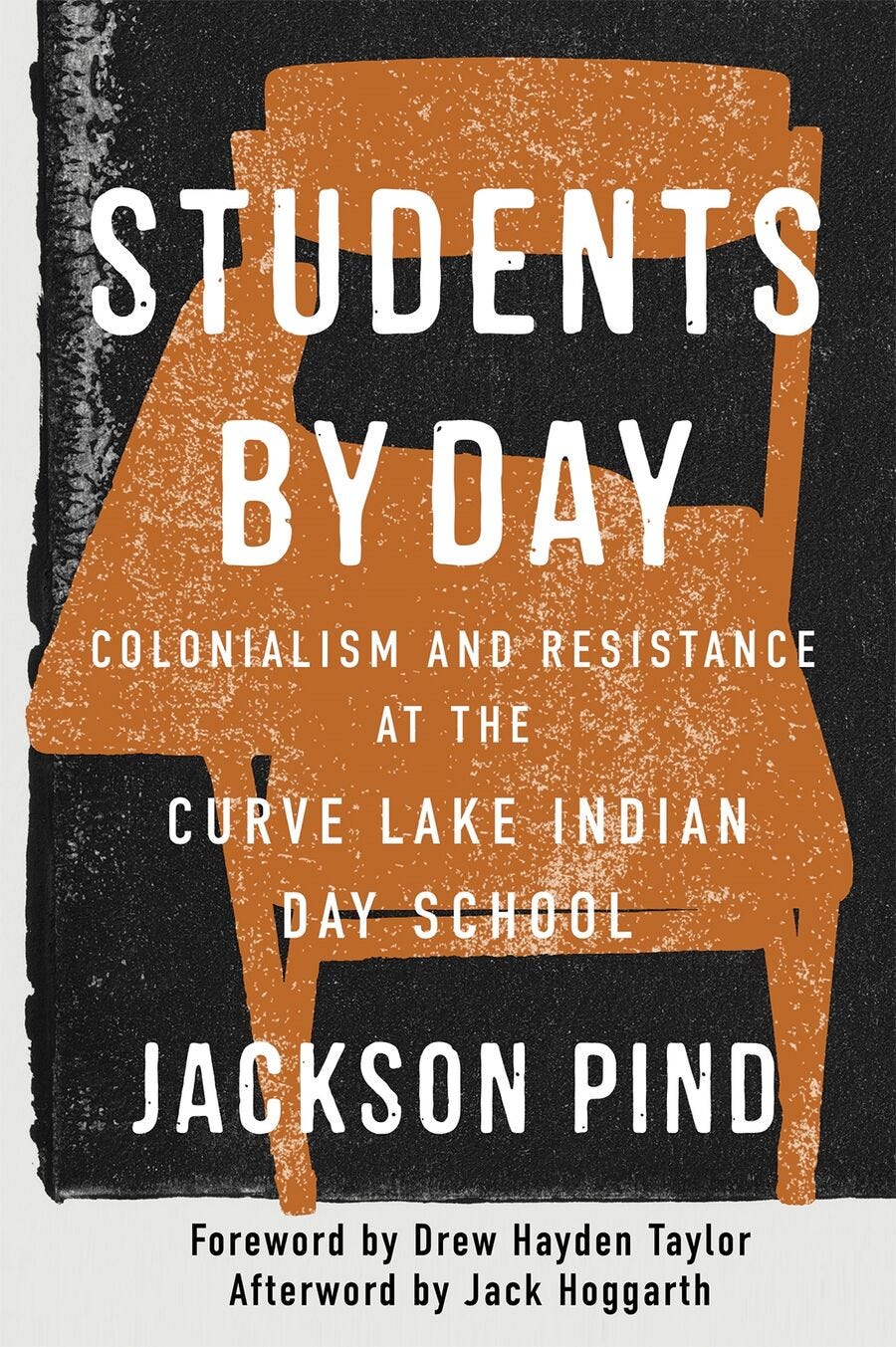
The experiences of Indigenous students at Indian day schools have received little attention, though close to 700 of these were operated by the Canadian government and the Church during the late nineteenth and twentieth centuries. These schools, located on-reserve and sometimes staffed by Indigenous teachers, were conceived as part of an overall assimilationist programme. English-language instruction in a schoolhouse setting served to displace Indigenous tongues and to disrupt traditional patterns of learning, daily rhythms, and social relationships, while inculcating settler worldviews via standardized curricula.
In Students by Day, Jackson Pind presents a case study of the Curve Lake Indian Day School, which operated on the Mud Lake Indian Reserve from 1886 to 1978. Pind, who is of mixed settler and Anishinaabe descent, grew up near but not on the reserve. He locates himself as holding a distinct relationship to the local lands and waterways, based on his personal and family history, one that incorporates settler perspectives on industrial and recreational uses of land and water alongside relational Anishinaabe views. He maintains awareness of his dual, insider-outsider positioning in undertaking research together with the Curve Lake First Nation.
Pind’s methodologies combine archival research with oral history. In co-creating this research with the Curve Lake First Nation, he’s been able to return to the Nation a digitized, searchable database of their own archival records related to the school, offered in reciprocity for their work with him. The work is individual and personal; he “acknowledge[s] that each Indigenous person’s identity and understanding of the Indian day schools was created in the context of their personal social experiences, and so may be completely different from other Survivors. Therefore, this book will not generalize the experience of Indian day schools in Ontario; rather, it will seek to highlight the relationships between the institution and individual Indigenous people within that system.”
Those individual experiences exhibit substantial variation and are not without their humorous elements. One early 1910s teacher, Mr. Prosser, was reported to spend much of the day asleep in the classroom. The school inspector’s report stated, “I fear he is indifferent and lazy and that it would be in the best interests of the Department to allow him to devote all his time to the education of his trick bear,” this being a circus animal kept by Mr. Prosser and displayed at nearby fairs. This report was not the end of the matter, however, and the teacher served nearly two years before tendering his resignation. At times, internal disagreements about the fitness of specific teachers divided the community. As early as 1916, Chief and Council were asking for a First Nation school board so as to have authority in hiring decisions, but the government was unwilling to entertain the concept at that time.
Through the 1920s and 30s, the school suffered overcrowding, understaffing with high turnover, low standards, and dilapidated facilities. As parliamentary approval had to be sought for most upgrades, even vital building repairs could languish indefinitely. The Department appeared tightly focused on cost factors, to the point of questioning the janitor about excessive wear-and-tear on brooms. As industrial activity expanded in the area in the 30s and 40s, the curriculum tended toward a narrowed vocational focus. In Pind’s phrasing, “The systemic underfunding and neglect of schools like Curve Lake reflect the broader national policy of using education as a tool for dispossession designed to erode Indigenous cultural ties while redirecting labour into the settler economy. Across Canada, the emphasis on manual training and basic education reinforced a system where Indigenous children were prepared only for subservient roles within the capitalist economy, ensuring the continuation of colonial dominance while minimizing state expenditures.”
Former students interviewed by Pind who’d attended in the 1950s and 60s remember corporal punishment (“the strap”), religious instruction, and rote learning emphasizing “the three Rs.” They felt alienated by Dick and Jane readers that had no bearing on their everyday lives. (In reading these recollections, I was brought back to memories of my own time in Yukon public schools in the 1980s, when the strap had been phased out but lived on as a vaguely remembered threat, and we began each day with the Lord’s Prayer followed by “God Save the Queen”.) One former student named Stanton Taylor recounted how he would skip school to spend the days with his grandparents, who were happy to collude in his absenteeism while teaching him traditional skills of hunting, trapping and fishing. “I did more learning up there than I ever had in school, you know,” he explained in his interview with Pind. “That is something you never forget, it becomes a part of you … while the [day] school became a part of me that I didn’t like, almost like my enemy.” Meanwhile, another former student who had excelled in school felt she was always walking between two worlds, aware she had to carry herself “in a non-threatening, reticent way” and tamp down on her presentation of Indigeneity in order to travel this educational pathway.
In the late 1970s, the community gained autonomy regarding education for its youth, with greater integration of linguistic and cultural activities—some 60 years after their initial requests for a local, Indigenous school board had first been rejected. While this demonstrates the resistance and resilience of the Curve Lake First Nation, it has come only after great cost. Jackson Pind and the former students whom he consulted for this research have done valuable service in gathering together documentation of one Nation's experience with day schools. While he’s at pains to note that this case cannot be generalized, it provides a powerful illustration of how systemic forces operate on the ground. The Curve Lake day school is history, but the complex experiences of Indigenous students in Canada’s public schools are ongoing. Much of what Pind recounts here feels distinctly aligned with points made by the Yukon First Nations Education Directorate in their 2025 report on systemic racism in Yukon schools, for example. Different time, different place, but systems have a life beyond their obvious structures. The work of reconciliation has only just begun.

About the Author
Jackson Pind is assistant professor of Indigenous methodologies at the Chanie Wenjack School for Indigenous Studies, Trent University.
About the Reviewer
Dawn Macdonald lives in Whitehorse, Yukon, where she grew up without electricity or running water. She won the 2025 Canadian First Book Prize for her poetry collection Northerny. She posts weekly at Reviews of Books I Got for Free or Cheap (on Substack), as well as reviewing for journals and for The Seaboard Review of Books.
Book Details
Publisher : McGill-Queen’s University Press
Publication date : Oct. 14 2025
Language : English
Print length : 282 pages
ISBN-10 : 0228026040
ISBN-13 : 978-0228026044
