

Tethered Spirits by Corinne Hoebers
Wiaqtaqne'wasultijik na Kjijaqmijinaq

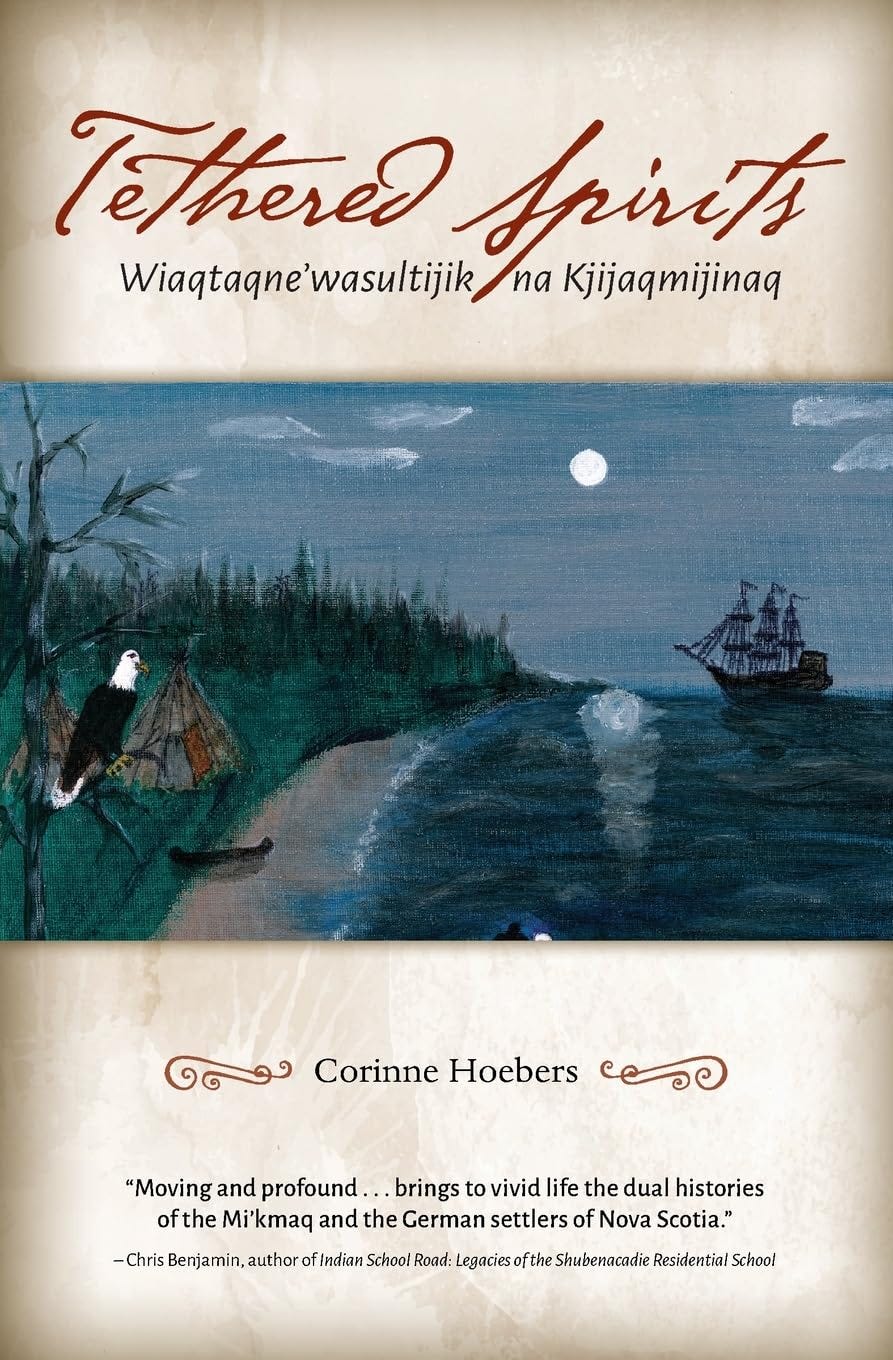
Corinne Hoeber’s passion for history, and her status as a direct descendant of one of the first German settlers of Lunenburg, led her to write Tethered Spirits, a comprehensive and absorbing historical novel. By working closely with members of the Mi’kmaw community, she was able to bring this fictional account of the interactions of the two communities to life. The detail and dialogue in the book are remarkable; a moving and valuable portrait of Nova Scotia from 1756 to 1761.
The novel opens with Bear Cub and his Mi’kmaq family, who, four years earlier, had found him near death and nursed him back to health. Prior to becoming “Bear Cub,” he was known as “Christian” to his German family who has since believed him to be dead. When Bear Cub runs into a family friend, he is persuaded to come back to Lunenburg to let them know he is alive and well. Doing so leads to unforeseen consequences for Christian and both of his families.
Tethered Spirits profoundly highlights the relationship between the settlers and the Mi’kmaq of the area; the friendships that flourished, as well as the hostilities. Hoebers crafts the story in a way that evokes compassion for both sides, but primarily for the desperate situation the Mi’kmaq find themselves in when their fishing and hunting grounds get cut off and the area in which they feel free to hunt and forage shrinks significantly. The overpopulation of the land means that they are forced to trade for food and become reliant on it for survival, creating an unwanted dependence on the settlers.
“… the new habitation was restricting their movements, making it more difficult to gather food safely. To continue trapping along the familiar trails and fishing by the rivers was treacherous. Sneaking around their own hunting and fishing grounds was inconceivable, but slinking they were.”
As I read this novel, I was struck by the violence that went on in the province at that time. Innocent people on both sides living in fear for their lives, never knowing when they might come under attack. The war between the French and English was also ongoing, concentrated in Louisbourg, but with a ripple effect to the rest of Mi’kma’ki. I was also struck by just how dire living circumstances became for the Mi’kmaq once the coast of Nova Scotia became populated with settlers who were claiming the land as their own and prohibiting the use of it by the Mi’kmaq. At the same time, they were suffering from attacks, some resulting in whole villages being burned to the ground. The new circumstances weighed on the minds of the Mi’kmaq leaders who were hesitant to turn to violence to solve the problem but also couldn’t think of another way out.
“If we resist, more of our People will die. If we do not, we are trapped under English control. Either way, we lose.”
It is one thing to know about the circumstances in which the Mi’kmaq found themselves as Europeans began to populate the area, another entirely to be immersed in it through thoughtfully written fiction. The pain and frustration felt by the People is palpable and heart-wrenching. As Corrine Hoebers writes in the author’s notes at the end of the novel, “While it is not possible to fully comprehend the emotional complexities of our ancestors, an attempt to do so is crucial to the telling of our shared history.” Hoebers also writes, “What if the newcomers had chosen the path of discernment, humility, and respect? How vastly different the story could have been.” What if, indeed.
“It was as if everyone was completely devoid of empathy as they blindly went about their business, sheltered within their own self-righteousness.”
This novel can feel heavy at times but includes moments of joy and lightness. Hoebers writes about the natural world and the habits of the surrounding wildlife, she includes interesting facts about both settler and Mi’kmaq societies of the time, as well as scenes of peace and friendship between characters. The very act of writing this novel signifies hope for future generations. Highly recommended.
About the Author
A member of the Writers’ Federation of Nova Scotia, Corinne Hoebers lives in the Annapolis Valley with her Dutch husband and a British Blue cat named Toby who is happiest when he is fed, loved, and has a clean litter box and a warm lap. Corinne and her husband have four grandchildren.
About the Reviewer
Naomi MacKinnon lives in Truro, Nova Scotia, with her family. She’s the happy duck behind The Happy Duck Bookshop & Readery, where she’s able to share her love of books with whoever walks through the door. Naomi can also be found talking about books online at Consumed by Ink.
Book Details
Publisher : OC Publishing
Publication date : Oct. 18 2025
Language : English
Print length : 440 pages
ISBN-10 : 198983356X
ISBN-13 : 978-1989833568
 | A guest post by
|