

The Alice Zorn Interview
An Interview by Sharon Berg, TSR's Resident Interviewer

Sharon Berg: Alice, I was impressed by the range of storylines in Mind the Gap. You explore a variety of characters in their particular situations: Claudia who is lovingly adopted in Canada but remains curious about her Mexican birth mother; city boy Ian who tries to rediscover his purpose with acquaintance Zeb in rural Gaspé after his wife leaves him; Canadian Barbara analyzing her long relationship with her Austrian cousin Freddy. Each of them discovers details they don’t expect, in places distant from their home environment, and each time you make that distant environment come alive for your readers. Do you, the author, have to visit a place in order to make it come alive and give the reader a sense of being there?
Alice Zorn: Your question makes me think of the famous example of the Brontë sisters who lived isolated on a moor, with seemingly no experience of romance, and yet they wrote novels of heartbreaking passion. They used their imagination. Yet even the Brontë sisters set their novels in the moors and local towns they knew. Unique details of place help make a story feel real. Indeed, I visited the places in these stories and I look for those details. The layout of a town, the buildings, how people dress, what they eat, conversations I overhear, scenes I witness. I return from trips with a fat notebook and many photos. I don’t always know what story I’m going to write, but when I get an idea, I can situate it. Being in a place can also suggest a story. For example, when I was in Mexico City and I visited Frida Kahlo’s house, I saw a young woman with a spinal disorder who was having difficulty walking, but she was determined to walk from room to room. “Frida Walks” is the story I imagined for her.
“What I hope to do with these stories is to invite the reader to leap across.”
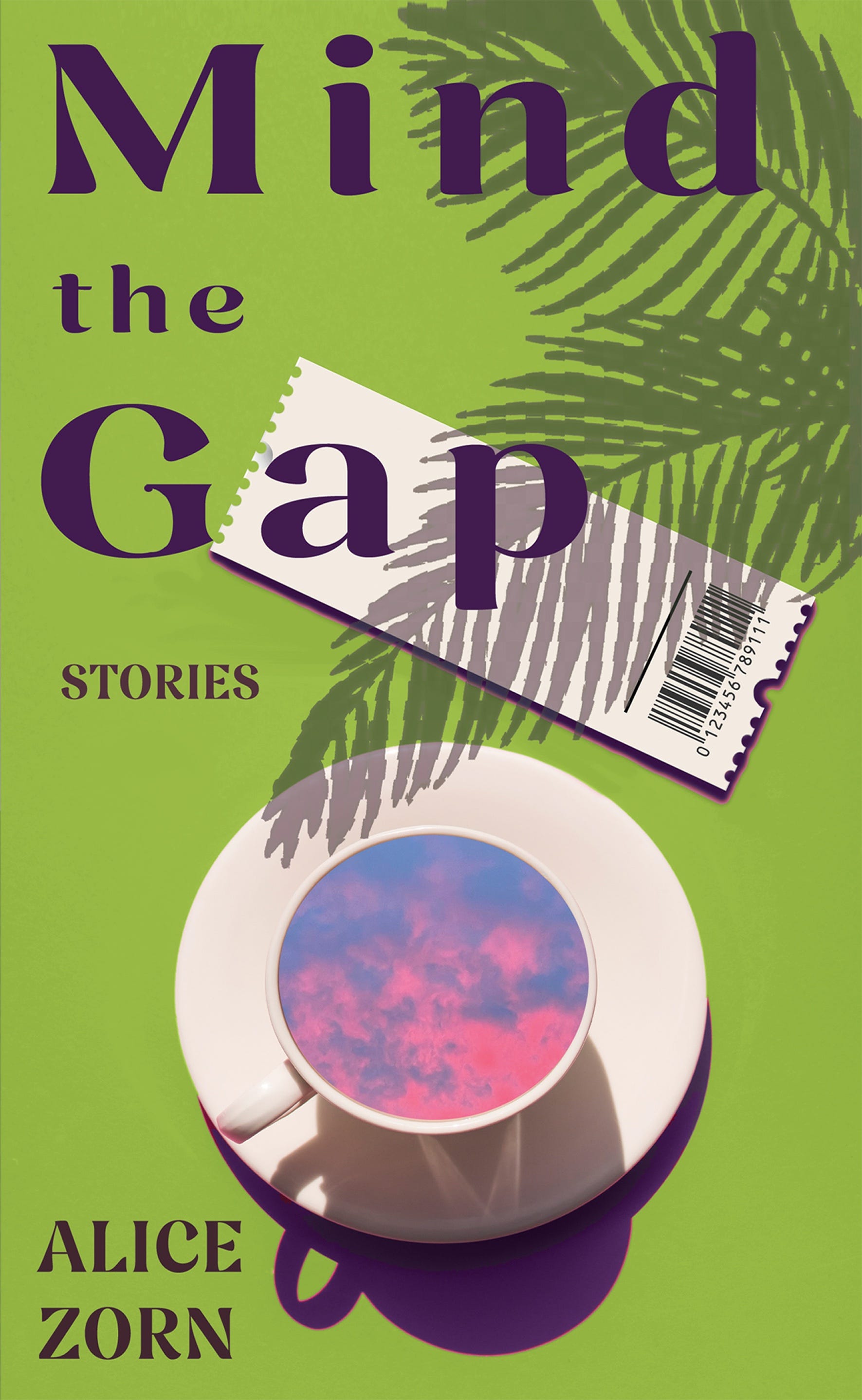
SB: I must admit to being inordinately curious as to your choice of a title for Mind the Gap. Is it due to the inability of one person to fully grasp any other person’s true perspective on life? If so, that seems to run counter to your literary pursuit, in various tales, to give your readers a taste of visiting cultures from around the world? Or are you highlighting the need for folk to make a serious effort to understand one another?
AZ: That’s an interesting question. I think there’s a gap between different cultures—that’s why we’re different—but it’s only a gap, not a chasm. What I hope to do with these stories is to invite the reader to leap across.
SB: In other words, you’re speaking of diversity rather than cultural gaps? I can see that. In each of your stories, the difference between the characters and the way they grate on each other or find harmony seems to be a focus, whether they’re from different genders, culture groups, or abilities. I can’t help observing just how observant you are about people, their emotions, and the way they interact, even as you offer the details of their environment. So I’m compelled to ask, do you find it easier to describe the conflicts that arise between people or to make their enjoyment of a particular activity together appeal to the reader? Is there a difference?
AZ: Thank you for appreciating my observations about people. To answer your question, I’ll back up a step. I find it makes a story more dynamic when a person has a dilemma. It doesn’t have to be a big D dilemma. It can be a secret that haunts them, an answer they need, an unexpected task. For the story to progress, the person needs to deal with the dilemma, and sometimes that leads to conflict—which hopefully can be resolved. But I’ve also shown togetherness. Although Claudia argues with her parents, she has a close friendship with Almaz. Although Vance feels bitter about how his wife left him, he later remembers dancing with her in the kitchen. Bev and Nessa, travelling in Morocco, have lots of points of contention, but they also know each other very well.
SB: You speak of many locations in this book, offering how the details of place affect the characters. This brings me to ask, Where do you live? Is it an urban or rural setting? Do you feel anything about the environment surrounding you impacts upon your writing? Is it wide open spaces? Or maybe crowds of people? Please explain how the environment around you affects your approach to writing.
I can work in a café, on a park bench, or on a train, but I prefer to be alone and for the room to be quiet. For most of the year I live in Montréal in what used to be a working-class neighbourhood called Pointe Saint Charles. We moved here in 2001, just when it was beginning to be gentrified. After ten years of witnessing the changes in the neighbourhood, I decided to write about it. The gentrification of the Pointe became the social context and setting for my novel, Five Roses. I also spend three or four months a year in northeastern Québec on the Gaspé peninsula. The setting is rural and Maritime. To date I’ve published two stories that are set there. One won first prize in Prairie Fire’s 2006 Fiction Contest. Another was also published in Prairie Fire and is included in Mind the Gap. The other stories in Mind the Gap are set in Morocco, Texas, Mexico, England, Austria, and Tunisia: all places where I’ve travelled. So yes, my environment has an impact on my writing.
“I wanted to explore how travelling—being a foreigner in a place where the language, culture, and values are different—can challenge our perception of the world and others, and how that reflects on who we are.”
SB: Environment, of course, is not just the physical place but the people who live there. So I imagine the struggles and conflicts they deal with would also have something of an impact on your writing, even if it’s only to recognize the emotional tenor of a neighbourhood or an event. If you had to describe the primary emotion that’s explored in Mind the Gap what would it be? Can you explain why you chose to focus on it? How close is this to the emotion(s) you dealt with personally on the subject of your book?
AZ: The primary emotion in these stories is what it feels like to be somewhere new. Some characters respond with curiosity, some with puzzlement, some with disorientation, and in at least one instance with hostility. I wanted to explore how travelling—being a foreigner in a place where the language, culture, and values are different—can challenge our perception of the world and others, and how that reflects on who we are. I believe that kind of questioning is always beneficial since it leads to a better understanding of others and ourselves. Is this an emotion I deal with personally? Yes, every time I travel.
SB: Of course, I recognize the phrase you’ve used, but titles are often difficult to come up with. What was your experience in developing a title for Mind the Gap? Did you try on a lot? How did you decide to eliminate other contenders?
AZ: I have no aptitude for titles! I can write a 300-page book, and after umpteen revisions I still don’t have a title that seems right. Ditto for each short story in this collection—except for “Frida Walks”. I always knew that would be the title. I don’t recall how or when I found the title for the story, “Mind the Gap”, but I guarantee that there were a couple of pages of possible titles that I rejected. My editor and I chose it as the title story for the book. You might wonder what I call the working files on my computer. Usually a joke title. The current project, a novel, is called Raccoons & Ruffles.
SB: So is this a book that seemed to fall onto the page quickly, as if it were channelled, or did you need to put a lot of effort into discovering its structure? Was there a developmental process for ordering the different stories? Please elaborate.
AZ: I don’t begin writing until I have a voice and an idea of where I’m headed, and then the first draft usually comes quickly. I don’t second-guess, I just keep writing. If it’s a short story, I write through to the end. If it’s a novel, I accumulate chapters. It is such fun! For me, the hard part comes next. Character consistency, holes to fill, cutting, restructuring, pace… There are many drafts. But: what I usually keep from the original draft are the images. If I first imagined a car rolling like a pea along a flat-ribbon highway in the vast expanse of Texas, then that’s how I always see it.
SB: Okay, well now that you’ve shared that visualization, I can imagine a whole lot of people seeing cars rolling like peas along flat-ribbon highways! That’s priceless! Shifting from the movement of cars to boats, I’d like to change tack a bit. Some books require intensive research of a particular topic, historical era, or some other aspect of the story. Please describe the most intensive research you did for Mind the Gap. Also, how far would you travel to conduct research? Do you perform most of your research through interviews, on the internet, or through books and printed documents?
AZ: The most intensive research that I did for this book was for the story, “The Land of Clouds”. Patricia, the protagonist, is a textile conservator. I was planning to write a novel about textile conservation and had already done some book and internet research. Next I needed to watch some textile conservators at work. In 2014, I asked the McCord Museum in Montréal if they would allow me into their conservation labs. They did and were very generous in explaining the work they do. That was where I saw the Inuit swan’s foot sewing pouch that I describe in “The Land of Clouds”. I also met with a freelance textile conservator, Joan Marshall, who talked with me about different projects and techniques. She was doing a treatment on a dress that later became the dress Patricia has on her worktable. In 2015, when I was in Vienna, I asked to visit the labs in the Institut für Konservierung. Again, I was welcomed and learned more about textile conservation methodology and techniques. I should add that I had a Canada Council grant to do the research and write the novel, and I’d asked them for a letter of introduction—and that certainly helped open doors! In 2017, when I went to Oaxaca in Mexico, I saw feather weaving in the Museo Textil. I was fascinated, did more research, and that gave me the idea for “The Land of Clouds”. Although I was primarily doing research on textile conservation for a novel, I couldn’t have written the story without having done that research.
SB: I can see your answer may help both readers and other authors to understand the level of commitment that is often involved in creating a novel or short fiction piece. As you must know, readers are also often interested in knowing how much of a work is invented by the author and how much is autobiographical. Would you care to share your approach or thoughts on this aspect of your readers’ curiosity?
AZ: I think it’s natural to wonder what parts of a story really happened. Decisions the characters face and what happens to them make readers feel sad or angry or happy. They might not want to feel that they got emotionally invested in a story that was made up. What I will say in response is that a well-crafted story can be more powerful and convincing than life. Part of writing a convincing story is to have true details, but sure, very often the story is invented.
SB: This may be a question about sequels, and certainly it’s hypothetical, but if Mind the Gap was burning and you could only rescue one character from that inferno, who do you think deserves the effort for a second chance at life? Please explain your choice.
AZ: I don’t think I can choose whom to save from a fire, but if you’re asking about sequels I can answer that. By definition, I believe short stories are an episode or slice of life. They’re complete in themselves. Even when they’re open-ended, the story is finished. However, a few years ago, I was considering applying for a writing residency in Mexico, and when I was thinking of a project I could work on while there, I considered beginning a novel with the story, “Born — Died”, as the opening chapter. I thought it would be interesting for Claudia to decide when she was older that, for her own peace of mind, she had to solve the mystery of her adoption. However, I decided not to apply for that residency, so that’s an idea that’s still on the back burner.
SB: Thank you, Alice, for all of your openness in answering my questions. I hope this interview inspires many more readers to dip into Mind the Gap.


About the Author
Originally from Ontario, Alice Zorn now lives in Montréal. She has published three novels: Arrhythmia (NeWest Press, 2011), Five Roses (Dundurn Press, 2016), and Colours in Her Hands (Freehand Books, 2024). Five Roses was shortlisted for the 2017 Ontario Library Association Evergreen Award, as well as translated into French. Her collection of short stories, Ruins & Relics, was a finalist for the 2009 Quebec Writers’ Federation First Book Prize. She has twice placed first in Prairie Fire’s Fiction Contest and won the 2013 Manitoba Magazine Award for Fiction. Her most recent book of short fiction, Mind the Gap, was published by NeWest Press in 2026.
About the Reviewer
Sharon Berg’s poetry and short fiction appears internationally (Canada, USA, Mexico, Chile, England, Wales, Amsterdam, Germany, Siberia, Romania, India, Persia, Singapore, and Australia). She’s released four chapbooks with BPR Press and three poetry books (Borealis Press, 1979 Coach House 1984, and Cyberwit 2020). Stars in the Junkyard was a 2022 International Book Award Finalist for Poetry. Her short fiction appears with Porcupine’s Quill and her nonfiction, The Name Unspoken: Wandering Spirit Survival School (BPR Press) won a 2020 IPPY Award for Regional Nonfiction. She became a popular interviewer during her work with Artisinal Writer (2021-2023) and The tEmz Review (2023-2026). She lives in Charlottetown, Newfoundland and operates Big Pond Rumours Chapbook Press.
Book Details
Publisher : NeWest Press
Publication date : April 15 2026
Language : English
Print length : 250 pages
ISBN-10 : 1774391341
ISBN-13 : 978-1774391341