


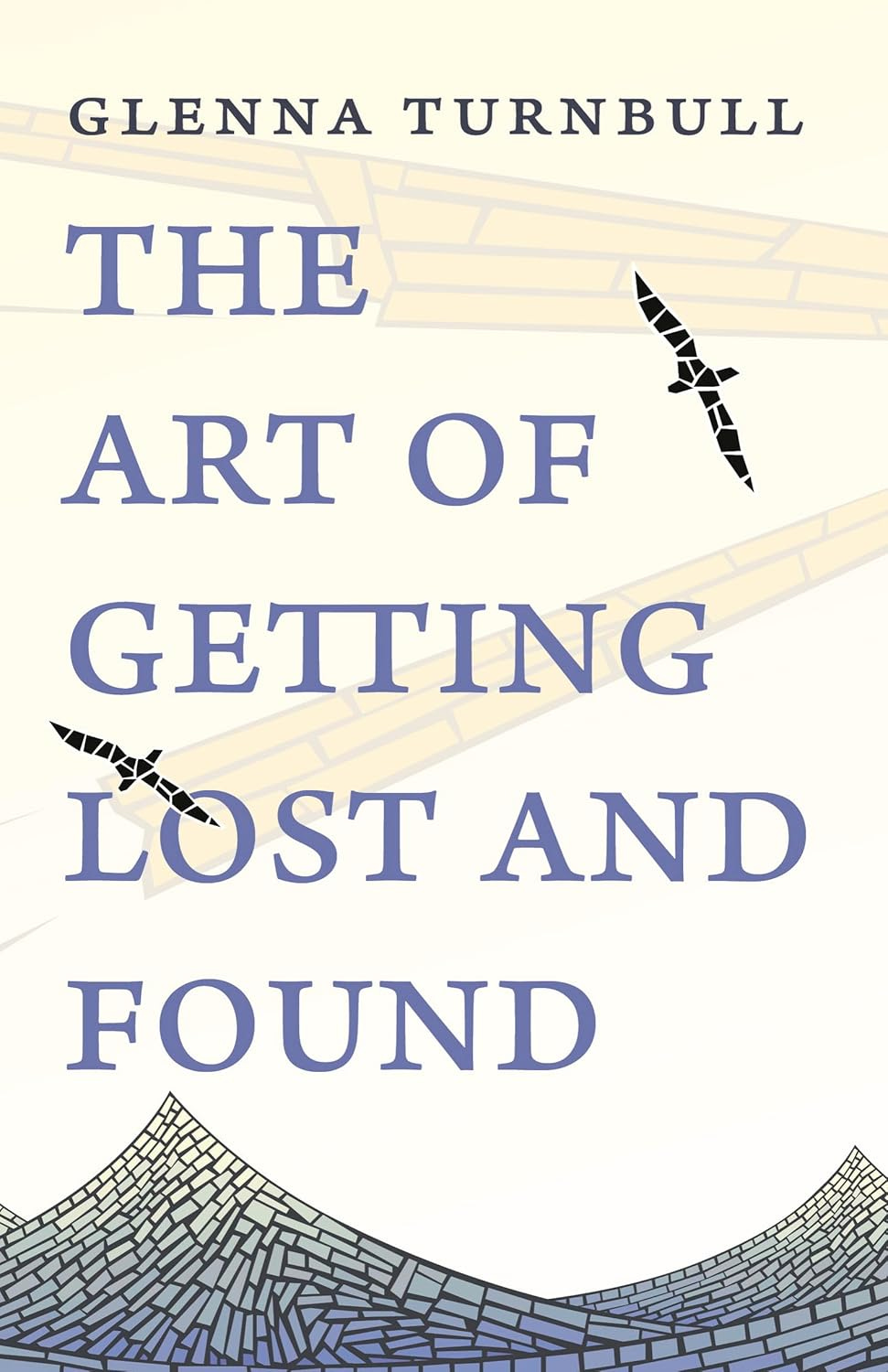
While Glenna Turnbull has previously published well-received short fiction, The Art of Getting Lost and Found is her first novel, one that clearly maps a successful future as a writer. This debut work tracks the lives of two women, one known as “Shorty,” in 1887 Newfoundland, and the other, Maggie, visiting her ancestral home there for the first time in 2017. Both women are victims of failed marriages, and each has to find a way to put the past behind her despite significant impediments. The problem of women having to escape intolerable situations is, unfortunately, all too common, and the contrast between the dilemma in the late nineteenth century and the early twenty-first makes for a compelling read.
The book employs two first-person narrative voices which are divided into separate chapters, so it is easy for the reader to distinguish between the two women by the details of their domestic lives 130 years apart, despite the fact that their speech patterns display no discernable differences. Too often, particularly when depicting Newfoundland characters, writers descend into spelled pronunciation (drop ‘h’ and add ‘s’) to establish their linguistic ancestry, although here the employment of some dialect might have been welcome. Persons living in the late nineteenth century did employ words and phrases not common in the early twenty-first century, if only when related to their domestic chores.
While there are obvious parallels between Shorty in 1887 and Maggie in 2017, it is impossible to ignore the vast differences there are between Maggie’s husband, who is insensitive and unsympathetic to his wife’s mental problems and indifferent to her suffering, and Shorty’s husband, who callously and violently beats his wife and eventually murders two of their small children. Shorty is very aware of the message that her bruises send to the neighbours, while Maggie has scars on her face that she is constantly referring to. It is not unreasonable to assume that Maggie, too, is a battered wife, so it comes as a surprise to find towards the end of the book that this assumption is incorrect.
The suggestion is that Maggie has lost her children in a vicious custody battle, but in fact it emerges that she just couldn’t face the battle and signed away her rights. Shorty’s situation is clearly worse--her husband is a vicious, controlling brute who works her and the children like slaves, refuses them an education, sexually assaults his eldest daughter, is clearly grooming the younger sister, and eventually kills two of the smaller children. In contrast, all we know about Maggie’s husband is that he is unsupportive of her artistic ambitions, and unsympathetic to her mental illnesses.
There are one or two puzzles in the course of the plot development. For example, one chore Shorty and the children are forced to do involves canning lobsters. Shorty comments on the way lobsters scream when dropped into the boiling water. Great Britain has recently made boiling lobsters alive illegal, as the shellfish have nerve endings and feel pain. However, lobsters do not have vocal cords, and they cannot shriek or cry, though occasionally a high-pitched whistle caused by air escaping from their shells can be heard. The screams of lobsters is the stuff of legend--ask anyone who has worked in a canning factory or boiled a few lobsters at home.
When Shorty finally decides she must escape with her children, she packs up as much of the household as she can while her husband is out hunting, and puts it all into his boat. Her plan is, if necessary, to take shelter in a puncheon down the shore and winter there with the children. A puncheon is a barrel, the largest of which can hold 140 gallons (ca. 636 litres) of molasses. How a mother and three children can hope to survive even an exceptionally mild Newfoundland winter in such a shelter defies imagination. In the closing pages of the book, we learn that this unlikely retreat features in the legend of how Shorty escaped and survived. As a legend, that detail isn’t unlikely, but as a factual element of the plot, which is how it is presented, it is simply impossible.
We are told that Maggie has a mental disorder which was presumably exacerbated by a drunken father and a controlling husband, but for this reader, these afflictions are not really parallelled by a vicious spouse who terrorizes the entire family, kills a baby son and throttles a crying four-year-old daughter.
Despite these puzzles, the book is a compelling and easy read, as long as you don’t mind repeated scenes of spousal violence. The lengthy “Acknowledgements” section at the end of the book reveals that the author “lived with mental health issues most of [her] life,” stemming from “early childhood trauma” and was a survivor of “extreme intimate partner violence.” One potential reader commented, wryly, that the book sounded “more like therapy than literature,” but perhaps Turnbull has now got this out of her system and is ready to buckle down and write an even better novel next time.

About the Author
Glenna Turnbull’s short fiction has appeared in several of Canada’s finest literary journals, including The New Quarterly, Prism International, and Riddle Fence. She was awarded the 2023 Jacob Zilber Fiction Prize, was an honourable mention for the Peter Hinchcliffe Award, and is featured in The Best Canadian Short Stories 2025 anthology. She is a UBC Okanagan graduate, having put herself through school as a self-employed single parent. She works as a freelance writer, photographer, and stained-glass artist living in Kelowna, British Columbia with her two dogs, close to her grown sons. She is a domestic abuse survivor and has first-hand experience living with mental health issues. This is Glenna’s debut novel.
About the Reviewer
Robin McGrath was born in Newfoundland. She earned a doctorate from the University of Western Ontario, taught at the University of Alberta, and for 25 years did research in the Canadian Arctic on Inuit Literature and culture before returning home to Newfoundland and Labrador. She now lives in Harbour Main and is a full-time writer. Robin has published 26 books and over 700 articles, reviews, introductions, prefaces, teaching aids, essays, conference proceedings and chapbooks. Her most recent book is Labrador, A Reader’s Guide. (2023). She is a columnist for the Northeast Avalon Times and does freelance editing.
Book Details
Publisher: Breakwater
Publication Date: March 2026
Language: English
Print Length : 318 pages
ISBN: 9781778530814 (softcover) 9781778530821 (ePUB)
Price: $24.95
Thank you, Robin, for taking the time to review my novel.
Unfortunately, there are a few inaccuracies I'd like to address, the first being, no babies are murdered in this book. Please reread the section on Daniel. It is very clearly an accident.
Secondly, in the present day story line, the cause of Maggie's scars are revealed in her conversation with Garth and are not from domestic violence. I purposely made Maggie the one who resorted to physical violence in her marriage and not her husband, reversing the roles of which partner was being violent from the other storyline. He was verbally and emotionally abusive (just as damaging if not worse in many cases) but never physical.
As for the puncheon barrel at the end, it is an integral part of the legend so I felt it needed to be written as such. Admittedly, it's hard to imagine a family living in an oversized barrel, I realize that, but legends need to be accepted with a suspension of belief.
In regards to the lobsters, I'm aware they don't have vocal cords however I doubted that a woman living in rural NL back in 1887 would have that knowledge. As you point out, when the steam escapes out of them, it does sound like a the lobster is screaming so I assumed she might think that's what it was.
Last but not least, this book was not written as 'therapy' but rather as an exploration of the effects domestic violence has on mental health and how it can ripple down through generations until someone steps in to break the cycle. My biggest hope in writing it is that it will spark conversations on this matter.
Thank you again for your time,
Glenna