


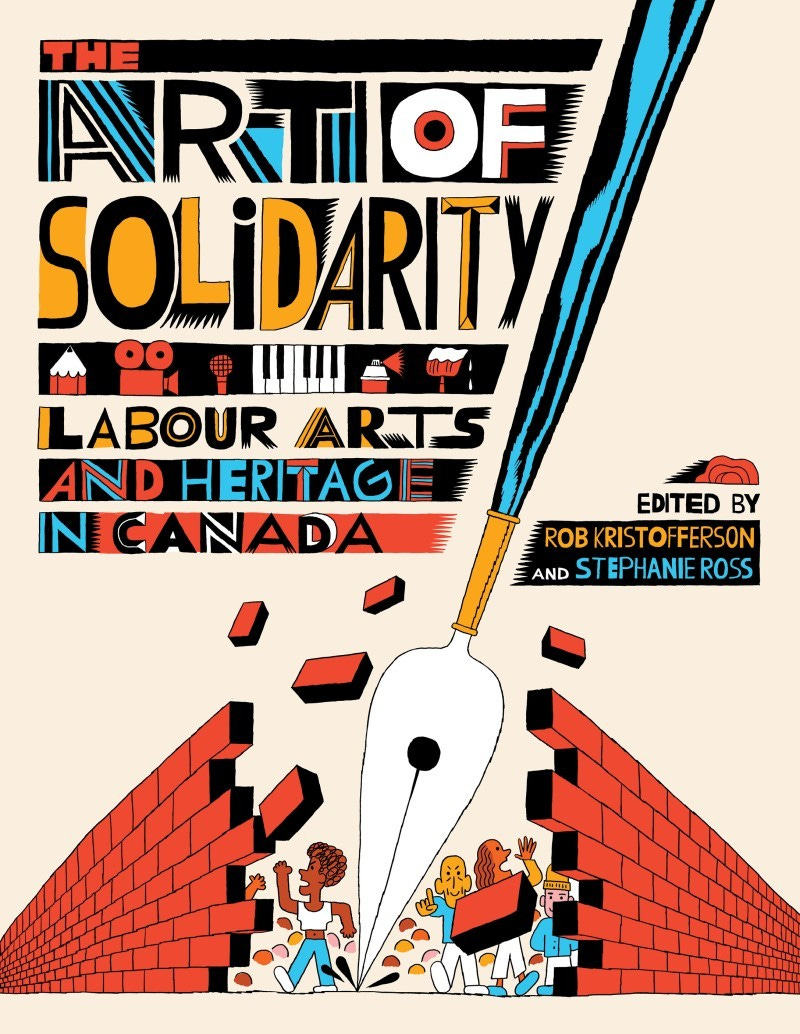
Labour organizations, activists, artists, and historiographers will find a valuable resource in The Art of Solidarity: Labour arts and heritage in Canada. Editors Rob Kristofferson of Wilfred Laurier University and Stephanie Ross of McMaster University have assembled a compendium of histories with a national scope, perhaps the only place in which a broad range of labour-focused arts and heritage activities has been so documented.
The book includes profiles of organizations and initiatives such as the Alberta Labour History Institute, the BC Labour Heritage Centre, and the Toronto Workers’ History project. These sections are variously authored by representatives of the organizations in question, perhaps more accustomed to writing grant proposals than anything for a popular audience. As such, these write-ups tend to be rather dry. Still, anyone involved in similar initiatives or thinking of starting something in their region will find much inspiration in these brief backgrounders, along with the wisdom of experience. Projects outlined in this book include oral histories, festival performances, installation pieces, graphic biographies, videography, musical productions, and sculptural works of public art. Some groups have dedicated display spaces, while others share work only online or at events. The BC Labour Heritage Centre, for example, was developed with the intent of establishing a multi-purpose building complete with “theatre, library, archive, and meeting rooms,” but this proved cost-prohibitive and the Centre turned toward collaborative projects where material could be hosted at a partner site, such as at the Vancouver Convention Centre with the support of WorkSafeBC. The struggle to obtain and sustain funding is a common theme across these organizational histories.
Several of the profiled organizations describe their efforts to broaden the inclusivity of labour histories. Multiple organizations have produced projects titled And Still We Rise (Alberta) or … and still I rise (Ontario) bringing attention to the experiences and contributions of Black workers in Canada. Volume contributor Joey Hartman, speaking on behalf of the BC Labour Heritage Centre, describes their Union Zindabad! project highlighting South Asian Canadian working lives: “It exposed the BC labour movement’s early exclusionary practices, followed by a growing recognition that racism is a tool of the boss to divide workers.” There is a broad and advancing awareness as to how racialized populations have been structurally and systematically excluded from unionized labour, and that this reality must be acknowledged as part and parcel of the history of labour activism.
Following these organizational profiles, individual artists and collectives are given space to write about their art practices. Musician Kevin Barrett notes that because he owns his guitar, which is his means of production, he is “technically … in the realm of the petty bourgeoisie,” but that as an activist, he remains aligned with the working class. Riffing on the emotional power of music, he suggests that “… if you want that union inspiration running through the workers’ blood, getting them singing might be more effective than making speeches.”
Don Bouzek of Ground Zero Productions describes his experience of putting on a play about nuclear testing for a group of “… mostly burly male unionists, many wearing the then-fashionable open mesh vest T-shirts, plunking down their beer bottles on the tables. Fortunately, the show held them and they stood up applauding at the end. Their comments afterward were nothing like an opening night in Toronto, where people talked about things like the costume concept. These workers focused on content ….” He explains how the group continued performing at labour conventions and eventually expanded into video production, and how this fed into the founding of the Alberta Labour History Institute in 1999.
Filmmaker Min Sook Lee notes that she had little exposure to the arts in her working-class upbringing, saying, “In fact, I thought ‘art’ was a pretty fancy word.” She articulates her initial discomfort with the thought of herself as an artist, considering art to be “more a tool, with a utility towards an end, as opposed to a form of personal expression.” She would go on to make powerful documentary films like El Contrato, a film about migrant workers that very nearly failed to see screening because of legal challenges from the employers involved. The film would eventually reach an audience of workers through circulation of pirated copies, and was nominated for a Gemini award.
The final third of the book is devoted to relatively new projects that look towards the future of labour arts and heritage. In this section, we hear about a redesign of the permanent exhibits at the Workers Arts and Heritage Centre, making the experience more interactive and responsive to community feedback. We learn about Albertan Black and Caribbean histories, including the expertise that highly trained Caribbean petrochemical workers brought to Alberta’s oil sands in the 1960s. We discover the untold biographies of activists through Mayworks Kjipuktut/Halifax’s extremely popular line of “social justice trading cards.”
There are many more stories here to teach and inspire. The book is well-illustrated with numerous black-and-white photographs and reproductions of visual artworks, as well as a selection of colour plates. Artists, activists, and historians will find this book to be an invaluable reference and a fine tribute to the collective efforts of those whose work has been dedicated to honouring the work of others.

About the Author
Rob Kristofferson is a professor of history and of social and environmental justice at Wilfrid Laurier University. He has worked extensively in workers’ public history and labour arts since the mid-1990s. He has produced several exhibits, tours, and other programming, much of this work in association with the Workers’ Arts and Heritage Centre, where he currently serves on the Board of Directors. He is co-author of the graphic history Showdown! Making Modern Unions.
Stephanie Ross is an associate professor in the School of Labour Studies at McMaster University. Her teaching and research focus on the politics and dynamics of labour movements, especially how unions deal with key questions of structure, democracy, bargaining priorities, political vision, political strategy, and collective identity. She has long been interested in the role of culture in working-class communities and in labour movement renewal and is a past board member of the Workers’ Arts and Heritage Centre. She is co-author of Building a Better World: An Introduction to the Labour Movement in Canada.
About the Reviewer
Dawn Macdonald lives in Whitehorse, Yukon, where she grew up without electricity or running water. She won the 2025 Canadian First Book Prize for her poetry collection Northerny. She posts weekly on Reviews of Books I Got for Free or Cheap (on Substack), as well as reviews for journals and The Seaboard Review of Books.
Book Details
Publisher : Between the Lines
Publication date : Sept. 4 2025
Language : English
Print length : 210 pages
ISBN-10 : 1771136790
ISBN-13 : 978-1771136792
