

The Blue Gate by Kathryn MacDonald
A Guest Review by Josie Di Sciascio-Andrews

“The Only Way Out is Through.” Robert Frost
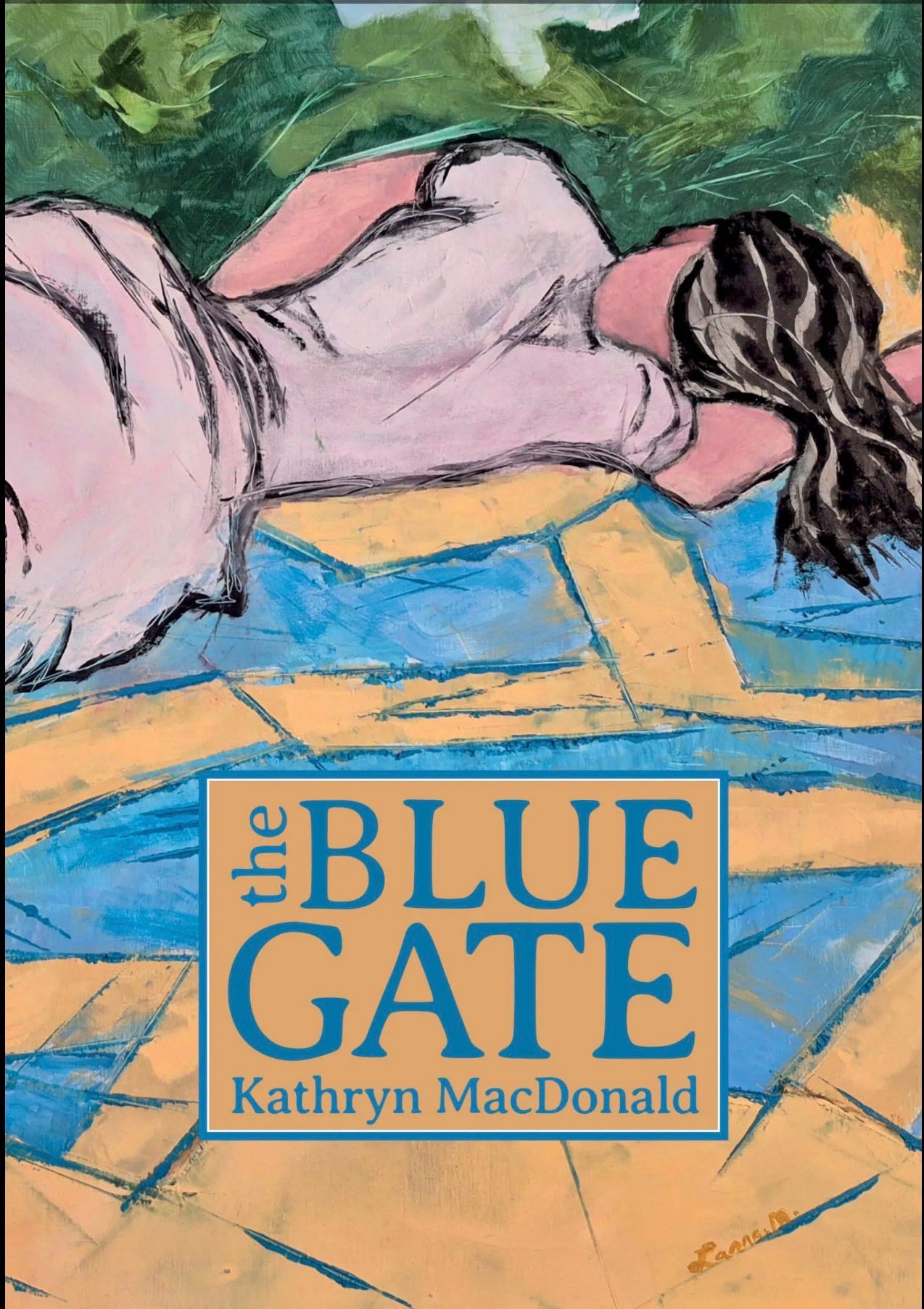
I received my copy of The Blue Gate from Frontenac House a few months ago. While busy completing reviews for some other poetry collections, it lured me into its pages with its captivating cover art, a detail from the painting Summer Breeze, by Larraine Milligan. Reminiscent of an Alice Munro character, the woman in the image is lying down facing verdant trees and a pale sky. She is wearing mauve, perhaps the colour of sorrow and transformation, and seems to be on a patio by a pool, sunlit ochre tiles contrasted by turquoise water.
Before I read any of the poems, the book design, its rich, creamy pages and special details like the insertion of the poem What She Knew, inside the front cover’s fold, as well as the pencil illustrations by the poet and her grandson, give the collection all the elements of a keepsake work of art to treasure.
If the cardinal rule of great writing is to show, not tell, in these meticulously penned verses, Kathryn MacDonald succeeds in expressing the most difficult emotions with precise, gorgeous language and memorable metaphors that lead us to enter The Blue Gate and to feel along with her, the world in her poems.
The collection is divided into four sections: Rain and You, Red Tails, The Blue Gate and Searching for a Warp in Time. The poems in the first section begin with the genesis of love, that blissful, limitless moment that felled her like a tree/ a robin’s egg in a windstorm/ a pretty blue thing/ a gift of spring. In the synchrony of two souls in love, the outer landscape becomes one with their inner world: a Northern Saw-whet…/ as tiny as my hand in yours…/ a mellow whistle rose/ from deep inside her downy breast…/ Our held breath/ flowed silently into her song. Also in the poem Rain and You,: with the rising sun/ on our backs, we walked-/ rain and you on my lips.
In the poems You Could Fall, Willow Dream, Dry July and Falling, we begin to glimpse premonitions of loss. Where the willow should be is only a gap, a hole/ the tree naked of leaves, its bark bone-grey. In Dry July, leaves curl and fall prematurely. In Falling, a foreshadowing of loss transpires into that time of day between dusk and night, an August sun that slips behind the row of poplars that marks the edge of our world. In The Farm, a fecund, idyllic season of life, rich with sonorous language envelops the couple. It is a landscape alive with the delight of tangible things and dreams. Remember the terrace of flat stones beyond the orchard of lost apple names? And seasons ripe and rich with life/ before unwinding. This last line in the poem leads to the subsequent piece where he tells her I’m dying, and her world falls apart in what will become the most catastrophic event of her life. We read: the sun fell toward the horizon at the end of the long lane.
For a while, after his diagnosis, life continues on as usual without many changes, although things are inexorably shifting, as the poet expresses in Undersong. We tramp the worn path, pass the apple tree in blossom, walk in the woods where the Red-tailed Hawks nest./…/ Too soon the height of summer parches with its drying heat. Like the earth you wither brittle as the grass. We trade our days of woodland odysseys for picnics on the porch, until that too is lost. The last poem in this first section spells the end of a life season. Your hand cools so quickly. / August turns autumnal. A life slips away like the seasons, their ebb and flow in common, a language of the body in unison with the landscape, inseparable from it. As summer fades to fall and then to the erasures of winter, I glimpse you in the doorway/ before you fade into mirage.
Red-tailed Hawks comprise the second part of this collection, carving circles in a clear sky. While we give ourselves to bacchanal afternoons/ le Déjeuner sur l’herbe-/ forget the surprise of death. Sacred messenger bridging the physical and spirit world, as well as symbol of threshold moments of life transitions, the Red-tailed Hawk is a pivotal, reappearing trope throughout these poems. Sharp talons and beak/ pierce my flesh, shred my heart/ death a bird of prey. And again the hawks circle above diving down to kill voles, field mice and rabbits, like death arriving to snatch us by surprise, when we least expect it, literally out of the blue
It is difficult to write about the death of a loved one and the ensuing grief. In the poem You Lie, in just a few lines, the poet describes exactly what it’s like: from the daybed of sheets and pillows, to wanting to be close to talk, to deteriorating physical changes, to the move to the hospital where family gathers to say goodbye, to the last breath which seems so uneventful, yet is so ruthlessly final. I hold your hand surprised how swiftly cold, / how quickly you are gone.
As the poet returns home after her husband’s passing, she sees one hawk perching on a wire. The internal void of grief becomes the whole landscape. In this lacuna he sounds a shrill skirl, and Icarus-like lifts up and up with the rising sun. The soul bereaved tries to make sense of reality, yet much as in the uprooted willow tossed on the beach in the poem Rain and You, there is an unmooring from normality. The loss of interest in living and the wish to die in order to join our deceased loved one is perfectly captured in the lines: It is not wax wings I need/ but cerement. Yet all around, as in Bruegel’s Icarus, the world goes on. We read: I see the cavernous sky/ hollow full of lament,/ startled that the sun has risen, dogs need walking, birds need feeding.
The third part of The Blue Gate ushers into the darkest period of the psyche as it tries to cope in the aftermath of loss and the struggle to continue existing by finding meaning through grief. A quotation by Rebecca Solnit greets us at the entrance of sorrow’s realm: Blue is the colour of longing for the distance you never arrive in. Seasons pass, winter looms long and sad. Escaping to another world becomes possible through a serendipitous invitation to visit Kenya. With its exotic landscape of vast lands, deserts, jungles and open skies, Africa is a symbol of the wilderness of the heart. The poet enters this dark continent on a spiritual journey through its beautiful, yet dangerous flora and fauna, aiming to be healed and redeemed.
With vivid detail and lyric grace the poet paints gorgeous images that spark into life, inviting us to step into the reality of the poems. Soon we are on a flight, looking out the cabin window of a plane, the skim of snow / an airplane wing glistens in the night/ an irradiance of neon-/ green de-icing fog before flight. Along with the poet, we soon see the orderliness of Amsterdam’s perfection, antithesis to the chaos swirling within me.
As in a ritual for purification, on her voyage through Africa, the poet walks through a multitude of dangerous passages. I step through the auto-opening glass doors and I may have slipped, like Alice down the rabbit hole. As her guide Kioko welcomes her, she crosses a threshold, slips past security, past walls topped with shards of glass, slips beneath a Sykes monkey, her long tail a tightrope walker’s pole as she sashays along electrical wires. We stop at a blue gate.
Beyond the threshold of the blue gate, the poet enters a courtyard where flowers bloom in all the colours of Africa - yellow, red, ochre and every shade of green. It is a welcoming, but wild place where if you open the windows, monkeys will come in. No matter the distance or the magical distractions of the new location however, memories of the old life with her husband resurface continually throughout the new experience, the mind trying to refashion them into the new context, love indelible. And there you are with a pail of tools/ and a ring of wire/ deep in the act of mending fences.
Beyond the blue gate, the poet yields to a foreign, hostile nature which is harsh and cutting, perhaps because of this, redeeming: a field of stubby corn which shapes steadily downward./ Leaves are sharp as knives polished with pumice/ slash my calves. I descend to this underworld. As in all spiritual journeys, the soul must descend to Hades to experience the full wrath of suffering in order to ascend to higher levels of spiritual purification and ultimate healing. After she walks down, down into the abyss, she returns to climb up towards safety. From the top of the biggest rock I view the world, turn slowly, box the compass with arms outstretched like an acacia’s branches. We can feel the mood turn from grief’s lament to the return of joy in an empowered accomplished feat. I climb up, over and down, jump from rock to rock, oblivious to danger and time.
In these beautiful poems, reality and dreams merge, the poet’s undying love, an eternal longing. Sensuous descriptive details make Africa’s landscape come alive. Wild lemon blossoms/ bougainvillea./ I wake to an elephant’s trumpet/ watch sunrise change the sky/ from pewter to periwinkle/ and blue/ African bluu. There is a wish to become one with the surroundings to assuage the feeling of separation, but no matter how beautiful the present reality is, it is a life without you. Always inner and outer experiences rock back and forth like boats in water.
Trying to make sense of the senseless, we go back to the rudder of our heart, to seek guidance from the one who guided us for a lifetime, only to realize time after time, that they are gone. You are ash and I am lost.
In the last section of the book the poems aim to overcome the void of grief by reconnecting with lost love through memory and imagination, by Searching for a Warp in Time, that space where there is no past and no future, but only one continuous, eternal now. A time suspended, where he is still alive and with her. Perhaps there is no before/ no after… No time for all time.
Delicately woven words sing poetic imagery that enraptures us to enter nature’s rhythms and nature’s cycles. I am thinned back to autumns of woodsmoke and days still undiminished.
Ultimately, The Blue Gate is an aperture into the dark night of the soul, a wild place we must enter in order to deal with the pain of grief to be able to re-emerge stronger and healed. Although I want to live in a space that is honey-combed with the past, in a life sensuous with the ripeness of a still life, there is no going back, except through memory and imagination. As we had read in the poem At the Blue Gate: Can grief be a perpetual falling?
In Albinoni’s Adagio, the last poem in The Blue Gate, we know it will be impossible to get over a love so deep. The poet writes: All the sorcery I conjure/ fails to resurrect you./ And still I live.
Time heals, but not completely. The price we pay for love is that we can never get over its absence. Healing does happen with time, but it is not a gentle mending. It is a long liminal transformation wrought through the fire of crossing a dangerous internal threshold, the necessary descent into the dark underworld of trauma. Having to continue living and even entering the blue gate, does not fully redeem, but only strengthens and wizens.
In the last poem the music of Hauser’s cello fills the air with cavernous yearning. The adagio rises, falls, swells into fullness/ slowly cascades into silence/ to haunt each blue breath. And still I live.

About the Author
Kathryn MacDonald’s poetry has been published in Room, FreeFall and other Canadian literary journals and anthologies, as well as internationally in the U.K., U.S., and other countries. She is the author of Wayside: A Small Boat, A Vacant Lot, A Man (poetry chapbook, 2026.) Far Side of the Shadow Moon: Enchantments (poetry chapbook, 2024), A Breeze You Whisper: Poems (2011), and Calla & Edouard (novel, 2009)
About the Reviewer
Josie Di Sciascio-Andrews has written seven collections of poetry and two non-fiction books. Her work appears in various journals and anthologies among which: Canadian Literature, The Malahat Review, Descant, The Canada Literary Review, Acta Victoriana, Canadian Poetry Review, The Blue Nib and Lothlorien, among others. Her poetry won first prize in the 2023 International Poetry Prize in Rome’s Antonio De Ferraris contest. Her poem The First Time I Heard Leonard Cohen was nominated for the 2022 Pushcart Prize. Her latest book of poems, A Nomenclature for Light was released September 2025 by Mosaic Press. Her poem Quantum Sparks in the Tabernacle is the first place winner of the 2025 Ontario Poetry Society’s Long Poem Prize. Josie is a member of The League of Canadian Poets, the Ontario Poetry Society, the Italian Canadian Writers Association and The Heliconian Club for Women in the Literary Arts. She teaches workshops for Poetry in Voice and is the host & coordinator of The Oakville Literary Cafe series.
Book Details
Published date: Apr 15, 2026
Language: English
No. of Pages: 84
Publisher: Frontenac House Ltd.
ISBN: 9781997580089
Dimensions: 6.0” W x 0.264” L x 9.0” H