
The Boat People by Sharon Bala
A Throwback Thursday Review by Ian Colford

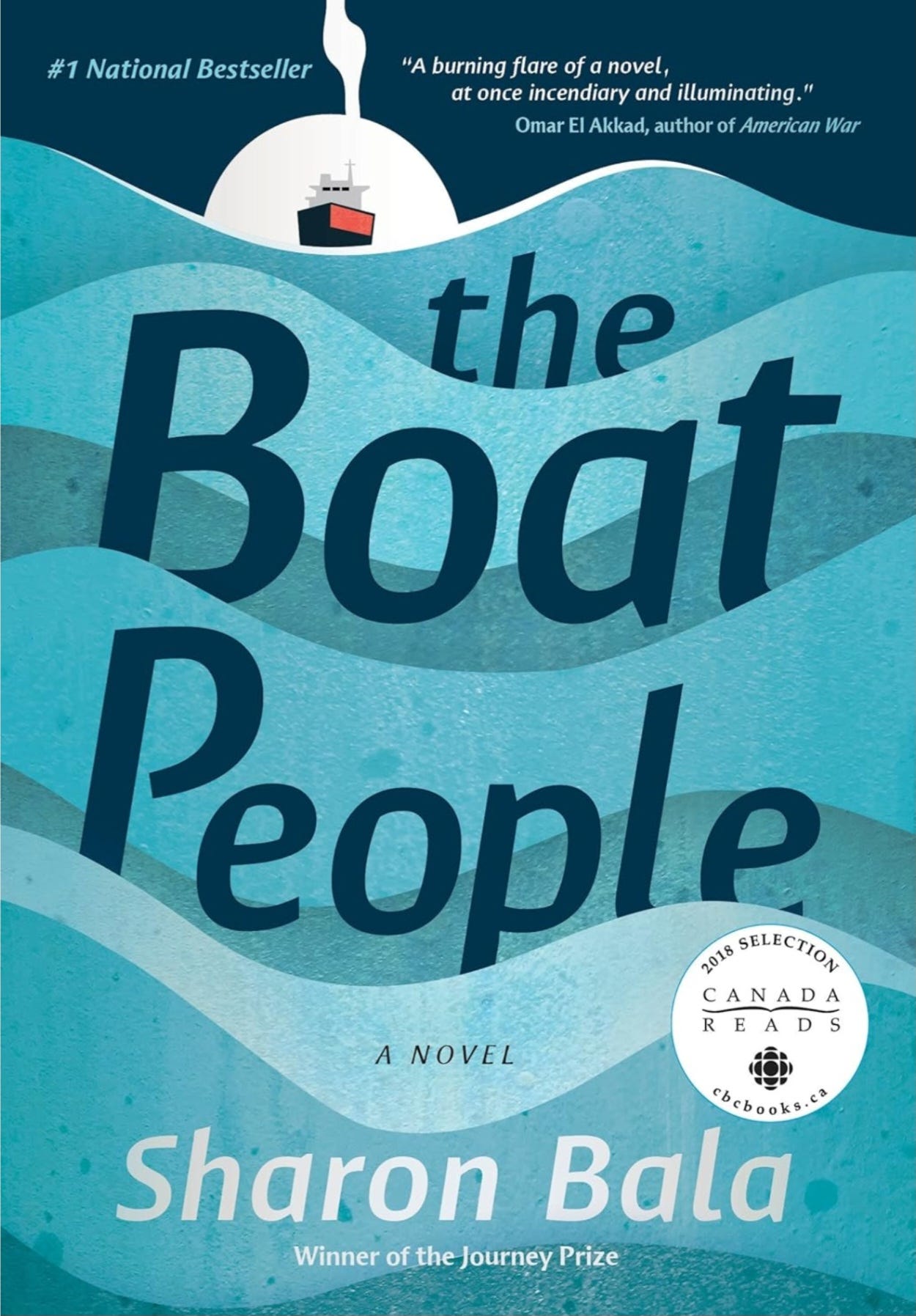
Immigration is a polarizing topic and, given the state of the world, is likely to remain so for years to come: a flashpoint for divisive sentiment and lines drawn in the sand. Is it courageous or reckless for a fiction writer to tackle what could very well be the hot-button issue of our time, and moreover one that ensures her novel will be viewed through the distorting lens of political opinion?
Sharon Bala’s The Boat People manages to come across more as valiant than imprudent, largely due to her considerable storytelling skills, adept characterization, and an engaging multi-perspective structure. The novel, inspired by events that took place in August 2010, when the Thai cargo ship Sun Sea landed at CFB Esquimalt in British Columbia with a payload of several hundred Sri Lankan asylum seekers, begins in the immediate aftermath of the boat’s arrival in Canadian waters and the detention of the refugees under the authority of Canada Border Services.
The story Bala tells takes us into the lives of three characters impacted by the influx of refugees. Priya Rajasekaran is a law student, articling at a high-profile Vancouver law firm. Though her main interest is corporate law, she is commandeered by the firm’s immigration lawyer, named Gigovaz, who is representing some of the refugees, when he discovers her Sri Lankan background. Grace Nakamura, a recently appointed adjudicator for the Immigration and Refugee Board, is overseeing hearings in which the asylum claims of the refugees are being assessed and their fates decided. Grace’s background is Japanese, and her mother, Kumi, who is in the early stages of dementia, has become obsessed with the internment of Japanese Canadians during World War Two, specifically the injustices perpetrated against her family by the Canadian government. Finally, the bulk of the novel is told from the perspective of Tamil refugee Mahindan, who has come to Canada fleeing persecution at the hands of the Sinhalese rulers of Sri Lanka following the bloody civil war. Mahindan, a widower, has made the journey with his six-year-old son Sellian.
We see much of the action through Mahindan’s eyes. Bala wants us to share his fear, anger and frustration as he struggles with the language barrier, endures an interminable period of incarceration while his motives for entering the country are endlessly dissected and questioned, and is separated from his son because the facility where he is housed cannot accommodate children. Bala also devotes significant space to Mahindan’s personal history: taking us to his war-torn homeland where we witness Sellian’s birth, the death of Mahindan’s wife Chithra, the daily hardships and torments of living in a place where ethnicity alone is sufficient reason to fear for one’s life, and the events that lead to his decision to get on the boat.
The Boat People walks a fine line, navigating its way through several complex narrative threads while struggling at times to maintain a balanced perspective and avoid the tempest of opinion, belief and emotion that any discussion of immigration can stir up. Are the Canadian officials who are barring the way forward for the refugees simply being cautious, or are they motivated first and foremost by politics, kowtowing to the xenophobic sentiments of a jittery and fickle voter base? Is the concern that terrorists have embedded themselves among the refugees justified, or is the official hard line simply for show, an opportunity to discourage similar mass migrations by pushing sound bites into the global news cycle and demonstrate to the world that Canada will not be a pushover haven for all and sundry?
Undoubtedly, Sharon Bala encourages her readers to take a sympathetic and compassionate view of the boat people and consider the choices they face. She also asks that we look beyond our borders and think about what drives people in desperate circumstances to risk everything for a chance to build a new and better life in an unfamiliar country. In the end, many questions remain unanswered. But that is the nature of life and art.

About the Author
Sharon Bala’s best-selling debut novel, The Boat People, won the 2020 Newfoundland & Labrador Book Award and the 2019 Harper Lee Prize for Legal Fiction, was short listed for several awards, and is in translation in four languages. She won the Writers’ Trust/ McClelland & Stewart Journey Prize in 2017. Her short fiction has been published in: Best Canadian Stories 2024, The Journey Prize 29, Hazlitt, Grain, PRISM international, The New Quarterly, and Maisonneuve. Her non-fiction has been published in The Globe & Mail, Maclean’s, and elsewhere. Sharon is the Creative Non-Fiction editor at Riddle Fence and a member of The Port Authority, a St. John’s writing group.
About the Reviewer
Ian Colford was born, raised, and educated in Halifax. His reviews and stories have appeared in many print and online publications. He is the author of two collections of short fiction and two novels, and is the recipient of the Margaret and John Savage First Book Award for Evidence.
Book Details
Publisher McClelland & Stewart
Publication date Aug. 11 2020
Language English
Print length 416 pages
ISBN-10 0771024312
ISBN-13 978-0771024313
The Boat People remains in my Top Ten list of Canadian novels alongside novels by Michael Ondaatje, Michael Crummey, Margaret Atwood, Timothy Findley, Esi Edugyan, Guy Vanderhaege and Yann Martel. I love the feeling of building excitement when I encounter a book so original, so vital, so big in scope-what some would call brave or ambitious-and to top it off, so very beautifully written. I can hardly wait for Sharon Bala's new book!