
The Book of Interruptions by Khashayar “Kess” Mohammadi
Reviewed by Melanie Marttila

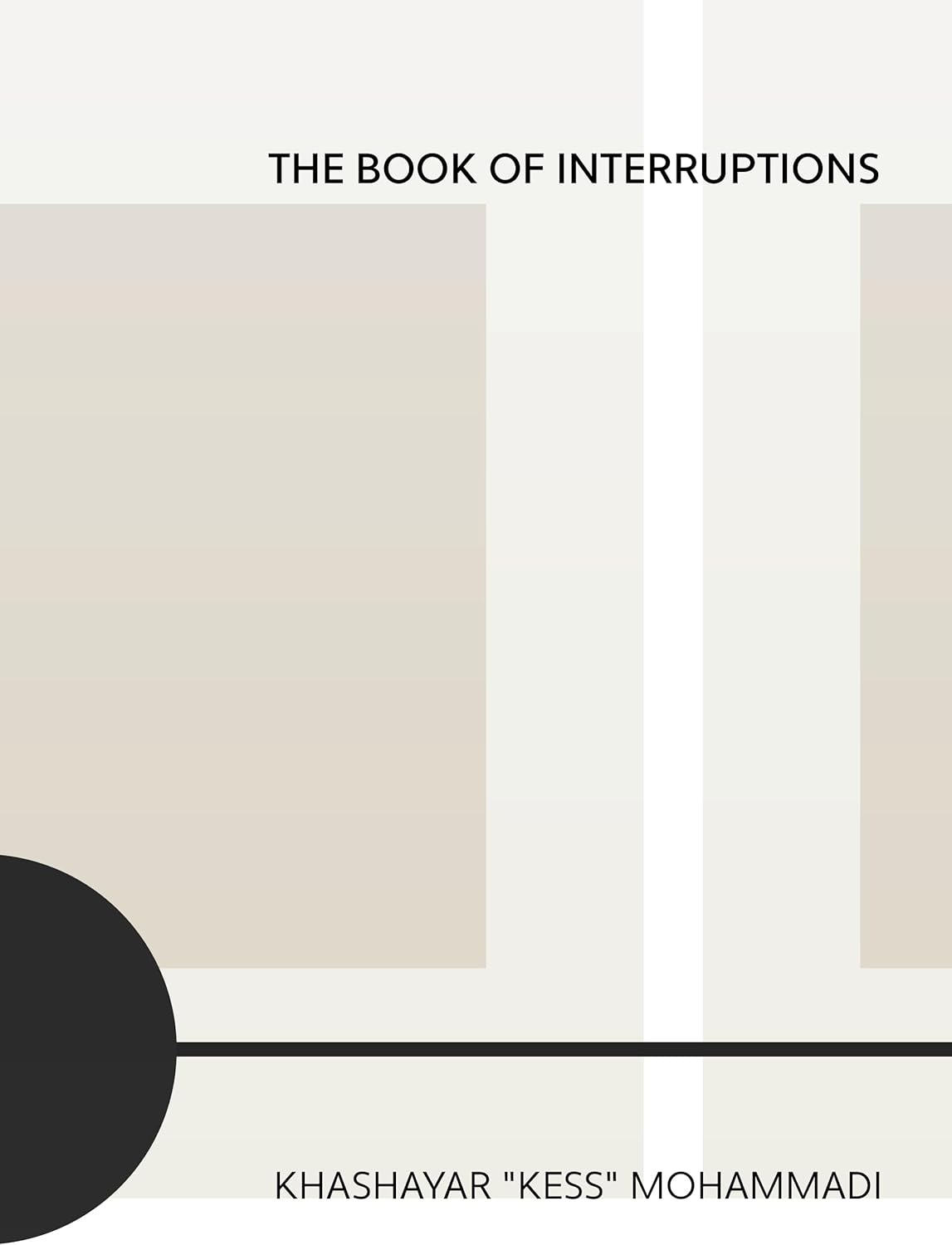
Ludwig Wittgenstein said, “… one should write philosophy only as one writes poetry.” In The Book of Interruptions, Khashayar “Kess” Mohammadi has created a philosophy in verse, including in their subjects, Persian Islamic mysticism, French psychoanalysis, queer theory, and Marxist critique.
They drop names, write of Rostam (legendary Iranian hero), who “slew the white deev / infinite in its capacity for madness” in a city “breathing / in the wake of madness”; of Farhad (romantic figure of Iranian mythology), “… sent to dig) / in the valley where nomads boil the petals for colour”; of “Marx’s ‘Permanent Revolution” / to redeem all the dead as martyrs”; of “Zarathustra, floating ribbon-light”, the Deus ex Machina no one wants; and of Majnun (madman and Romeo of the East), who “aged a thousand years / in an instant of longing”.
Mohammadi writes of Guy Hocquenghem (one of the founding fathers of queer theory), David Bowie, and Brian Dedora, “[a]t the centre of it all … / an autonomous sexuality / / each man a surplus / where masculinity compounds interest”.
They write of Freud, and his “fatal sodomy OR / all acts eluding reproduction”, his “retroflex”, “halfway between the death drive and that oceanic feeling”; of “Lacan’s enjoyment of the unconscious”; of “Pollock and his canvas on the floor”; of “Kant and his boring fucking ideas / / Kant and his boring fucking life”; of Shamlu (Iranian poet and dissident), who wrote about the “Crimson Bloom of a Shirt”.
The poems in this collection meet at the intersection of war, immigration, sexuality, history, and at the crossroads of Perso-Islamic and Western philosophy. An intersectional life is one of interruptions, and the more intersections of identity you own, the more interruptions intrude.
You cannot simply live your life, you are constantly observed, scrutinized, judged. The panopticon of Western society demands internalization, so you’re not even safe from yourself. In “Purgatorial Imagery” they write “the newspapers know my predisposition / but they sell me my fix anyway / if not THE consumer then… / an alternate consumer / of hyphenated products.” The private becomes public, the sacred, profane, and the intimate, vulgar. Everything becomes content. Everything is consumed.
In “Before we begin …” the city breathes “in the wake of poets”, “in the wake of madness”, “and screams / and screams”. The city (Toronto) returns in each sequence-section, still screaming. Later, Mohammadi writes, “I am shaped where the city meets my anger” and “I am the city’s profoundest fear”. This is the seed of the city’s screaming, the unsettling of the intersectional, othered poet.
In the final sequence-section, Consonants*: A Book of Visions*: A Book of Illuminations*: A Chorus of*: L*ght: Against L*ght: Against L*ght, various letters of the Arabic or Persian alphabets are examined: Qaaf, the root of which relates to sufficiency or adequacy; Alif, representing Divine Unity (Tawhid), the absolute oneness of God, and the ultimate source of all creation; Daal, which holds spiritual and numerical significance in Islamic mysticism as the letter of divine return and unity; also Che, Noon, Vaav, Jeem, and He (Haa), which all have spiritual, political, and artistic/aesthetic values.
These letters are writ large on the pages beside Mohammadi’s verse, inviting contemplation. A smaller version of He/Haa appears elsewhere in the collection, at the end of two lines to connote possession (“through the psychotic’s binocular”, “through my binocular”). It is also associated with the breath of life as its sound is a gentle exhale.
The Book of Interruptions is a fascinating collection that rewards repeated reading but there’s no need to dive deeply into the references (though you can if you want to, I’ve barely touched the surface). Read and let Mohammadi’s words swirl around you like the breath of life, let that life be interrupted by the screaming city, and see where it leads you.

About the Author
Khashayar “Kess” Mohammadi (they/them) is a queer, Iranian-born, Toronto-based poet, writer, and translator. They are the winner of the 2021 Vallum Poetry Award and the author of nine chapbooks of poetry. The Book of Interruptions is their fifth poetry book.
About the Reviewer
Melanie Marttila (she/her) is an #ActuallyAutistic SFF author-in-progress, writing poetry and tales of hope in the face of adversity. Her poetry has appeared in The /tƐmz/ Review, Polar Starlight, Sulphur, and her debut poetry collection, The Art of Floating, was published in 2024 by Latitude 46. Her short fiction has appeared in SuperCanucks, Through the Portal, and Pulp Literature. She is a settler writing in Sudbury, or ‘N’Swakamok, on Robinson-Huron Treaty territory, home of the Atikameksheng Anishnawbek and the Wahnapitae First Nation, in the house where three generations of her family have lived, on the street that bears her surname, with her spouse and their dog.
Book Details
Wolsak and Wynn
October 7, 2025 | ISBN 978-1-998408-25-2 | 96 Pages
 | A guest post by
|