

The Book of Maggie by Stephanie Wyeld
Reviewed by Ezra Anderson

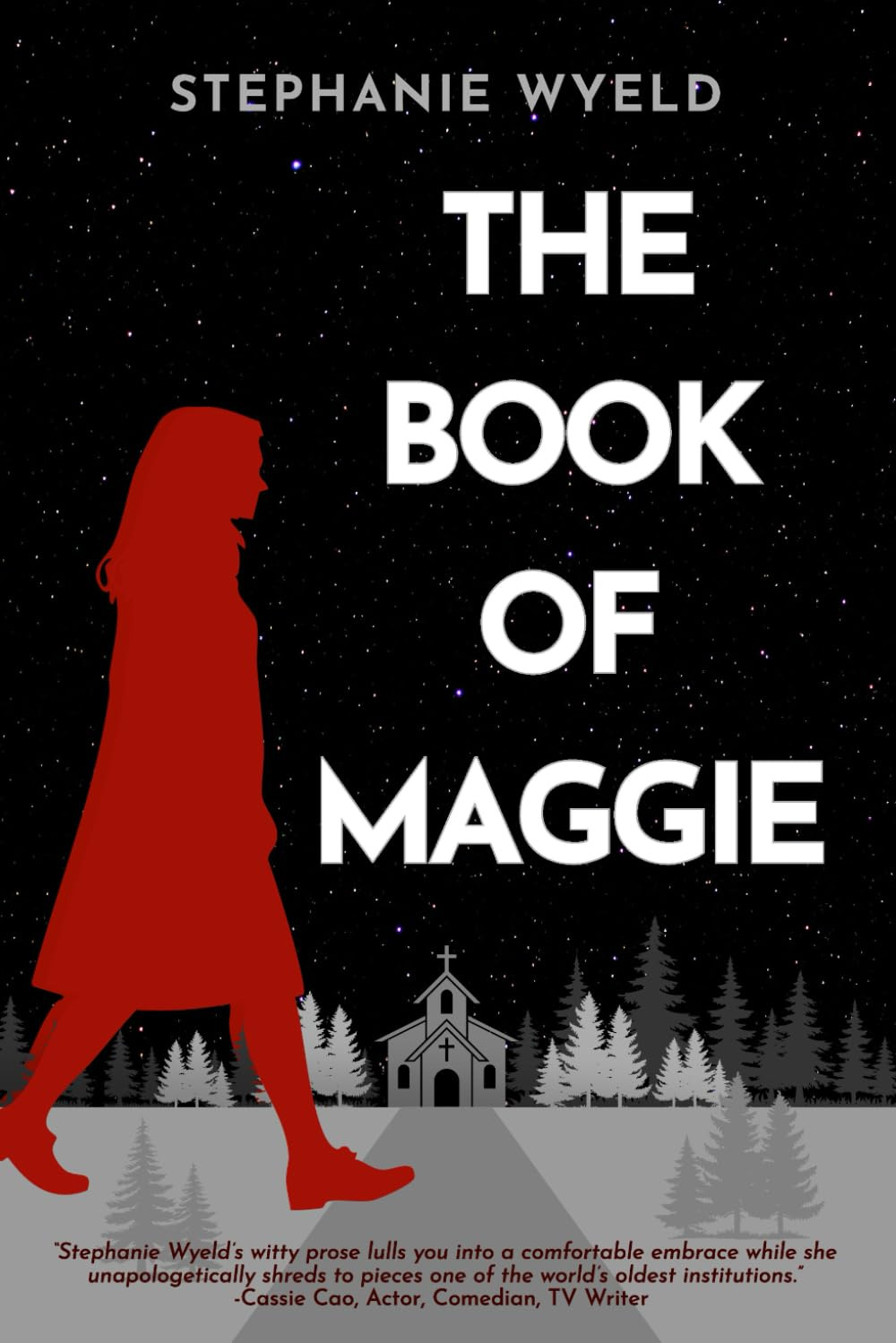
As Western societies face renewed appeals to traditional values — in politics, in religion, in public policy — Stephanie Wyeld’s debut novel arrives as an almost uncomfortably pressing work of literary witness. The Book of Maggie opens and closes with a pastor being shot at a pro-choice rally inspired by the overturning of Roe v. Wade. How does a society arrive at such a moment? Wyeld shows us that it’s been heading there for over a generation. The novel’s conclusion feels both like a tragic inevitability and, at every stage, entirely preventable. That tension is the engine of the book, and Wyeld never lets it rest.
“Wyeld’s novel follows Maggie’s coming of age in Pentioch, a fictional Ontario bedroom community, circa 1984, where a small fundamentalist church, a tight-knit neighbourhood, and a pastor’s household form one closed system.”
Wyeld’s novel follows Maggie’s coming of age in Pentioch, a fictional Ontario bedroom community, circa 1984, where a small fundamentalist church, a tight-knit neighbourhood, and a pastor’s household form one closed system. She is named for Mary Magdalene, a woman whose testimony was edited out of scripture and whose reputation was edited into something more manageable by the institutions that feared her authority. Wyeld does not labour the parallel. Maggie’s only acknowledgement of her namesake is a recurring, breezy aside — she was named, she says, “after a whore” — delivered so lightly that it lands first as a joke.
But those little jokes accumulate, and each repetition makes it harder to laugh and easier to see what has always been operating beneath the surface: the same misogynist agenda that diminished Mary Magdalene’s role in the Bible, from one of Christ’s closest confidants to a cautionary footnote, infects every area of Maggie’s life. Wyeld trusts readers to draw the connection, which is characteristic of her method — precise and unhurried, making the invisible forces of patriarchy materialize with remarkable lightness of touch.
Maggie’s voice is distinctive and disarming: wry, clear-eyed, mordantly funny about things that are not remotely funny. She watches her worth get appraised in the only currencies her community accepts — beauty, fertility, composure, loyalty — and narrates the process with the dark precision of someone who has understood the game far longer than she has been permitted to say so. There is something almost unbearable about her clarity. She sees the walls closing in, names them, often brilliantly — and what does the naming change? Wyeld vividly depicts Maggie’s expansive and witty interior life, and then shows, methodically, how every institution around her conspires to deny that it exists. The accumulation lands with the weight that only quiet, incremental losses can produce.
Nowhere is this pain clearer than in her marriage to Patrick. What Wyeld renders is an erosion: the passionate lovemaking of their honeymoon becomes, through years of failed conception, something functional and joyless — a duty performed on behalf of the church, her body administered rather than inhabited. Nothing violent happens. Nobody raises their voice. Everything proceeds, politely and systematically, until Maggie has been reduced to a chalk outline of herself, all of her contours carefully rubbed away.
Pentioch is a microcosm of the patriarchal institutions that govern society, including the legal and mental health industries and a broader culture of shame deployed as social control. Maggie’s sister’s manageable anxiety is weaponized against her in a custody battle. Her mother has already fled, an earlier casualty of the same logic. Constraints stack on one another, the domestic and the political clicking together with inexorable, elegantly rendered precision. Wyeld never overstates the connections. She doesn’t need to. The architecture of Maggie’s universe speaks for itself.
When the narrative loops back, at the close, to that rally and the gunshot that opened the book, the circularity lands as a verdict. The overturning of Roe was a destination, and Maggie’s entire life is the map. We have watched a woman be erased, piece by piece, from her family, her marriage, her body, her faith, and her own sense of reliable selfhood. The surprise ending reinforces that trajectory. And confirmation, here, is its own form of grief.
A striking debut. Wyeld has the comic touch to make The Book of Maggie as readable as it is disturbing, and the structural discipline to make it devastating — making the ugliest of patriarchy’s attitudes visible with such lightness and control that you barely notice, until you do, and then you see them everywhere.

About the Author
STEPHANIE WYELD was raised in various fundamentalist churches. Though she parted ways with them as an adult, the Christian guilt creeps in now and again. Stephanie has a couple of degrees, in science and engineering, and lives with her family in Toronto. She is a past writer-in-residence at Heliconian Club. The Book of Maggie is her debut novel.
About the Reviewer
EZRA ANDERSON is a writer and bookseller based in Toronto.
Book Details
Publisher: Dark Winter Press
March 2026
Format: Trade Paperback
Pages: 332
ISBN: 9781998441419
Price: $19.99 CAD
OMG thank you so much for this stunning review