

The Bright Afters by Sadie McCarney
Reviewed by Anne Smith-Nochasak

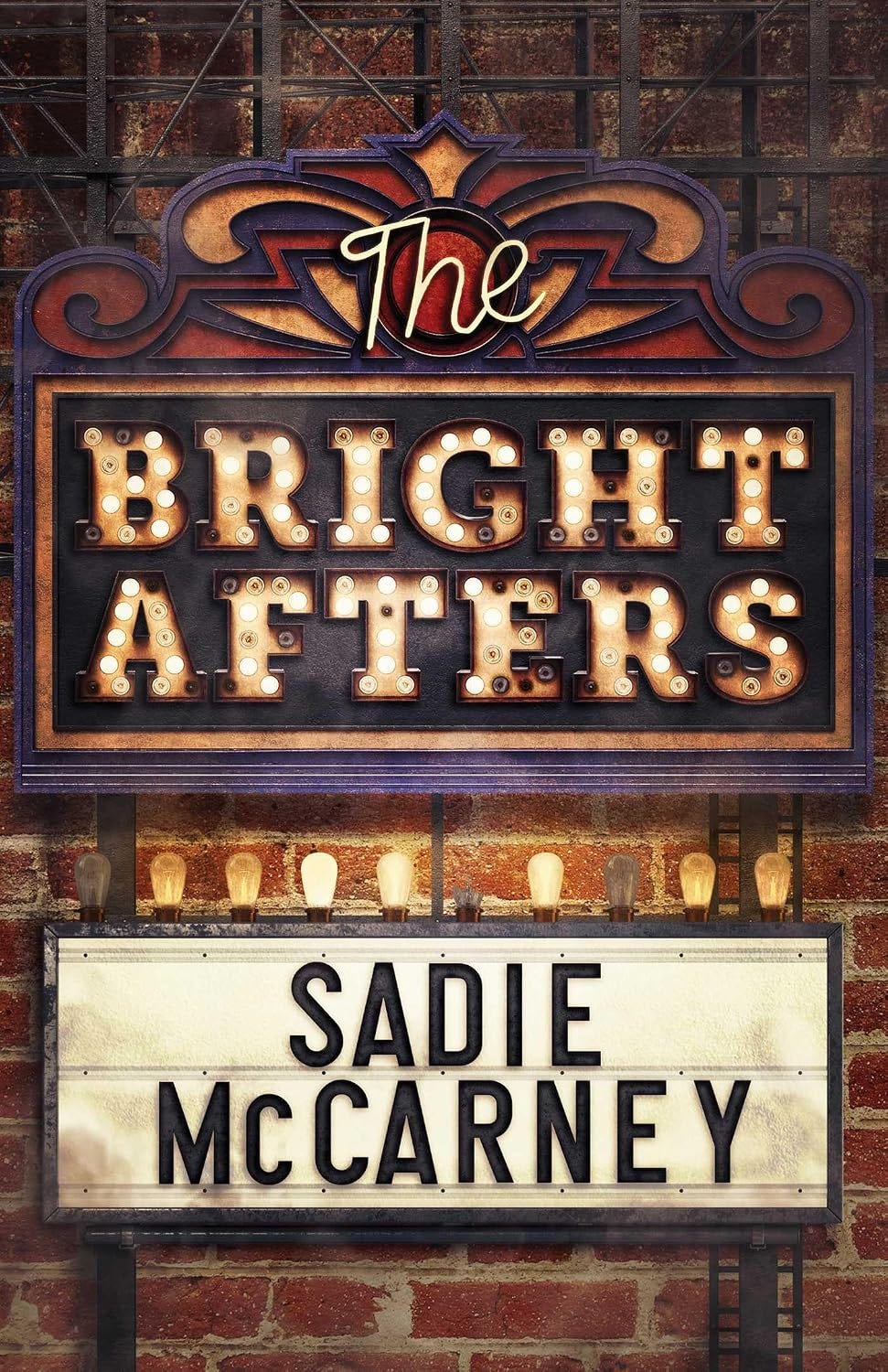
In the fictional town of West Nowhere, Nova Scotia, a gay teenager is stabbed in a high school washroom. The event forms a focal point by which queer belonging, trauma, anger, and small-town culture are revealed. Although The Bright Afters has a narrative effect, it is not narrative poetry. Instead, through a collection of images and impressions, an organic whole is created; we are immersed in the town, hearing what its people say, feeling what they feel. We sometimes say we cannot put a book down, and that was the case here for me, but not for the usual reason. I could not put the book down because then I would be walking away from Colton, from Annie, from Derek and Calvin, and I needed to stay with them until I had heard all they had to tell me.
The images of the opening poem capture the essence of West Nowhere: the physical setting, the social setting, the dreams that define it:
Some, run loose, spray-paint
dicks on the gangway beneath
the Nowhere bridge in the rain,

while a crazed SUV warbles new
war cries past on a breaker of foam.
In back, two girls are harnessed

By halter tops, sip neon-blue slush
From paper cones.
Sadie McCarney reveals West Nowhere as a place of immediate goals and unimaginative expectations. Within this town, Colton and Christine grow up, raised by their stepfather, Calvin, since their mother’s death. Here, Colton’s gay identity comes under scrutiny. In his last year of high school, Colton is stabbed in the neck and back by a childhood friend. And every element is connected. We learn this story not by observation or reading an account, but by overhearing the thoughts and feelings expressed by participants, family, and bystanders. We piece together what we hear and that becomes the story. The point of view of Colton, his friend Annie, his sister Christine, his attacker, his stepfather, even the custodian and one of the teachers during the evacuation, contribute to our overall understanding.
Characterizations are vivid and authentic—Calvin struggles to find the words, Derek has nightmares, unable to work out the “Why” of his action. Christine is steeped in anger: But maybe at last I’m as wild as Calvin and the shrinks and the aid workers say. Maybe I’m gonna try to get that boy who tried to get my brother that day. Christine, Annie, Derek, Calvin, and Colton examine the event in the present, and at times reflect on childhood times, rounding out the experience in the present. Elements of personality are revealed in Colton’s memory of his mother’s response when he played with Barbies, Annie’s realization that twirly girlhood was not to my taste, Derek’s rage (But I can feel the rage flow out of me like music. I can see his blood bloom on the tile floor),and Calvin’s bewilderment at the seriousness of Colton’s condition and Derek’s attack (He mucked ’round here with mud pies when him and Colt were kids.) Each personality is unique and each is alive on the pages.
Characters are built based on what they say and do, and what others say about them. Word images also reveal their differences. Calvin, a mechanic, has his own views on childrearing, being intolerant of Christine’s anger while striving at some level to teach Colton the basics of auto mechanics. Colton, an active student with dramatist aspirations, is lost in the explanations he receives. The author supplies what was given by Calvin as heard by Colton: Then you do this complicated thing: words, words, something about a brake line maybe?
By examining through multiple points of view the time of the event, then the time before, and finally the conclusion to the time, captured in the moments of the Pride Parade, the author builds a composite image of the incident, but it is much more than this. Queer identity and queer acceptance are explored with integrity and whatever our identity, we can read the separate pieces and draw together a vision of life in which there is a place for all of us. Sadie McCarney’s The Bright Afters is a living, interactive text, one which we do not so much read as enter. A remarkable achievement.


About the Author
Sadie McCarney’s other books are Live Ones and Your Therapist Says It’s Magical Thinking. Her work has also appeared in Best Canadian Poetry, The Walrus, Grain, Foglifter, The Malahat Review, and The Fiddlehead, among other publications. She lives in Cornwall, PEI.
About the Reviewer
Anne M. Smith-Nochasak grew up in rural western Nova Scotia, where she currently teaches part-time after years in northern communities. She has self-published four novels with Friesen Press: A Canoer of Shorelines (2021), The Ice Widow (2022), and two books in the Taggak Journey trilogy: River Faces North (2024) and River Becomes Shadow (2025). A member of the Writers’ Federation of Nova Scotia, Anne enjoys incorporating local settings into her writing. In her spare time, she likes reading, kayaking, gardening, renovating, and exploring the woods with her golden dog, Shay, while her cat, Kit Marlowe, oversees the house. Anne can be contacted through her website. https://www.acanoerofshorelines.com/
Book Details
Publisher : ECW Press
Published: April 2026
ISBN: 9781770418523
Pages: 80
 | A guest post by
|