

The Burrowing Owls of the Prairie Grasslands by Deborah Hodge, illustrated by Karen Reczuch
Reviewed byMelanie Jackson

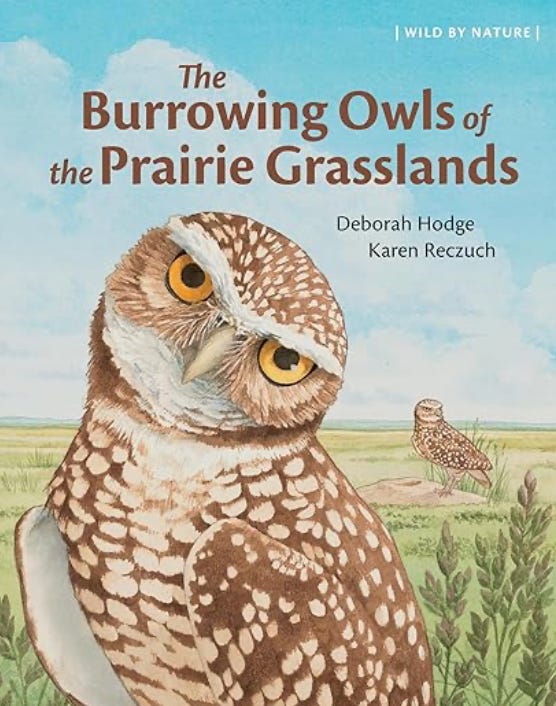
Head tipped sideways, the white-flecked brown owl looks straight at you. “What’s up?” his bright, curious golden eyes seem to inquire.
To which your response might be, “What’s down?” After all, he’s a burrowing owl, the world’s only owl species that nests underground. As Deborah Hodge explains in The Burrowing Owls of the Prairie Grasslands, these owls seek out burrows once inhabited by intrepid diggers such as prairie dogs, badgers, and ground squirrels.
I had to smile on reading about burrowing owls’ innovative, if slightly cheeky, habit of helping themselves to homes others did the heavy (soil-)lifting on. It reminded me of the Scrounger in The Great Escape, John Sturges’s WWII movie about British POWs. Rather than trying to make or find useful supplies himself, the Scrounger steals/cons them from others, usually the German camp guards.
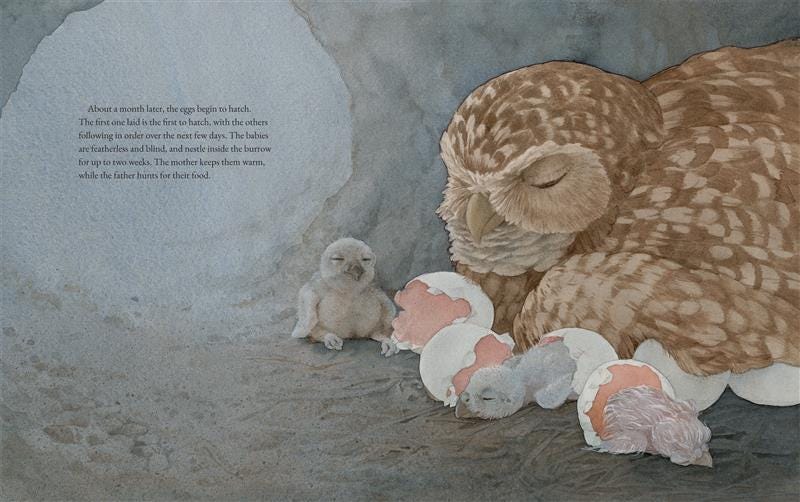
Of course to be a successful scrounger, flesh or feathered, it helps to look compelling. Thanks to Karen Reczuch’s vivid illustrations, the stars of The Burrowing Owls arrest your gaze on every page. Like the baby owls, three weeks old, learning to hop, run, pounce, and clap their wings.
Or, like the reaction from mom, dad, and owlets when a hungry fox sidles up to their burrow. Immediately the entire owl fam lets loose with rattlesnake imitations. Via the close-ups of their pointy, wide-open beaks, and now decidedly unfriendly golden eyes, you can practically hear their sibilant hissing. The would-be predator, outfoxed, slinks away.
One thing burrowing owls haven’t been able to outfox is the loss of habitat. As Hodge notes in her afterword, Canada’s burrowing owl population has dropped 90% since 1990. “At one time, untouched wilderness covered much of the middle of the continent, but today almost all of the prairie is farmed and developed and there are far fewer places for the owls to nest.”
However, with commitment and effort, some of burrowing owls’ lost habitat may be restored. Canada’s western provinces and parts of the mid- and western U.S. have recovery programs.
And here’s where Hodge’s riveting narrative and Reczuch’s compelling illustrations serve as a call to action. Young readers absorbing the owls’ story now may one day join the biologists, Indigenous groups, conservationists, private landowners, and other citizens working to save this fascinating species.
For example, in Saskatchewan’s Grassland National Park, one of North America’s only remaining large stretches of native prairie, biologists supplement owls’ food. They tuck goodies such as defrosted mice inside the burrows.
On reading that, you may do what I did: flip back to an illustration of owlets waiting to be fed. Some peek out of the burrow. Some hop outside and look straight off the page at you. With, you guessed it, “What’s up?” in their bright, curious golden eyes.

About the Author
Deborah Hodge is the author of more than 35 books for children. Her awards include the Children’s Literature Roundtables of Canada’s Information Book Award and the Green Prize for Sustainable Literature. Deborah’s work has also been featured on such lists as ALA’s Top Ten Best Environmental Books for Youth. A former teacher and curriculum writer, Deborah lives in Vancouver, B.C.
About the Illustrator
Karen Reczuch has illustrated many award-winning children’s books, such as Loon by Susan Vande Griek, which won the TD Norma Fleck Award for Canadian Children’s Non-Fiction, the Ruth and Sylvia Schwartz Children’s Picture Book Award and the Children’s Literature Roundtables of Canada’s Information Book Award. Karen lives in Lake Country, B.C.
About the Reviewer
Melanie Jackson is a Vancouver writer/editor. She’s also the award-winning author of middle-grade/YA suspensers, including Orca Books’ Dinah Galloway Mystery Series, and several chillers set in amusement parks.
Book Details
Publisher: Groundwood Books, June 2, 2026
Language: English
Hardcover: 40 pages
ISBN: 9781779460318