

The Confederation Poets by James Deahl
The Founding of a Canadian Poetry, 1880 to the First World War


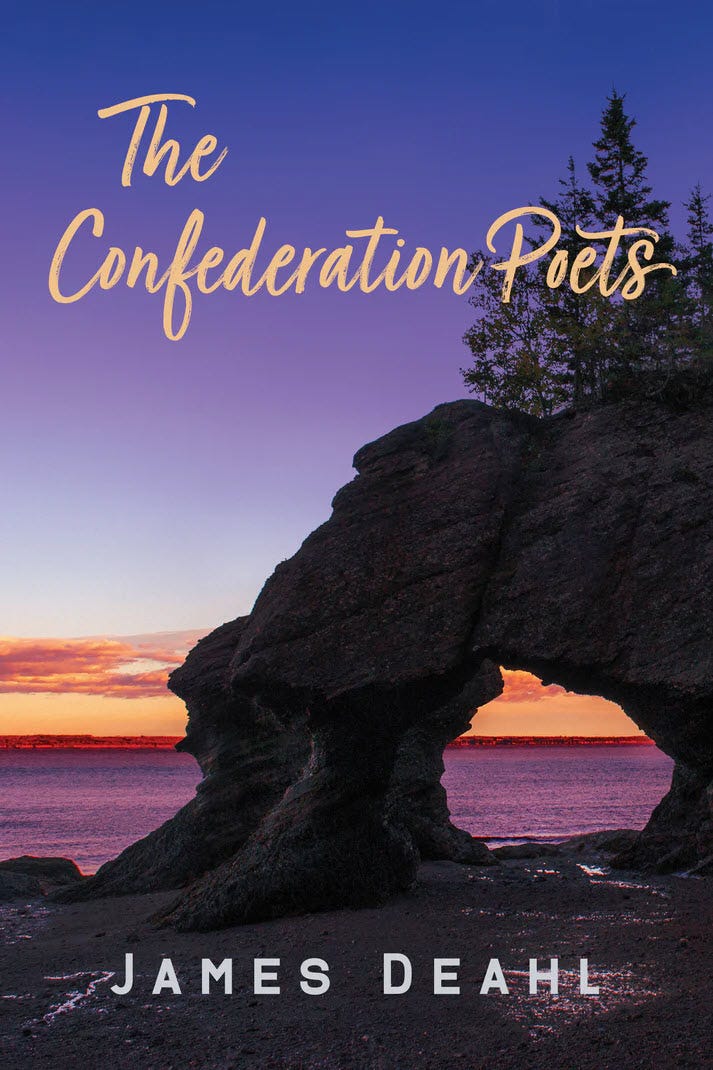
If Charlottetown, Prince Edward Island is the cradle of Confederation, the nearby Bay of Fundy may be considered the cradle of Confederation Poetry, as James Deahl makes clear in his anthology, To Possess the Land. Of the sixteen poets Deahl has assembled, only a handful are well known – Wilfred Campbell, Sir Charles G. D. Roberts, Bliss Carman, Archibald Lampman, and Duncan Campbell Scott. Not only has Deahl chosen judiciously, but his “Introduction” provides clarity on the historical and geographical contexts for these poets. The reader wishes for an even longer introduction, which may be found in his companion volume, The Confederation Poets, also published by Guernica Editions. Guernica has produced a handsome anthology with generous spacing.
These poets are possessed by the land from the Tantramar Marshes around the Bay of Fundy to the vastness of Newfoundland on one side, and the rest of Canada to the west. To possess the land, these poets rely on traditional verse forms inherited from the Romantic and Victorian poets. Sonnets and personification abound in their rhyming verse with Keats, Shelley, Wordsworth, Tennyson, and others looking over Canadian shoulders. There is a kind of family compact in three cousins – Barry Straton, Sir Charles G. D. Roberts, and Bliss Carman – which may be extended to include the poetry of others in this anthology.
Isabella Valancy Crawford is the first poet featured. Consider the opening stanza of her first poem, “A Harvest Song”:
The noon was as a crystal bowl
The red wine mantled through;
Around it like a Viking’s beard
The red-gold hazes blew,
As tho’ he quaffed the ruddy draught
While swift his galley flew.
Regular rhyme scheme, alternating iambic tetrameters and trimeters, and similes sing in this stanza. On the one hand, the scene is brought home in the bowl; on the other, it spreads historically and geographically through the Viking’s presence with the red-gold colour configuration of wine and noon. The last two lines use f and l consonants for the fricative and liquid sounds to harness the impetus of waves.
Similarly, her “Toronto” poem relies on personification: “She moves to meet the centuries, her feet / All shod with emerald.” These nineteenth-century lines move to the twenty-first century reader. George Frederick Cameron writes “Three Sonnets: On Leaving Nova Scotia, 1874.” His sequence, “Shelley,” pays homage to his precursor and concludes, “Spirit to spirit was true, and not ‘dust unto dust’!” By negating the dust of the land, the Romantic spirit takes possession of Canada. Marshland overcomes dust in Barry Straton’s “Evening on the Marshes,” and in “A Dream Fulfilled” he spreads his white sail: “I heard the buzzing sea-like hush.” The Bay of Fundy localizes the Atlantic which stretches back to the Romantic poets.
Ethelwyn Wetherald writes sonnets such as “The Silent Snow” which imagines footsteps of snow like angel travellers that “drown the old earth’s furrowed griefs and scars / Within the white foam of a soundless sea.” William Douw Lighthall recognizes the Indigenous presence in “The Caughnawaga Beadwork Seller” and “Commandant’s Isle” – “Last of your tribe and long departed hence, / Algonkin brave.” Susan Frances Harrison also favours the sonnet as she rewrites Wordsworth in “Tintern Abbey” – taming forms against forces of nature, the compact sonnet against the land’s expanse. Similarly, Wilfred Campbell’s sonnet, “The Tides of Dawn” ends with “The waking world leaps to the day’s desire.”
Sir Charles G. D. Roberts balances the Tantramar Marshes and “An Ode for the Shelley Centenary.” These features recur in the Acadian poetry of John Frederic Herbin and Helena Coleman. Pauline Johnson covers Indigenous subjects in “As Red Men Die” and “A Cry from an Indian Wife.” Frederick George Scott writes the sonnet “By the Grave of Keat.” Bliss Carman, Duncan Campbell Scott, and Archibald Lampman offer a wide variety of poetry. Sophia Hensley is the final poet who concludes with “Somewhere in France,” which pays homage to the fallen of the First World War: “Leave me alone here, proudly, with my dead.” From cradle to grave, To Possess the Land offers a bounty of Confederation Poetry.

About the Author
James Deahl was born in Pittsburgh in 1945, and grew up in that city as well as in and around the Laurel Highlands of the Appalachian Mountains. He moved to Canada in 1970 and holds Canadian citizenship. He is the author or editor of forty literary titles, recently his two prior collections from Guernica, Rooms the Wind Makes and Red Haws to Light the Field, as well as Tamaracks: Canadian poetry for the 21st century, the first major anthology of Canadian poetry published in the U.S. in three decades. He is the father of Sarah, Simone, and Shona, with whom he is translating the poetry of the Québécois poet Émile Nelligan. Deahl lives in Sarnia with companion Norma West Linder.
About the Reviewer
Michael Greenstein is a retired professor of English (Université de Sherbrooke). He is the author of Third Solitudes: Tradition and Discontinuity in Jewish-Canadian Literature and has published extensively on Victorian, Canadian, and American Jewish literature.
He has published 250 essays and reviews in books and journals across Canada, the United States, and Europe.
Book Details
Publisher : Guernica Editions
Publication date : Oct. 1 2022
Language : English
Print length : 100 pages
ISBN-10 : 1771837470
ISBN-13 : 978-1771837477
 | A guest post by
|
My mum grew up on a dirt road that ran along a river through deep woods in rural New Brunswick. These were her poets. Especially Bliss Carmen. “My tent stands in a garden/of aster and goldenrod,/ tilled by the rain and sunshine,/ and sown by the hand of God.
So nice that someone has brought them back into the light.
I wonder if there’s a critical examination of Duncan Campbell Scott’s impact beyond writing a few well-received poems in this anthology? Given his notoriety no justice is done for the reader to completely gloss over his professional and political legacy. I find it striking and slightly off-putting that this review completely ignores these realities as if they do not exist.