

The Eleventh Hour: A Quintet of Stories by Salman Rushdie
A Michael Greenstein Review
Kafka’s Clockwork
“In the South,” the first of five stories in Salman Rushdie’s The Eleventh Hour, begins with a sentence that conveys the rhythms and implications of a master stylist: “The day Junior fell down began like any other day: the explosion of the heat rippling the air, the trumpeting sunlight, the traffic’s tidal surges, the prayer chants in the distance, the cheap film music rising up from the floor below, the pelvic thrusts of an ‘item number’ dancing across a neighbor’s TV; a child’s cry, a mother’s rebuke, unexplained laughter, scarlet expectorations, bicycles, the newly plaited hair of schoolgirls, the smell of strong coffee, a green wing flashing in a tree.” This sentence is divided by the rhyme of loud TV and quiet tree: The cacophony and chaos of an entire society are contained in this sentence that introduces the rise and fall of individuals, nations, and a cadence of colon, commas, and semi-colon. From synaesthetic sunlight to the sacred and profane, the narrator composes a macrocosm of Chennai in India’s south.
An equally long second sentence develops the contrast between old and young in an atmosphere where a green wing flashing in a tree may refer to an instantaneous epiphany or the hidden elements of a lifespan – be it fourscore, eleventh hour, or midnight. “Senior and Junior, two very old men, opened their eyes in their bedrooms on the fourth floor of a sea-green building on a leafy lane, just out of sight of Elliot’s Beach, where, that evening, the young would congregate, as they always did, to perform the rites of youth, not far from the village of the fisherfolk, who had not time for such frivolity.” Rituals play a significant role in the clockwork between the young and very old, or between the lives of Junior and Senior. The concluding sentence of this paragraph opens their eyes further in an accidental world whose author has been traumatized by a knife cutting through his vision. “With the sun stabbing through their window blinds, the two old men struggled to their feet and lurched out onto their adjacent verandas, emerging at the same moment, like characters in an ancient tale, trapped in fateful coincidences, unable to escape the consequences of chance.” Junior and Senior are ancient characters who reflect their author’s fiction and personal trauma.
Since Rushdie’s ritual often turns the mundane into the magical, Junior and Senior enact these rites mixing friction, festival, and fiction: “These were ritual speeches, obeisances to the new day, often in call-and-response format, like the dialogues or ‘duels’ of the virtuosi of Carnatic music during the annual December festival.” The narrator sings the local colour which resonates to broader appeal, so that the “south” becomes a state of mind calling into question geographic boundaries. As Junior praises the south for its warmth, Senior contradicts him: “the south is a fiction, existing only because men have agreed to call it that.” Inverting the universe, Senior casts doubt on Junior’s notions of warmth. In fact and fiction these octogenarians are inextricably bound: “they fought, going at each other like ancient wrestlers whose left feet were tied together at the ankles.” Junior’s ankle proves to be his Achilles heel in an accident that causes his death.
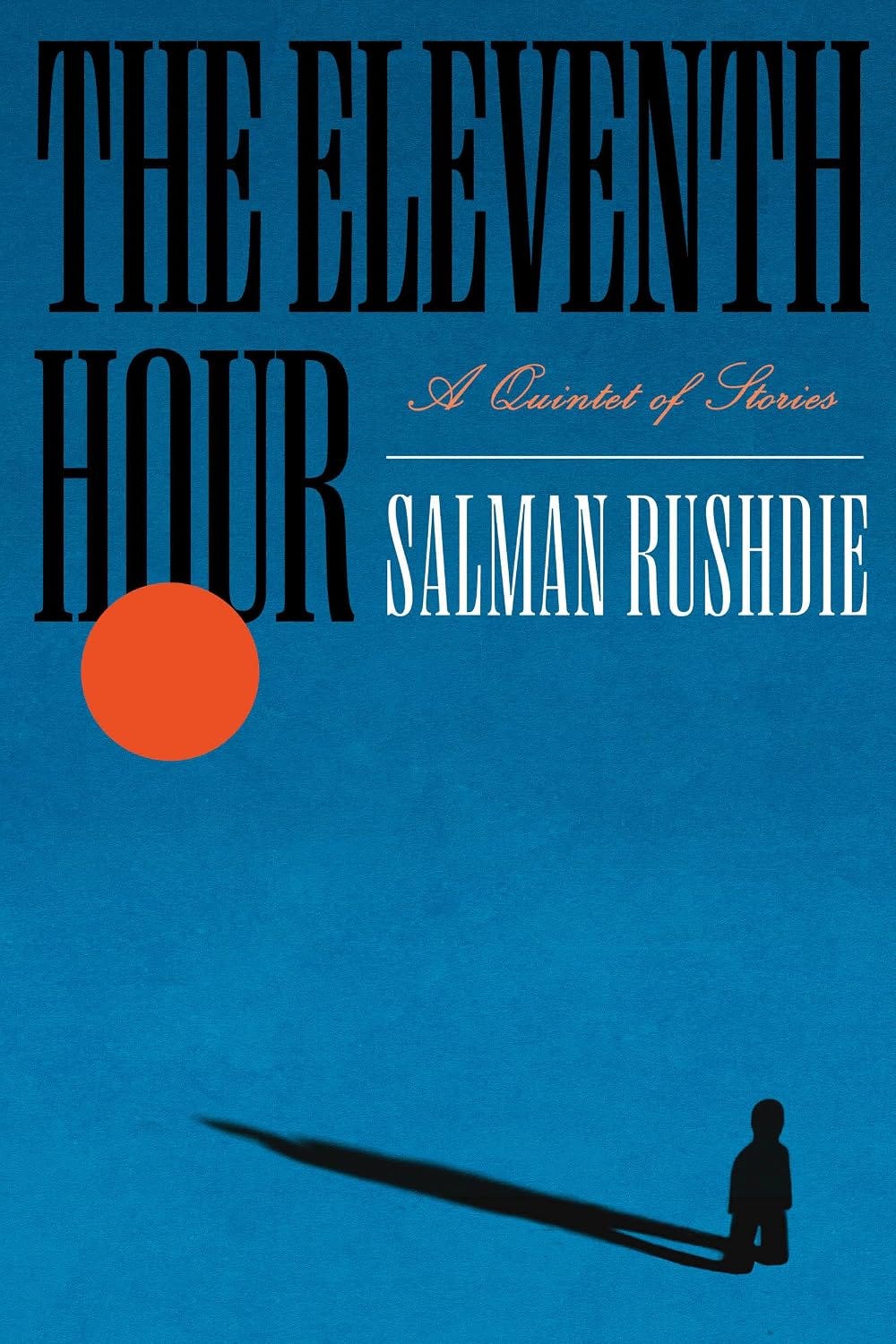
Joined at the ankle, the two men share a long name that neither of them cares to speak. “By banishing the name, by reducing it to its initial letter, V., they made the rope invisible …. They echoed each other in other ways … but it was the unused name, that symmetrical V., the Name That Could Not Be Spoken, that had joined them together for decades.” Un-naming the ineffable, Rushdie renames them in other ways as Junior V. and Senior V. – the letter tied at the ankles, the shadow cast on the book’s cover that points towards the fateful eleventh hour, towards the sun, an eyeball, or clock. (V. also stands for Vespa, the deus ex machina that destroys Junior.) “If old age was thought of as an evening, ending in midnight oblivion, they were well into the eleventh hour.” The clock strikes back in this short story as in Midnight’s Children. First published in the New Yorker after the fatwa but before the knife attack that damaged Rushdie’s eye, “In the South” disorients any space-time continuum and almost foretells its author’s fate.
Senior comes from a large family, while Junior is an only child. Senior rises to a senior position in the railway company, and after his wife dies, he remarries unhappily a widow with a wooden leg who takes her revenge on him by inviting members of her family to disturb his peace in their small apartment. He endures multiple health problems of his advanced age: “the daily penances of bowel and urethra, of back and knee, the milkiness climbing in his eyes, the breathing troubles, the nightmares, the slow failing of the soft machine.” Rushdie’s anatomy of dotage portrays the pathos of these years. If Senior’s widow has a wooden leg, Junior walks slowly, plagued by a weak ankle so that he becomes “a man at a desk,” a bystander of world events: “He had stood by and watched, as an empire fell and a nation rose.” He has one friend, D’Mello, who is twenty years younger, from Mumbai but no longer has a “foothold” in his native city. D’Mello tells postcolonial stories about Mumbai’s Black Horse district.
Each section of the story ends with some mention of death that is characterized by a fall. The two friends climb slowly down their building’s stairs helped by walking sticks to the local post office to cash their pension slips. Junior “understood the nature of the contempt in the eyes of the post office employee. It was the scorn of life for death.” The story hovers between eyes and feet, vision and motion, yet humour dispels despair. Junior sighs that his friend’s gloom and doom “will be the death of me.” “This sentence struck them both as so funny that they laughed heartily, and then had to huff and puff for breath.” They pause briefly by the golden shower tree standing in their front yard, which they had watched grow from a tiny shoot to its present sixty-foot grandeur. This tree serves as nature’s commentary on themes of life and death in the story. Like other place names in India, this Indian laburnum is known as “konrai” in their southern language, “amaltas” in the tongue of the north, and “Cassia fistula” in botany. Junior comments that the tree has stopped growing, having understood that eternity is better than progress. To which Senior replies that the tree has stopped because of its nature.
As they walk along the crowded streets, they look down at their shadows, which lay side by side upon the dusty pavement. After Junior falls, Senior laments the loss of his shadow: “And now I am a shadow without a shadow to shadow.” The golden shower tree casts a long shadow over the decades. When Junior is struck down by the girls on the Vespa, he twists his weak ankle and bumps his head on the sidewalk. In a prophetic note, Senior calls the girls “assassins.”
In the story’s final section death spreads beyond Junior’s demise in a move from a personal to a planetary event: “The next morning in the south of the planet, far away from Senior’s hometown, but not far enough, there was a great earthquake under the ocean’s surface and the mighty water, answering the agony of the land beneath it with an agony of its own, gathered itself up into a series of huge waves and hurled its pain across the globe.” Rushdie’s global reverberations cover all of its countless victims. Senior, who had asked for death, is left untouched. “The texts were empty and his eyes were blind.” He imagines a shadow move on the adjacent veranda. The story concludes with a familiar setting atmosphered by shadows in the south. “Death and life were adjacent verandas. Senior stood on one of them as he always had, and on the other, continuing their tradition of many years, was Junior, his shadow, his namesake, arguing.” In the south a long shadow lurches and foreshadows Rushdie’s argumentative fate.
If the first story has its Dickensian moments, then the second, “The Musician of Kahani,” tilts more in the direction of Franz Kafka who is featured in subsequent stories in this quintet. “The story of the discordant musician and the billion-dollar baby began in a time of unsettling change.” The rush in Rushdie measures unsettling changes in history and narrative sequences. Name changing in India invites the author’s un-naming and renaming in his clockwork with its music of magic realism. “Our city’s name was changed some years before the millennium came along to change time itself.” From Mumbai to London and New York, Rushdie chronicles mean time and place in global fictions. “I decided to rename the place myself, just for myself, and began in my writing and conversation to call it ‘Kahani,’ or ‘Story,’ because it’s where my stories come from.” His self-reflexive pronoun reflects the commingled identities of persona, place, and fiction, for his stories come from metafictional Mumbai. In his imagination he replaces the old colonial names with fictional characters from page and screen. Malgudi Circle ripples outward “because this has always been a cosmopolitan city, facing outward to wider worlds – William Shakespeare Bunder.” In that magical circle the city is a “wonder tale,” with its narrator as Prospero taming tempests.
Rushdie’s magic oscillates between individual and national births, and between eleventh and twelfth hours. The twentieth century ends, “And at midnight, the approved hour for miraculous births in one part of the world, a baby was born to a Breach Candy family, and a new thousand-year era began.” We hover between the moment and the millennium. The father is Raheem Contractor, a fifty-year-old mathematics professor; the mother, Meena Contractor, twenty years younger, specializes in information technology; and baby Chandni, the eponymous Musician of Kahani, becomes the mother of the billion-dollar baby. Although there are many contracts within the story, it is ultimately the contract between Rushdie and reader that counts as he serves up satire alongside magic realism. The upscale neighbourhood of Breach Candy affords an opportunity for satire: nobody can agree on the origins of its name, but all concur on its “niceness”: “The people living there, nice people. All kinds, all religions, Hindu Muslim Parsi Christian Jain and one-two Sikhs, getting along. Old-young, side by side. Well-to-do, for sure, well-off families.” Side-by-side hyphens establish the social contract and satire among various groups within this affluent community. Yet the denizens of Breach Candy cannot boast of the wealth of others above them: “not rich like the folks on the high ground, up on ‘those’ parts of Malabar Hill or most of Altamount Road. Dear me, no. That’s rich-rich-rich up there, big-big-rich.” Dickens surveys Mumbai, hyphenating classes as he goes along.
The narrator parenthetically inserts himself in metafictional moments as part of his contract. Describing Raheem Contractor’s mathematical pursuit of proof for Fermat’s Last Theorem, he concludes: “This assertion, incomprehensible to ordinary people, including the present author, whose age increasingly presents him from grasping complex ideas, has vexed the minds of the finest mathematicians down the centuries.” The Eleventh Hour never leaves aging far behind.
Chandni becomes a musical prodigy on the piano and other instruments; Raheem discovers religion and abandons his family; and Meena sells her technology discovery and becomes rich enough to buy her dream home for the family. Chandni charms the billionaire Ferdaus family, marries their son Majnoo in an over-the-top wedding, and becomes pregnant only to lose the baby. Artistic magic takes its revenge on capitalistic power, as Chandni’s fingers resume their magical movement: “It was music of a kind they had never heard before, and the instruments on which it was being played were unknown to them.” Much as the earlier wealth ascended above Mumbai, music now overtakes the city. “It rose above their home like a pillar of smoke, like a column of fire, like the weapon of an invading alien species, and then it rushed across the city and the country to do its deadly work.” Chandni’s unearthly music destroys an entire empire.
After this apocalyptic cleansing the narrator comes down to earth: “Here I am visiting my yesterdays one last time and they are visiting me. I will not come this way again. And at the end of the lane, while the children play, I look up at the end of my story.” A certain nostalgia visits the family’s veranda where Chandni smiles “her strange little smile,” while Dickens and Kafka lurk in the background.
The next story, “Late,” shifts to England where it relocates themes of ageing and naming at Cambridge University. A framing introduction chronicles the College’s history: “The College was almost six hundred years old. It had been founded by a king who was mad for most of his life. After his death he began performing miracles.” Rushdie contracts centuries to a shorter time frame for his story: “Such occurrences, if true, may serve as a sort of foreshadowing of the unusual events that occurred more recently, approximately fifty-five years ago, and that will be set down without judgment in this belated account.” Fiction encompasses miracles, foreshadowing, and belatedness in its quest for truths. “They are events that cannot easily be accommodated within a rigorously rational description of the world.” “Late” offers up delights of irrationality.
So the story begins: “When the Honorary Fellow S. M. Arthur woke up in his darkened College bedroom he was dead, but at first that didn’t seem to change anything.” Echoing Gregor Samsa’s awakening in Kafka’s “The Metamorphosis,” this protagonist’s wakeup call transforms nothing in the twilight zone between the eleventh hour and midnight’s magic. He reaches for his small bedside alarm clock (“it was the day when the clocks went back”): “The clock hands were stuck at midnight.” Rushdie turns back and multiplies clocks through history and narrative clockwork in his grasp of time. If S. M.’s name carries meaning that is revealed by the story’s end, so too does the Provost’s redoubling name, Lord Emmemm. This ghost story carries a frisson of its author’s fate under a fatwa, rescued by authorial irony avenging revenge with a knife that cuts both ways: “in spite of the evidence of his own eyes – the sight of his own body lying dead in bed – he continued to see himself as having his usual physical form.” Hindsight and foresight converge in fiction’s knife-life after death. And Rushdie’s self-deprecating humour plays a role: “If this was death, then it was something he could live with.”
“Late” invokes Shakespeare, Dickens, and Oscar Wilde. Kafka too: “S. M. Arthur’s father, like Kafka’s father, had been a brute …. Brutish fathers had already been ‘taken’ by the literary insurance officer from Prague.” The Honorary Fellow is fully aware of his British and brutish precursors. Belatedly he writes about the Garden of Eden at the end of the world. His preposterous unfinished fiction includes “The Country of Shrinking Borders”: “The idea seemed to be that in the end the borders would arrive at the edges of his own body” – anatomy as destiny under fatwa. His middle name is Merlyn, for he is a magician suppressing and revealing homosexuality, solving cryptic crossword puzzles, and flipping time: “The time in Bombay was five and a half hours later that at the Greenwich meridian. A curious consequence of this was that if you turned your wristwatch upside down in England its hands showed you the time in India.” Always on the alert, Rushdie’s bifocal vision covers inverted time zones. Another part of Arthur’s secret existence is his participation in decoding enemy messages during World War II. The code breakers called themselves the Round Table, as Rushdie comes full circle from the small alarm clock at the beginning of “Late” to an international circle of spying that comes to light after a generation.
Kafka appears most prominently in “Oklahoma,” which alludes to “Amerika,” Kafka’s unfinished novel in which the American state is a destination never reached by protagonist Karl Rossmann. Written between 1912 and 1914, published posthumously in 1927, and originally titled “The Missing Person” or “The Man Who Disappeared,” this picaresque tale appeals to Rushdie who has disappeared for years after the fatwa was issued. As part of his clockwork, Rushdie delays and defers plot, character development, themes, and structures, even as he foreshortens names in his onomastic games. The “Foreword” to “Oklahoma” frames these names: “The text that follows is the last work of a writer whom we sadly lost too early, Mamouli Ajeeb, who preferred to be known by his initiales de plume, ‘M.A.’” Inversions of first and lasts, and foreshortening of identities expose the fate of a writer under a fatwa. Contrasts between revealing and concealing appears in the fate of a manuscript with instructions that parallel Kafka’s: “(contradicting an indication in the text itself that it should not be published).”
The story opens with Uncle K. addressing M.A.: “Uncle K. said to me that first weekend on Long Island, ‘and he never called it Amerika’.” Rushdie’s metafictional modes reinvent Kafka’s modernism a century earlier. The twenty-seven-year-old narrator confesses that he has never read “Amerika,” but has read other related works. “We must carry whole libraries in our heads, like Peter Kien, the hero of Canetti’s Auto-da-Fé.” Like Kafka and Rushdie, “Uncle K. was obsessed with disappearance. His novels and stories were full of vanishings.” Dreams, magic, and ghost stories weave through Rushdie’s fiction. As he works his way through mythological disappearances from the Greek gods to King Arthur, he arrives at an Irish ridge where James Joyce awakens Finn MacCool: “ ‘All Finnegans,’ Uncle K. liked to say … ‘eventually wake’.”
At present Kafka’s first anti-hero is on his mind. Karl Rossmann (a horse man) never arrives in Oklahoma (home of red people); instead, he is stuck in a railway carriage across the vastness of America, having survived the earlier Atlantic vastness. When M.A. suggests that Uncle K. should write an ending for Kafka’s story, he understands the impossibility of such a task. “In the first place I think he saw Karl Rossmann as another Kafka – lost too young but also eternal – and to ‘finish’ him would be … a stepping into boots none of us could fill.” The burden of the past weighs heavily on this acolyte. “And in the second place, could any of us truly imagine what that Oklahoma would be like?” An anti-heroic K. Rossmann in a utopian no-man’s-land invites one more consideration: “And in the third place, he thought of his country – ‘Amerika’ or, as I grew up calling it in my mother tongue, ‘Amrika,’ – as somehow unfinished too, somehow lost in the middle of its own story, its future unknown; so the unfinishedness of the novel felt appropriate. In its incompleteness its meaning was complete.” Hence the sense of an unending and upending in its postmodern turns.
Among Rushdie’s intriguing tangents are ekphrastic excursions to Madrid’s Prado Museum where Velázquez, Goya, and Bosch come alive. Saul Bellow and Lewis Carroll make cameo appearances in his reading list of disappearances. After reading Uncle K.’s manuscript, M.A. concludes that the unstated message of the pages in a manila envelope is “Find me.” That this message in turn points to Rushdie’s disappearance is further underscored by a visual reference: “I was no private eye. I couldn’t see myself sleuthing across America to search for him.” Ultimately the private eye is knifed into the public eye. Oklahoma is shortened to OK and Mamouli Ajeeb’s name is explained as strange and ordinary – an oxymoronic name searching for its


About the Author
Salman Rushdie is the author of fifteen previous novels, including Midnight’s Children (for which he won the Booker Prize and the Best of the Booker), Shame, The Satanic Verses, The Moor’s Last Sigh, and Quichotte, all of which have been shortlisted for the Booker Prize; a collection of stories, East, West; a memoir, Joseph Anton; a work of reportage, The Jaguar Smile; and three collections of essays, most recently Languages of Truth.
About the Reviewer
Michael Greenstein is a retired professor of English (Université de Sherbrooke). He is the author of Third Solitudes: Tradition and Discontinuity in Jewish-Canadian Literature and has published extensively on Victorian, Canadian, and American Jewish literature.
He has published over 300 essays and reviews in books and journals across Canada, the United States, and Europe.
Book Details
ISBN 9798217154203
Available onAug 04, 2026
Published byRandom House Trade Paperbacks
Pages 272