
The End of Prim by Michelle Tocher
Reviewed by Anne Smith-Nochasak

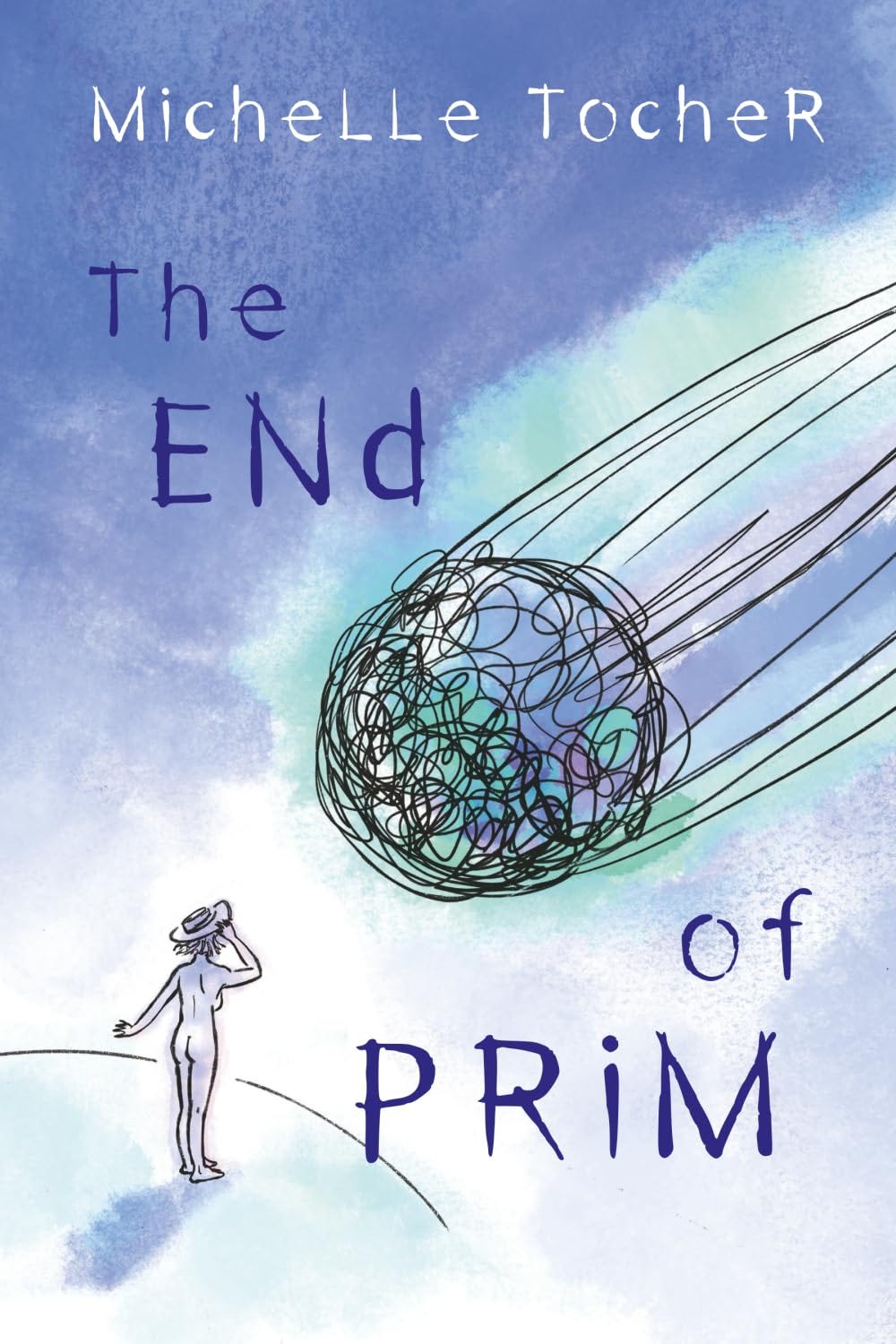
In The End of Prim, Michelle Tocher examines the ways we reinvent our lives. Although this theme is by no means new, the treatment in this novella is refreshing. For although the character of Prim is on one level very typical—a woman in her sixties during a time of world crisis who sets out to change her response to the world—on all other levels, Prim simply turns that world upside down. Through Prim, the author teaches us to look at the world in a new way. And the illustrations by Shelagh Armstrong capture the meaning of those Prim moments very well.
Prim has always been a follower, someone not really noticed, always shielded by her flat-brimmed hats and sedate clothes. She has worked quietly in educational publishing, never drawing attention to herself, never stepping out of line. With a confident older sister and a mother who “accepted everything and everyone heartily,” but never seemed quite satisfied with her, Prim explains that she is “stuck in a soiled history—helpless and needing a mother willing to face her daughter’s shit and love her anyway.” (48) There is never open mother-daughter dialogue between them; Prim does not hear her mother’s story until she is twenty-four, when she learns how her mother’s aunt hid her mother during the war. Even then, there is a distancing.
As December 2012 unfolds, and with it the expectation of the end of the world, Prim takes steps to change. The flat-brimmed hat is replaced by a backwards baseball cap sporting a dragon fly, and Prim books a visit to a spa. She is not a bold or outspoken character, but she sets out, consistently and with quiet courage, to lay claim to the life that is hers. She takes deliberate steps to do the things that Prim would never do. Subtle things like changing her hat, sending back food in a restaurant, taking in the amenities of a spa, having a pedicure.
The change continues. Prim trusts her friend Eva with the story she has been carrying since childhood, and in the sharing of stories, a genuine closeness emerges. Later, she buys an expensive shawl as a gift for someone who needs cheering up, makes friends with someone she meets online —and opens her house to others.
In 2021, the mask replaces the hat as a means of hiding her face from the world. And there are other milestones in Prim’s journey to recreate her life. When her friend Eva, although younger than Prim, exhibits early symptoms of dementia, Seventy-year-old Prim invites Eva into her home and provides care and companionship. When Eva’s son threatens Prim because of this, Prim stands up to him. She joins an online writers group, where she develops an online relationship with Danny, another participant. The evolution of the friendship involving Prim, Eva, and Danny is a delight to follow—at times heartwarming, at others poignant. There is often an undertone of humour.
“Swallowing” is a key term. Prim has always “swallowed whatever was given to her, no matter how nasty, because she would not wish to offend the offender.” (20). Often, it is her own words which are swallowed. Prim sets out to reclaim her words, at one point telling Danny, “Before anyone else names me, I want to name myself. And that is almost impossible to do in this world where the only thing we know about ourselves is what other people think they see.” (90)
I found, as I read, that it was the way this author put the story together that gripped me from the beginning. The way Prim looks at the world and the way this relationship is expressed catch the attention and lead us to exclaim, “Yes. I have felt that too,” even though we might not have thought about it before.
As for the conclusion, no spoilers will be given here, but I found the ending satisfying and uplifting. Others may feel differently, but I am with the author in her observation: “Prim is and will always be for me an emblem of the triumph of imagination over the life-stuff that can drag us into a riptide of grief.” (145)
This novella pays tribute to the quiet ways in which people lay claim to their independence—and to the ways we can grow in independence while growing together in friendship.

About the Author
Michelle Tocher writes fiction and non-fiction books that bring mythic perspectives to real-world situations.
About the Reviewer
Anne M. Smith-Nochasak grew up in rural western Nova Scotia, where she currently teaches part-time after years in northern communities. She has self-published four novels with Friesen Press: A Canoer of Shorelines (2021), The Ice Widow (2022), and two books in the Taggak Journey trilogy: River Faces North (2024) and River Becomes Shadow (2025). A member of the Writers’ Federation of Nova Scotia, Anne enjoys incorporating local settings into her writing. In her free time, she likes reading, kayaking, gardening, renovating, and exploring the woods with her golden dog, Shay, while her cat, Kit Marlowe, oversees the house. Anne can be contacted through her website. https://www.acanoerofshorelines.com/
Book Details
Publisher : WonderLit Press Ltd.
Publication date : Sept. 13 2025
Language : English
Print length : 150 pages
ISBN-10 : 1069368601
ISBN-13 : 978-1069368607
 | A guest post by
|
A ball cap is a dangerous thing in your sixties. The world looks different from under the bill of a taupe cap sporting a Kejimikujik Park crest. Try it. You’ll be amazed. I look forward to Michelle Tocher’s adventure.