

The Fall-Down Effect by Liz Johnston
A Michael Greenstein Review

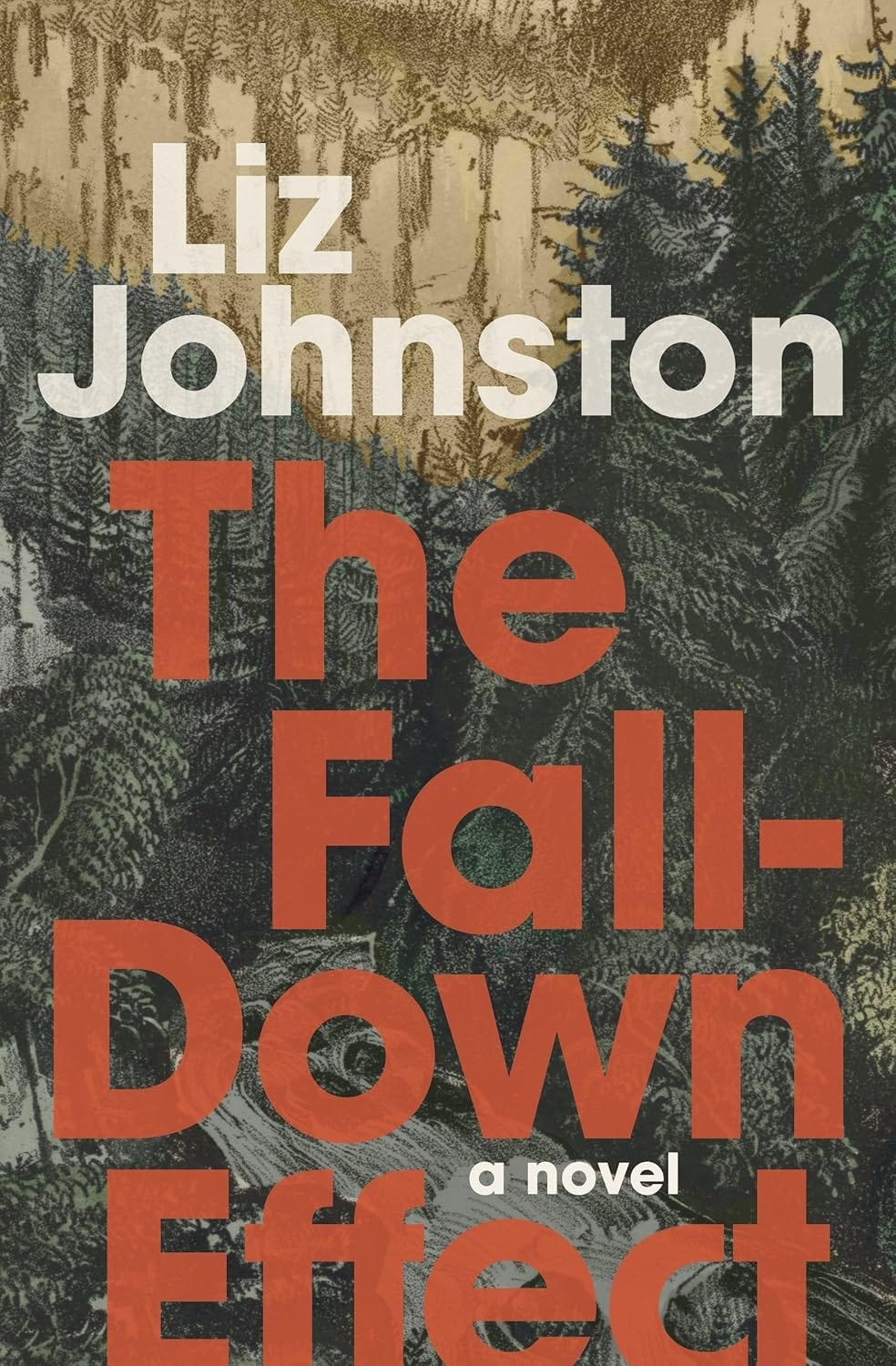
Not until about two-thirds of the way through Liz Johnston’s debut novel do we find an explanation of her title: “She’d learned the concept of the fall-down effect in school, how timber production declined as the old growth was depleted – logged.” The character in question here is Sylvia, one of three children named after a connection to nature in British Columbia: Sylvia in her sylvan setting, her brother River, and Fern the middle child in this somewhat dysfunctional family. Each member of the family is engaged in the ecosystem of Johnston’s roman à thèse. “Whatever grew back would not be equal to what had been lost.”
From the outset The Fall-Down Effect oscillates between entropy and empathy for family and forest. The novel is structured around three years – 1989, 2001, 2020 – each introduced by a telling epigraph. The first epigraph belongs to Adrienne Rich who focusses on forestry and empathy: “Because you still listen, because in times like these to have you listen at all, it’s necessary to talk about trees.” In pleasurable prose Johnston talks about trees from her opening sentence: “Fern pressed her body into the bark.” A symbiotic relationship between nature and character tills the novel, despite the forces that stand in the way. This young tree-hugger appears to prop up any fall-down effect: “Amid the spare lower branches, she’d found a perfect outline for her seven-year-old frame, no limbs or knobs sticking out where her head and shoulders wanted to go.” This chameleon camouflaging foreshadows Fern’s disappearing act later in the novel. Oscillating among each member of the family, the novel’s outline frames character and setting in an ecological drama.
“Although the novel’s events turn around the turn of the twenty-first century, there is an epic backdrop surrounding contemporary life in British Columbia’s timeless forest.”
The youngest of the three siblings, Fern is also the most politically active, following in the footsteps of her mother, Lynn. She eventually sets fire to the local mill and disappears for decades in the United States. “The hemlock welcomed her” – as if this ominous tree prepares her for her destructive activism. In their game of hide-and-seek Sylvia and River call out to her, but Fern remains camouflaged, even as she later loses her identity to become Di, goddess of the hunt. When the small child wets herself in the woods, her older sister reassures her: “We can fix everything before Mom or Dad comes home.” In this first fall-down effect, the children try to repair the world around them. Sylvia knows that “she wasn’t a free-floating atom. Her family was a molecule, and she was bound to every member.”
Although the novel’s events turn around the turn of the twenty-first century, there is an epic backdrop surrounding contemporary life in British Columbia’s timeless forest. “River travelled softly along the boundary line between sleep and waking.” In this semiconscious state he invokes Dante’s epic: “he was also wandering through a deep dark wood, looking for Fern.” This prepares the way for Lynn and her children chaining themselves together to block logging trucks. After this incident Constable Stott addresses the family: “We can’t have a five-year-old running around.” Johnston’s narrative wanders between woods and words; between forestry and their car (Maeve), which “felt like an animal, a lumbering, legged creature;” and between padlock and Mom twisting on her seat “so she could lock eyes with each of them in turn.” The narrator locks eyes on each character in turn through a wood darkly. The family is forced to give up home schooling, and the children enter the local school with varying degrees of success and fall-down effects in their bildungsroman. Their transition from home to school is marked by trees: “As they got closer to town, the trees stopped being forest and started being decoration.”
Lynn and Tom eventually divorce, as she finds love with a woman instead. Part 2 jumps to 2001 when Fern detonates five homemade bombs at the local mill and sets it ablaze. She then leaves for the United States where she disappears. Part 3 skips to 2020 when the family members gather but maintain distance during Covid. B.C. forest fires also plague their lives. The novel ends with Fern composing a postcard to River. “She wanted to explain everything, but she could never explain.” The novel instead does most of the explaining.

About the Author
LIZ JOHNSTON grew up in Revelstoke, B.C., and now lives and writes in Toronto. Her essays and short stories have appeared in Poets & Writers, The Fiddlehead, The Humber Literary Review, Grain, The Antigonish Review, and The Cardiff Review. Johnston is an editor of Brick, A Literary Journal. The Fall-Down Effect is her debut novel.
About the Reviewer
Michael Greenstein is a retired professor of English (Université de Sherbrooke). He is the author of Third Solitudes: Tradition and Discontinuity in Jewish-Canadian Literature and has published extensively on Victorian, Canadian, and American Jewish literature.
He has published 250 essays and reviews in books and journals across Canada, the United States, and Europe.
Book Details
Publisher : Book*hug Press
Publication date : April 21 2026
Language : English
Print length : 352 pages
ISBN-10 : 1771669624
ISBN-13 : 978-1771669627
 | A guest post by
|
'Although the novel’s events turn around the turn of the twenty-first century, there is an epic backdrop surrounding contemporary life in British Columbia’s timeless forest. “River travelled softly along the boundary line between sleep and waking.” In this semiconscious state he invokes Dante’s epic: “he was also wandering through a deep dark wood, looking for Fern.” This prepares the way for Lynn and her children chaining themselves together to block logging trucks.'
I have to read this. (Oh... the teetering tbr pile.) As usual, thanks to the Seaboard Review of Books for bringing powerful new Canadian work to my attention. I wonder if Liz Johnston's novel will remind me of my current read, Michael Christie's Greenwood.