
The Hidden Hand: The Information War and the Rise of Antisemitic Propaganda by Warren Kinsella
Reviewed by Chris Reed

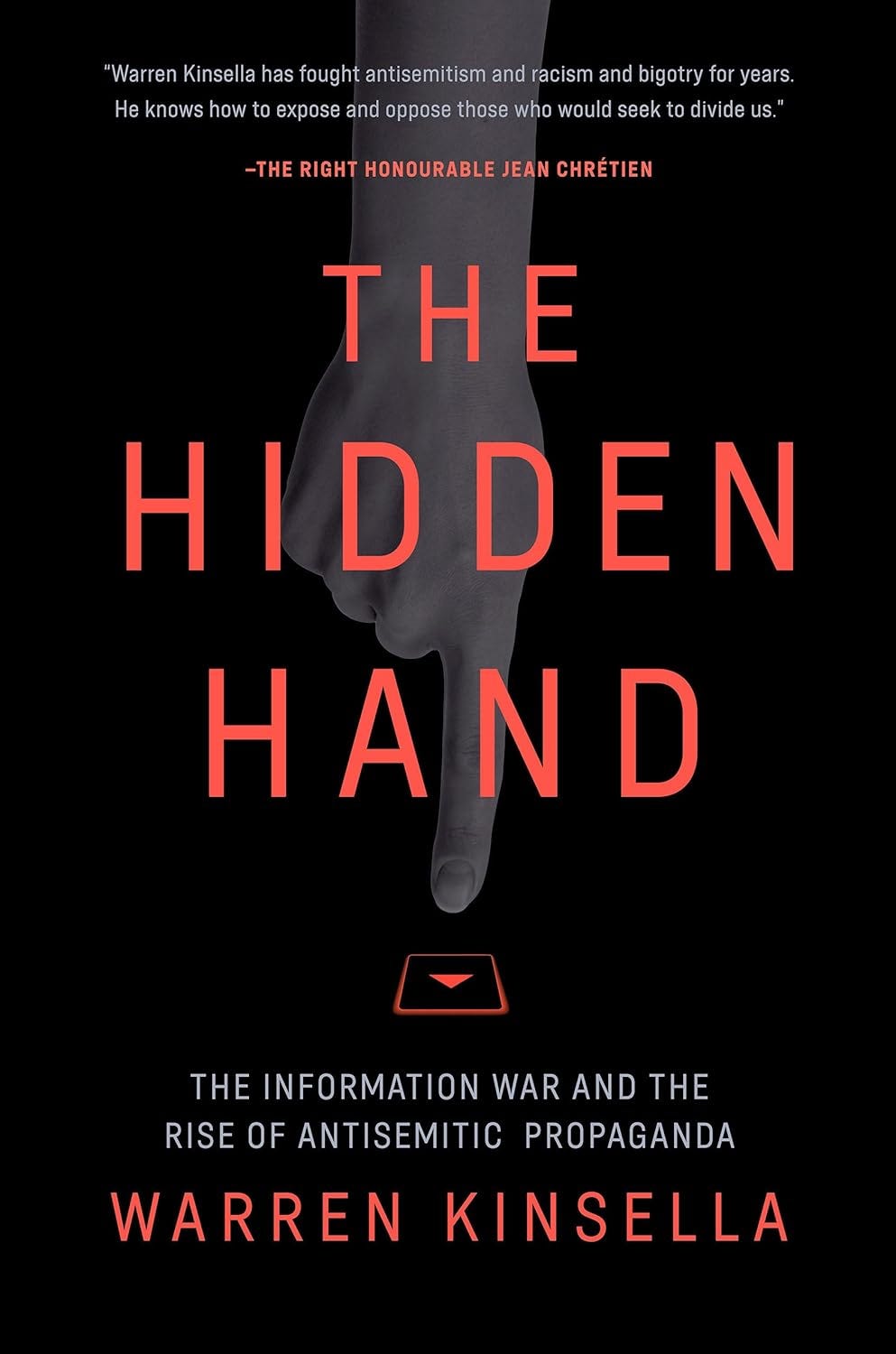
When protests erupted across Canada, the United States and Europe immediately after Hamas’s Oct. 7, 2023 attack on Israel, veteran political strategist Warren Kinsella saw the same slogans, signs and tactics surface in city after city, worldwide. To someone who had spent decades running political campaigns, it had all the tell-tale signs of a coordinated operation. How did a country still reeling from a massacre become a global pariah within hours, before it had fired a shot in response?
In The Hidden Hand: The Information War and the Rise of Antisemitic Propaganda, Kinsella investigates the twin forces behind the surge of anti-Israel activism after Oct. 7. First, he argues that anti-Israel sentiment and antisemitism were already far more prevalent than many civic leaders were willing to admit. Second, those currents were amplified by a propaganda campaign of unusual speed, sophistication and reach. Such a vast movement cannot run without a steady flow of workers and money. Above all, he writes, “it needs a hidden hand.”
Kinsella’s use of the “hidden hand” shrewdly inverts one of antisemitism’s oldest lies: the racist fantasy of Jewish control. But the shadowy force he identifies is not Jewish power. It is the machinery of anti-Jewish influence itself: Iranian funding, Hamas propaganda, activist networks, social-media campaigns, campus organizations and extremist fellow travellers. Kinsella is keenly alert to the strange convergence of the far right and radical left, which share a rhetoric that denies Jewish legitimacy.
The book reaches beyond the Middle East into Western democracies, where a propaganda war of words and images reshapes public opinion through bot networks and fake accounts. Long before Oct. 7, Hamas and its allies aimed their online efforts at Gen Z and millennials, particularly on feeds like TikTok, where speed and outrage routinely trump context. They are “targeting the hearts and minds of millions, especially our young,” Kinsella says. “And we are losing that war.”
The Hidden Hand dwells on Hamas’s earlier propaganda for a pointed reason, captured in one of its bluntest and most chilling lines: “you cannot fashion a Jews hating terrorist out of thin air.” Radicalization takes preparation; before violence can be justified, language has to strip its targets of their humanity. That groundwork, Kinsella argues, had been laid for years — cultivating a generation already primed to see Israel, and often Jews themselves, as uniquely monstrous.
Kinsella has spent much of his career exposing the workings of organized hate. A lawyer, political strategist, journalist, author, punk musician, and, most recently, filmmaker, he wrote a foundational account of Canada’s far right, Web of Hate. Three decades of that work have taught him that “antisemitism is a shapeshifter” — an insight that illuminates how the hatred jumps between digital platforms around the globe and stays below official notice.
Antisemitic incidents, vandalism and public hostility have risen sharply in Canada since Oct. 7. The Hidden Hand traces how the nation’s demographics, vulnerability to foreign interference, institutional weakness and political reluctance have left it badly exposed. A country that prides itself on pluralism, Kinsella argues, has become disturbingly susceptible to anti-Jewish intimidation and foreign propaganda.
The sheer volume and variety of material Kinsella gathers is almost daunting. What keeps it from becoming a catalogue of outrage is his instinct for character and story. He follows not only the messaging of some 150 student groups, for instance, but the impact such material has on people of all stripes: we meet pollsters alarmed by generational attitudes, observers of campus radicalization, and analysts who have watched anti-Israel rhetoric harden into antisemitic conviction.
When Kinsella follows the money, the connections he has assembled click into place. He traces how funds intended for benign or progressive purposes can move through institutions and end up supporting anti-Israel activism. The result is politically grotesque: Western organizations committed to pluralism, queer rights or social justice wind up adjacent to messaging that serves the interests of Iran, Hamas and other forces openly hostile to those values.
Language is central to the process. “Much of the haters’ lexicon,” Kinsella writes, conveys “a precise message using words and images that are deliberately imprecise.” Propaganda does not merely lie. It simplifies. It blurs. It hands people phrases that feel morally clarifying while distorting the truth. It “lets language do our thinking for us.”
The propaganda network Kinsella uncovers ultimately distorts the debate for everyone, not only its targets. If public opinion is shaped by bot networks, activist toolkits and slogans engineered to inflame rather than clarify, then neither Israelis nor Palestinians are served; both are trapped in competing echo chambers. How can there be progress if the public square is flooded before the conversation begins?
The hatred Kinsella tracks is ancient; the delivery system is state-of-the-art. A democracy cannot answer a campaign it refuses to see. The Hidden Hand makes this one — the circuitous funding, the standardized slogans, the digital toolkits, and the patient work of turning a generation against a people — impossible to ignore.


About the Author
WARREN KINSELLA is a lawyer, pundit, political consultant, and a newspaper and magazine columnist. He is the author of The War Room and the bestselling Web of Hate. He lives in Toronto, is a dad to four amazing kids, still plays in a punk band and is the president and founder of the Daisy Group, a political consulting group.
About the Reviewer
CHRIS REED is a freelance book publicist (@reedbookspublicity) and an occasional book reviewer. He lives in Toronto.
Book Details
Penguin Random House Canada
On Sale: April 21, 2026
Pages: 344
ISBN: 9780771021572
Price: $39.99
 | A guest post by
|