

The Instrument Must Not Matter by Christine Fischer Guy
A Guest Review by Laura Rock Gaughan

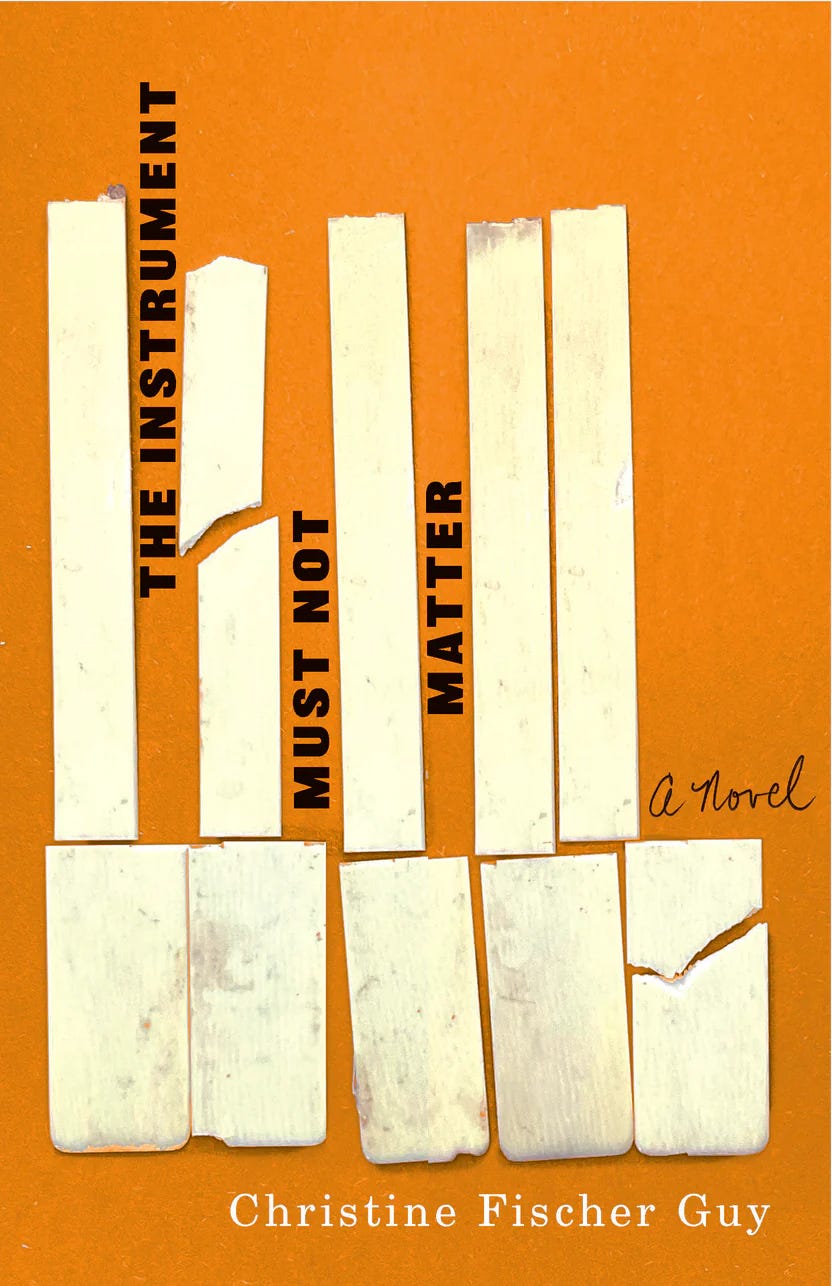
The Instrument Must Not Matter is an intricate and engrossing coming-of-age story in which the musical development of the main character, Lila Rys, matters as much as her personal trajectory. A promising young pianist, Lila travels from her home in Toronto to New York City to study with the famed teacher George Vrubel. Her family supports the move financially and emotionally. Her uncle provides an apartment and the finest piano she has ever played, while her twin brother Lucas, a literature student at NYU, shares the apartment and keeps her grounded. As the one who best understands Lila’s needs, he helps her navigate intense feelings. Among many obstacles she must confront in her journey through the hypercompetitive world of classical music, she’s torn between Vrubel’s edicts and the influence of Sofia, an esteemed concert pianist, who becomes both mentor and romantic partner.
Lila sees music and voices as colours, and she hears visuals as music. A bright sky, clouds rolling in, light on the river—each arrives in a distinct musical key, in her perception. Her synesthesia is one of several neurodivergent traits that accrue on the page without labels applied to these differences. She struggles to read social cues. In conversation she reminds herself—channeling her mother’s advice—to say the polite phrases that, to her, are empty and unnecessary. And in a subtle way, it becomes evident that Lila’s photographic memory and pinpoint focus enable her to excel musically.
One does not need to understand classical music to enter fully into this novel. Fischer Guy weaves into the narrative intriguing facts about musicians, compositions, technical challenges for pianists, and famous performances—from the concert hall to YouTube—in a way that left me wanting to learn more. The action moves between Toronto, New York, and the Czech Republic, settings imbued with history that matters to the characters in the present. Lila’s relationships with friends are rendered deftly in realistic dialogue and threaded text messages that keep the tempo allegro.
The book comes into its full power with the intertwining story of Lila’s grandmother, in a Czech care home suffering from dementia. In her youth, Juliana was a talented violinist during the brutal 1968 Soviet occupation. Juliana’s memories create a dual-timeline narrative involving a forbidden public performance and a newly discovered samizdat novel, dissident literature that had to be hidden from authorities. Translating the novel becomes Lucas’s obsession, a key to understanding their family history. The two timelines, and the big questions—musical, literary, and familial—converge at the end in a most satisfying way. In The Instrument Must Not Matter, Fischer Guy has created a contemporary portrait of the artist as a young woman, informed by history.

About the Author
Christine Fischer Guy is a Toronto writer and journalist. She’s a 2024 VCCA fellow and is the author of The Umbrella Mender (Wolsak and Wynn 2014), a “terrifically entertaining read” that “keeps the reader interested partly because she avoids setting up stereotypical opposites.” Her second novel, The Instrument Must Not Matter, is a coming-of-age story about a classical pianist and arrives in spring 2026. Her short fiction has appeared in Canadian, American and British journals. She was awarded a National Magazine Award and contributes criticism and interviews to literary journals.
About the Reviewer
Laura Rock Gaughan’s fiction and essays have appeared in Canadian, Irish, and US literary journals including The Antigonish Review, the New Quarterly, Southword, CutBank, and CRAFT Literary. She’s the author of MOTHERISH, a short story collection, and is currently at work on another collection, as well as a novel.
Book Details
Publisher : Buckrider Books
Publication date : May 12 2026
Language : English
Print length : 250 pages
ISBN-10 : 1998408388
ISBN-13 : 978-1998408382