

A Maestro Act: Review of The Lost Queen by Heidi Von Palleske
Reviewed by Olga Stein

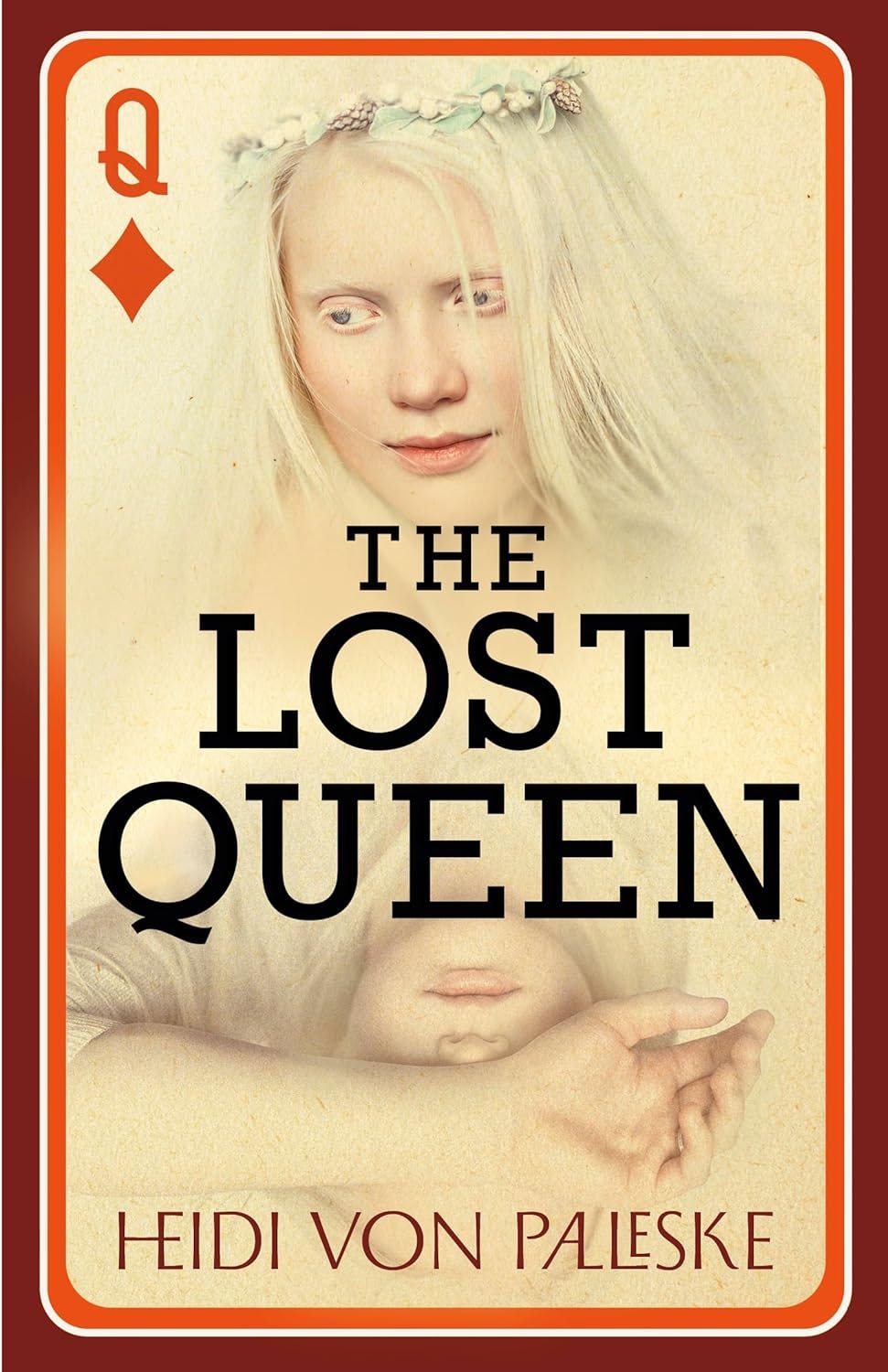
Heidi Von Palleske’s The Lost Queen is the second in a planned trilogy of novels centred on musically-gifted near-identical albino twins, Clara and Blanca. I haven’t yet read the preceding book, Two White Queens and the One-Eyed Jack (2021), so it took a few chapters into this sequel to get my bearings, but once I did, my, oh my. Von Palleske, who is also a recognized actor and prolific poet, won an HR Percy Award for the manuscript of her first novel, They Don’t Run Red Trains Anymore (2017).
“Von Palleske writes with an awareness of a demanding, literate audience that expects a good return on their time and reading efforts.”
Her latest work, an intricately wrought story that revolves around Clara’s calamitous disappearance, inclines me to think that more actors should try their hands at penning fiction. Von Palleske writes with an awareness of a demanding, literate audience that expects a good return on their time and reading efforts. The Lost Queen meets such expectations, and not just by offering entertainment (though let’s not gloss over the importance of being entertaining). This novel is comprised of lovely writing, the crafting of which requires refinement as regards language and depth. One might even say that it has flavour and substance. After all, there’s a reason the title and other aspects of the novel invoke the disappeared operatic singer Clara and The Iliad’s Helen of Troy, whose vanishing from Sparta sparks a tragic decade-long conflict (Helen’s ‘abduction’ is explored here along lines I haven’t encountered before). Von Palleske shares with readers her extensive knowledge and understanding of many things, including history, opera, literature, and myth, as well as the ways different types of artistic endeavour can interact to produce complex yet engrossing storytelling.
Some evidence is certainly called for when a reviewer asserts that a novel has merit. Here, then, is one of The Lost Queen’s most notable achievements: the tight-knit circle of friends introduced in Two White Queens and the One-Eyed Jack, with the exotic-looking and talented Clara and Blanca at the centre, captivate with their intelligent, witty, and distinctive voices. They are a diverse cast in terms of their personal histories, ages, peccadillos, and driving passions. Each follows a trajectory carved out by current events (in a post-9/11 world), personal histories, formative relationships, yearnings, and anxieties. Yet, as with some of the most effectively constructed fiction, Clara’s eight-year absence in the novel and its excruciating consequences — for her twin and artistic collaborator Blanca, husband Gareth, 13-year-old daughter Iris (an uncannily intuitive girl who may be clairvoyant), Gareth’s lifelong friend and Clara’s one-time lover Jack, as well as punk opera impresario and Clara’s partner Martina — succeeds in uniting them in shared trauma and collective need to put to rest the uncertainty that continues to gnaw at all of them.
Blanca is the most deeply affected; eight years after Clara’s presumed abduction from Cape Town’s International Airport, she’s barely managing as she suffers from extreme anxiety and listlessness. She cuts herself to dull the pain, indirectly hurting Martina, who watches helplessly as her beautiful lover self-lacerates despite all of Martina’s efforts to prevent it. Master ocularist, Gareth, whose other early romantic partner, Sabine, had stepped into the void resulting from Clara’s absence, is acutely aware that he must let go of any remaining hope of finding his missing wife and fully commit to Sabine. The latter has been a protective step-parent to Iris and a fulfilled mother to little Fritz, her son with Gareth. Meanwhile, journalist Jack (Gareth’s closest friend from childhood) has had a second tragedy profoundly alter his life: the passing from AIDS of his beloved Tristan. He spent long periods in South Africa, ostensibly to document the spread of AIDS, but primarily to search for Clara, and must now come to terms with the heart-wrenching reality of having forfeited precious remaining time with Tristan.
In The Lost Queen, even characters who are outside the core of the group of friends that formed around the twins are compellingly rendered and seamlessly integrated into the plot. In fact, Von Palleske showcases her dramaturgical know-how by making these somewhat ‘secondary’ roles in the novel the source of comic relief or, at any rate, a respite from the intense lives of the main characters. For example, Jack’s mother, Hilda, whose romance with her now-deceased second husband, Siegfried, featured in Two White Queens, is the embodiment of warmheartedness and consideration for others, even when it comes to John, the ailing ex-husband who abandoned her for younger woman Jean. Hilda’s quiet rural life in Canada in a large house with a garden, where she gathers plants for creating her own essential oils, offers high-strung Iris a much-needed get-away from her life in Berlin, where she’s surrounded by reminders of her absent mother.
Other seemingly peripheral characters include Hungarian Holocaust survivor sisters, Bözsi and Esther Perlman, who found each other four decades after WWII. During the Holocaust, Bözsi had escaped to Spain, then to Algeria, where she ran a brothel, sang and danced the cancan, and later, privately entertained “officers from either side,” taking their money and afterward “pass[ing] their whispered secrets on” to the French Resistance. Esther, by contrast, saved herself by leaving for Canada where she married and led a conventional life as a wife and music teacher until her husband passed away. Esther happened to be the twin prodigies’ first musical mentor, which led to their debut in Toronto’s Massey Hall. It’s her longing to reconnect with her protégés after more than a decade that spurs these elderly sisters to leave their tenement rental in the Bronx (in New York City) for Berlin. Later, the sisters accompany Blanca, Martina, and Jack on a trip to Paris. They aim to track down Clara, convinced that the mysterious appearance of a vocal score to an original opera about Helen of Troy by an unnamed composer is a sign that she might be alive and wishing to be found.
Sections describing the sisters’ travels contain some of the wittiest passages in the novel. I include a sample below, where Bözsi and Esther argue about Charles de Gaulle’s legacy — specifically, the part he played in Quebec’s FLQ crisis by yelling “Vive le Québec libre!” from the balcony of Montreal’s City Hall during Montreal’s Expo ’67. The sisters’ conversation, reproduced here, is a testament to Von Palleske’s talent for devising colourful and engaging personalities:
On November 9, 1970, long after Esther and her husband had returned to Ontario [from Montreal], the news came out that de Gaulle had died. Esther bought a moderately priced bottle of Spanish sparkling wine. With a pop of a cork, she celebrated de Gaulle’s death. Her only regret was that he had died of natural causes and not been hanged, publicly, in Canada, for treason.
“Innocent people were tortured and killed in Quebec because of de Gaulle. He has the blood of Pierre Laporte on his hands.”
“Who?”
“Pierre Laporte! There is a bridge named after him in Montreal.”
“A bridge. Le pont! Hah!” Bözsi roared with laughter. “A bridge, really? Not exactly like having an airport named after you! And not just any airport. The busiest airport in Europe.”
“He lost his life. He was killed needlessly. Garroted.”
Bözsi shrugged. “What is one life, compared to a cause, a movement?”
“Then let’s not hear you whine about Henri being tortured! After all, it was only one life compared to a cause. A movement!”
“Not the same at all! I loved Henri.” Bözsi was hurt. Henri was a man she had known, had loved beyond reason. How could she compare some stranger, some man with a bridge name after him, to her greatest love?
“And Pierre Laporte had a wife and family who loved him, too!”
Because of this difference in opinion regarding de Gaulle, Bözsi referred to the airport as Aéroport de Paris-Charles-de-Gaulle, and Esther called it by its other name, Roissy Airport (148-149).
At the end of the novel, the above-mentioned opera is staged, and is a tour de force of contemporary ekphrastic writing. A section renders the full opera and its vocal performances. Note in the excerpt that follows, Von Palleske’s attention to sound, timing, and exquisitely conveyed stage direction in what the reader experiences as an unfolding spectacle about the aftermath of the sacking and burning of Troy:
Act three. There was now a huge wooden horse on stage. The Greeks ran out of it and set Troy on fire. The stage was aflame from red backlights behind the scrim and moved with the rustling of red silks.
Where was Helen and why wasn’t she in the arms of Menelaus? There, where she could get away, she didn’t. She chose not to. In a moment’s madness, she broke free of the Greeks and ran straight into the flames of Troy. It seemed that the fire consumed her. The stage lights flickered in orange and red. The smoke machine coughed up a wall of smoke. The stage silks wrapped around Blanca…..
….
Then there it was, seemingly out of nowhere. A sound like a wailing siren, breaking through the chaos. A reverberation that cut through everything. The orchestra was absolutely silent, and the note continued in purity and fierce defiance. It was music and scream combined! It pierced through the fire, cut through the dark. And there she was, dressed like a spring bride whose clothes had lost their sweetness in the flame. …Helen emerged from the fire itself. A goddess, immortal and alive. She had survived war. She had survived fire. She had survived love. (321)
The Lost Queen has a mystery at its centre, which the reader is eager to see solved. The mystery of Clara’s whereabouts therefore succeeds in propelling the narrative forward. Yet the novel proves itself worthy in other ways, not least for thematizing important social issues — for instance, the persistent danger of AIDS, the scourge of drug addiction, and the ruinous consequences of self-harming behaviours. Crucially, despite such serious subject matter, the novel preserves its general wholesomeness. This is because Von Palleske tells her characters’ individual stories with compassion and understanding, and because her characters are bonded by love.
*
What follows now is a kind of postscript to my review of The Lost Queen, which I hope readers will take a moment to read. In 2015, I purchased an anthology in anticipation of starting a PhD thesis on literary prizes. Fiction and Literary Prizes in Great Britain (2006) turned out to be one of the best then-available books on the subject. Among its eleven essays — all incisive and necessary for scholarship on contemporary fiction and criteria related to its valuation — is Ioana Vagner’s “And the Winner Is … Rose Tremain.” Vagner peruses the specific qualities of novels that do and, conversely, don’t gain recognition from Booker Prize juries, offering superb analyses of Tremain’s brilliant and intricately plotted ‘historical’ novels, Restoration and Music & Silence. Much of the discussion, though a boon for the literary scholar, exceeds the scope and aims of this review. Yet, the distinction Vagner maps out between ‘sun-lit’ and ‘grim-lit’ fiction is germane because it forces us to read and assess novels like The Lost Queen on their own terms. Here is a snippet from Vagner’s essay:
In an article in Mslexia, the author and journalist Amanda Craig makes the distinction between what she calls ‘sun-lit’, books that are both literary and pleasurable, lifting the spirits while engaging the mind, and its opposite, ‘grim-lit’, “the sort of novel that, if suprebly written, offers an awful sort of consolation, the feeling that Life is even worse than you suspected.” She claims that authors like Fay Weldon, Joanna Trollope and Joanne Harris, although they are read and loved by millions, fail to pick up prizes because it seems they are too upbeat for critics. (79)
For Vagner, Craig deserves a hearing also regarding the related and equally fraught distinction, she claims is too often made, between ‘commercial’ and literary books. However, the crux of Vagner’s overall argument is this: first, such distinctions tend to rest on the assumption that great storytelling (or a great plot) precludes the possibility of stylistic muscle in novels, a view belied by 19th century literary giants like Charles Dickens, George Eliot, Honoré de Balzac, Fyodor Dostoevsky, Victor Hugo, among others, and more recently, by Margaret Atwood, Carol Shields, Ian McEwan, Pat Barker, Sebastian Faulks, A.S. Byatt, and so many more. Vagner’s second and related assertion is that Tremaine should’ve been awarded a Booker Prize — that is, in addition to the many less prestigious literary awards she garnered. Vagner explains: “The recurrent themes in her work are: dispossession, the effect of religious and exlusive ‘clubs’ of all kinds…, compassion, class antagonisms, solitariness, sexual deprivation, emotional bravery, and, above all, love” (85).
I bring Vagner’s essay to readers’ attention here simply to underscore the difficulty involved and, unavoidably, the inexactness of any attempt to categorize The Lost Queen, especially given still-current critical frameworks. For me, this is ‘sun-lit’ fiction and truly fine writing. Von Palleske deserves a large readership, and an award or two.

About the Author
Heidi von Palleske is a film actor and the author of Two White Queens and the One-Eyed Jack, a novel that explores themes of identity and history. Known for populating her stories with outcasts and misfits, Heidi’s work spans film, TV, and literature, often challenging societal norms. She lives in Toronto.
About the Reviewer
Olga Stein is an academic, writer, editor, and university and college instructor. She was born in Moscow, the capital city of the former Soviet Union. She immigrated to Canada with her parents as a child, and has lived in Toronto her entire adult life. Stein earned her BA and MA at the University of Toronto. She studied philosophy, political science, literature, and languages. After serving for two decades in medical and literary publishing, including as chief editor of the literary book review magazine, Books in Canada, she returned to academe, and completed a PhD in contemporary Canadian literature and cultural institutions.
Stein has been writing literary essays and cultural commentary for nearly two decades. Since completing her PhD, she has also been writing short fiction and poetry. She has three children. Love Songs: Prayers to gods, not men is her debut collection of poems.
Book Details
Publisher : Dundurn Press
Publication date : Feb. 24 2026
Language : English
Print length : 344 pages
ISBN-10 : 1459756916
ISBN-13 : 978-1459756915
Works Cited
Görtschacher, Wolfgang, and Holger Klein, editors. Fiction and Literary Prizes in Great Britain. Praesens, 2006.
Vagner, Ioana. “And the Winner Is…” Fiction and Literary Prizes in Great Britain. Edited by Görtschacher, Wolfgang, and Holger Klein, Praesens, 2006, pp. 59-87.
Craig, Amanda. “Bring Me Sunshine.” Mslexia, no. 17, Apr. 2003, pp. 17-19.
 | A guest post by
|