


Ah, the fabled 1960s. Idealistic students, protesting against injustice. Inspiring leaders, like Martin Luther King, Jr., with his noble “I have a dream” march on Washington, D.C. Or John F. Kennedy, facing down the Dr. Strangelove-type generals pressuring him to invade Cuba. (The wistful irony of such a president from today’s perspective, hey?)
But back to the students. It’s not like they were all nonstop crusaders for justice. They were, after all, human. With wit and poignancy, Robert Wilson depicts some very human students of the era in his novel The Love You Take.
Wilson borrows his title from the 1969 Beatles hit The End: “And in the end/The love you take/Is equal to the love you make.” Which is both the theme of the story and the enlightenment that the protagonist, Andy, struggles toward in his hapless way.
As the novel opens, it’s 1970. The calendar may indicate the ’60s are over but, as Wilson notes, the protest decade actually extended for another few years.
Andy is starting student life at the fictional Concordia College in Virginia. Being all-male, steeped in tradition, and wealthy, the college is hardly a hotbed of social awareness. Still, when the Ohio National Guard shoots and kills four anti-Vietnam-War student protesters at Kent State University, the righteous rage reaches even these hallowed halls.
Wilson has tremendous fun, which we as readers share, in depicting a visit to Concordia by firebrand lawyer and civil-rights activist William Kunstler. The “bottle-tanned old attorney with the irritating habit of parking his glasses far up on his head, where his deeply receding hairline marked a too-dramatic transition from too-brown skin to too-dark, too-wild hair” screams at the students to “Close it down, close it down, close it down!” That is, to boycott classes in favour of protesting.
Andy and friends are impressed by shaggy Kunstler’s “striking at the very heart of the capitalist beast.” Still, it’s all a bit—well, of a bother. “First bell was pretty early for a revolution, eight in the morning.”
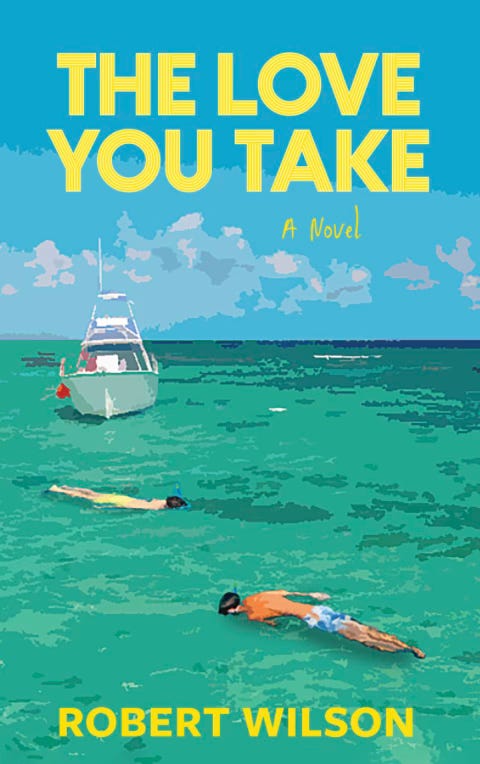
Next section of the novel: 1975 in Key West, Florida. The 1960s have now officially ended, but indeterminate Andy keeps—shades of T.S. Eliot’s The Waste Land— drifting. (As, indeed, he’s shown doing on the novel’s cover.) Though married to his college girlfriend, Shelley, he’s never quite got over his torrid, if brief, college romance with foxy Susanna from New Orleans.
Shelley is enjoying her job as a history teacher to Grade 8s at a private school. Andy, working part-time at a newspaper, doesn’t feel Woodward-and-Bernstein vibes so much as boredom.
Andy takes on a second part-time job, as a waiter. He also enrols in an MA-in-English program, toiling “away at papers about Milton or Whitman or the 18th-century English novel, without thinking too much about what these tasks were preparing him for.”
Even supposedly fun activities aren’t. While spearfishing, Shelley accidentally fires a spear gun at Andy. The result: a serious thigh wound. Again, whiffs of the Waste Land: Eliot features the Arthurian figure of the Fisher King, who suffers a thigh wound that won’t heal.
In any case, as readers, we don’t feel that sorry for our drifting-about protagonist. Killing little fish? C’mon, Andy.
Next time-stop: Washington, D.C., 1980. At the news of John Lennon’s assassination, Andy flashes back to Concordia, “when in the dorms guys could elicit the words ‘Paul is dead’ by making the White Album play backward.” Meanwhile, he’s had a fling 2.0 with old flame Susanna. And, in a—I’ve mentioned that our hero is hapless—literal car crash of a moment, he botches concealing the fling from Shelley.
Still, as David Bowie once observed, the advantage of growing older is that you become the person you were always meant to be. Good news, Andy: there’s hope for even the hapless.

About the Author
Robert Wilson’s previous books include biographies of P.T. Barnum, Matthew Brady, and Clarence King. From 2004-22 Robert was the editor of The American Scholar; other positions he’s held include founding literary editor of Civilization and an editor at the Washington Post Book World. Robert lives in Manassas, Virginia.
About the Reviewer
Melanie Jackson is a freelance Vancouver writer/editor. She’s also the award-winning author of middle-grade/YA suspensers, including Orca Books’ Dinah Galloway Mystery Series, and several chillers set in amusement parks. Visit Melanie’s page at The Writers’ Union of Canada.
Book Details
Publisher: Warbler Press, October 23, 2025
Language: English
Paperback: 280 pages
ISBN: 978-1-965684-48-1