

The Mobile Ruin Traces the Berlin Wall's Travels
The Everyday Life of the Berlin Wall

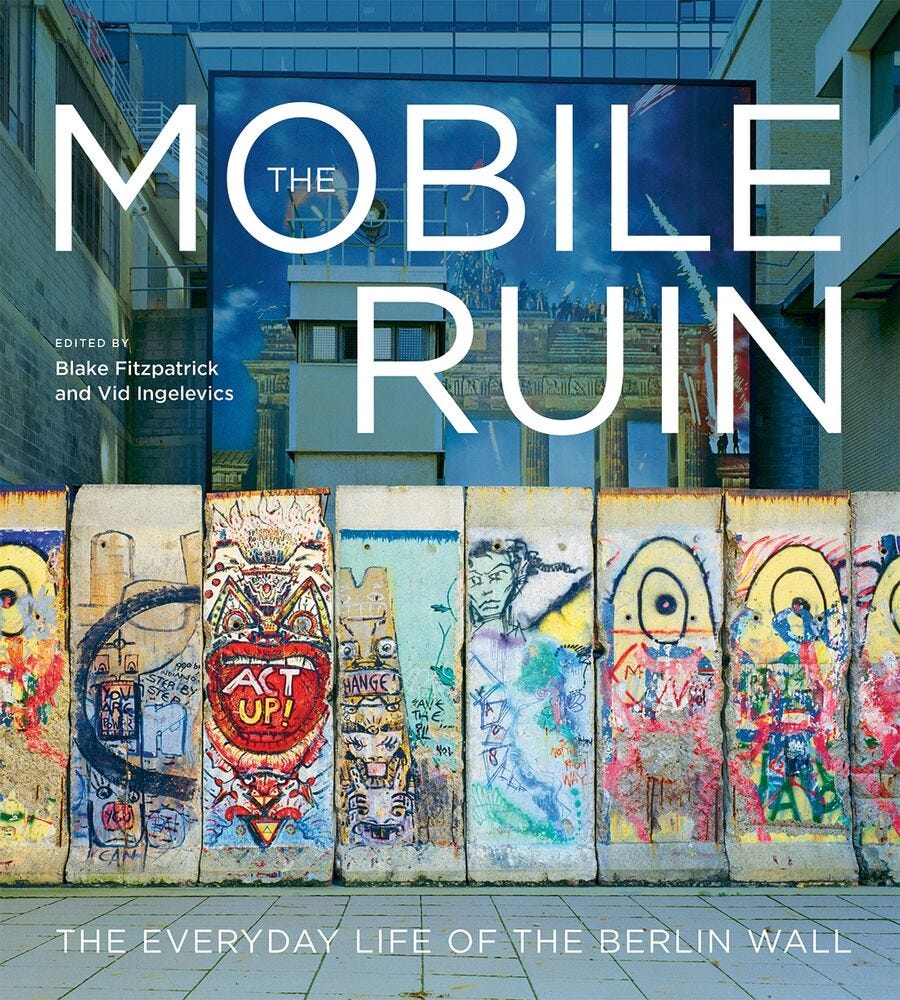
Though the fall of the Berlin Wall on November 9, 1989 happened more than three decades ago, the event still has historical resonance. The guarded wall encircled West Berlin, preventing people from East Berlin and nearby areas of East Germany from access to the West.
Construction began in August of 1961, and when completed the wall was around 156 kilometers long (there are some slight variations in length depending on the source you consult.) The border included 54,000 concrete segments, some of which ended up as landfill or construction material.
The Mobile Ruin: The Everyday Life of the Berlin Wall, edited by Blake Fitzpatrick and Vid Ingelevics, discusses what happened to the wall after its fall, while also pondering the Berlin Wall’s symbolic significance.
Many pieces of the wall have travelled since the events of 1989. The Mobile Ruin notes that there are “as many as 280 complete wall segments … in 170 separate sites” throughout the world.
“As The Mobile Ruin reveals, sections of the wall have ended up in museums, private collections, or public displays.”
As The Mobile Ruin reveals, sections of the wall have ended up in museums, private collections, or public displays. Many have served as canvases for artists. Chunks of the wall have also been sold as souvenirs. Many of these chunks were harvested by “wall-peckers,” called Mauerspechte in German. Using tools like hammers and chisels, the Mauerspechte chipped off pieces of the wall to be sold as mementos.
The Mobile Ruin includes both text and photographs, and these two components complement and expand on one another. A number of topics or themes are tackled, including the fact-based history of where the wall has travelled, both as two-ton sections, and as fragments.
One chapter focuses on the six sections of the wall that for a time graced Prince Street in Truro, Nova Scotia before being moved to Bible Hill, on the Dalhousie Agricultural College grounds. How the sections got to Truro, how they were perceived, and why they were moved make up an interesting part of the overall story of the wall and its fate.
The Mobile Ruin discusses anniversary celebrations that have been held to commemorate the wall’s fall. The book also briefly sketches out the events on the day the wall fell.
The book includes interviews with artists like Thierry Noir, who painted a number of wall sections. There are also interviews with Berlin Wall souvenir sellers, with a former Mauerspechte, and with organizers of one of the anniversary events.
The Mobile Ruin includes more than 100 photographs, and these greatly enhance the content. Many of the photos show segments of the wall in their new locations, but there are also photos of anniversary celebrations, historical photos, photos of “Berlin Wall” products including packaged fragments, and other illustrative images.
In the book’s Foreword, Doina Popescu notes that “the deconstructed wall was instantly memorialized around the word as a symbol of global peace and freedom.” Quoting architecture journalist Catherine Slessor’s Observer article, Popescu adds that there has been a “ ‘furore of barrier building’ ” since the Berlin Wall came down. In fact, 50 out of the 66 physical barriers currently separating nation states were built after the year 2000.
“My mom’s brother lived in East Germany, and we passed through Checkpoint Charlie. I still recall how intimidating I found that transit.”
The book’s subject matter appealed to me in part because of my own experience with the Berlin Wall. In 1967, when I was eight years old, I traveled to Germany with my mother to visit relatives. My mom’s brother lived in East Germany, and we passed through Checkpoint Charlie. I still recall how intimidating I found that transit.
The numerous references in The Mobile Ruin to Checkpoint Charlie, at the time of the Wall and after, were intriguing for me, as was the panoramic view the book afforded of what has happened to the wall itself.
Fitzpatrick and Ingelevics have been following the Berlin Wall’s travels for more than two decades, making this book like an in-depth tour given by experienced and knowledgeable guides. Printed on glossy paper, the book offers a sumptuous view of the Berlin Wall’s ultimate fate. It’s an interesting read on a number of levels, and the photos are worth the price of admission.

About the Author
Blake Fitzpatrick is professor emeritus in the School of Image Arts, Toronto Metropolitan University, and co-editor of Place Matters: Critical Topographies in Word and Image.
Vid Ingelevics is professor emeritus, School of Image Arts, Toronto Metropolitan University, and a visual artist, writer, and independent curator.
About the Reviewer
Ontario resident Lisa Timpf writes poetry, book reviews, short stories, and creative nonfiction. Her speculative poetry collections Cats and Dogs in Space (2025) and In Days to Come (2022) are available from Hiraeth Publishing in print and electronic formats. You can find out more about Lisa’s writing projects at http://lisatimpf.blogspot.com/. Lisa is also on Bluesky, @lisatimpf.bsky.social, and her author Facebook page is @lisa.timpf.author.
Book Details
Publisher: McGill-Queen’s University Press
Publication date: April 21, 2026
Pages: 216
ISBN: 9780228026860