



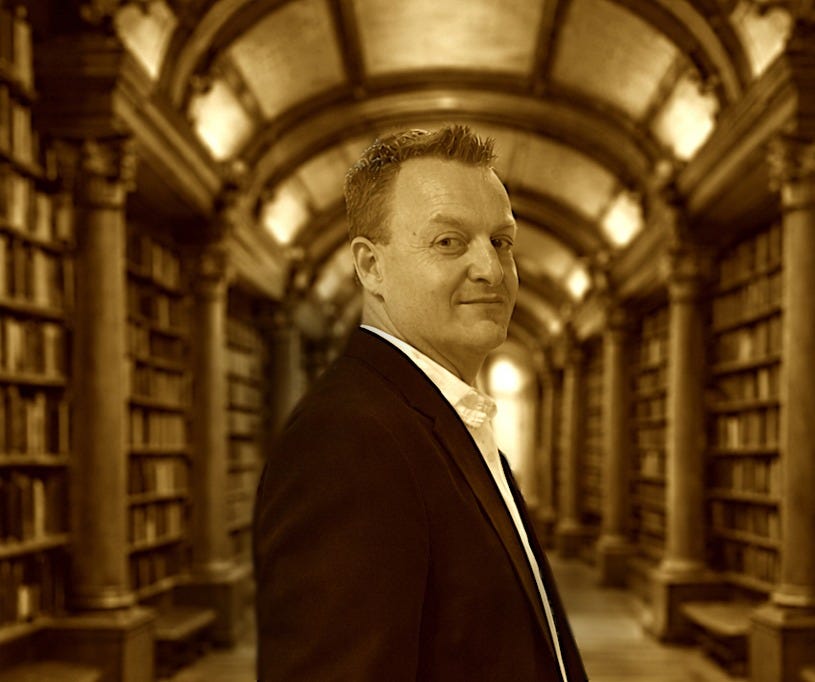
Nicholas Racz is an international award-winning writer, producer and director for film, television and podcast. He is the host of THE GREAT UNTOLD, a YouTube series that features great untold stories. He created and wrote the international television series CONCORDIA. He has also created and written TV series for leading networks including FX, Fox and AMC. He wrote, produced and directed the international award-winning feature film THE BURIAL SOCIETY. He holds an Honours Degree in Biochemistry, Immunology, Microbiology and Physiology from McGill University. He left McGill Medical School to pursue a career in advertising, television and film. He worked in senior creative roles at Ogilvy & Mather, Saatchi & Saatchi and DDB, creating advertising campaigns for some of the world’s leading pharmaceutical companies. His scientific training informs his research-driven approach to understanding human potential and resilience. He was born and raised in Montreal, Canada, and lives in London, England.
Nick and I sat down to discuss his book, Master the Future: Unleash The You AI Can’t Replace. Edited with permission for length and clarity, this conversation took place on March 5th, 2026

Kevin Andrew Heslop: Let me begin by summarizing that the book is less about AI and more about overcoming obstacles with a kind of survivor’s intuition cultivated through tens of thousands of years of evolution. I feel like it was written both to diminish a reader’s anxiety in the face of unknown unknowns and as a remedy to your town concern about the writer’s obsolescence, coming from advertising and screenwriting as you do. Been said, “We write the book we need to read.” I wonder whether any of that resonates for you, or whether you’d like to say a few words in summary about the book if I’ve mischaracterized it.
Nicholas Racz: I think that sums it up very well. People tend to assume the book will either be a how-to full of technical tools or a doomsaying thing about AI. But the book is actually about neither of those things. It’s about the single most powerful tool currently at your disposal – that powerful processor that resides between your ears. And with it, the creativity and intuition and human resilience that AI simply can’t compete with – at least not yet.
“The genesis of the book could have been some other social cataclysm, but I was genuinely inspired by how pervasive AI was becoming.”
The genesis of the book could have been some other social cataclysm, but I was genuinely inspired by how pervasive AI was becoming. Not just how it was impacting me and people around me financially, but that I could see the writing on the wall for more and more people.
People fell into one of two categories, it seemed to me. Either they’d rather not think about AI and were hoping everything would just work out for the best—which I just find intriguingly optimistic in at this day and age – this idea that you can see what’s going on around you and think things will work out for the best. Meanwhile, there was the other contingent of people, who simply didn’t want to hear about AI because the subject was just too gloomy.
So yes, that was the impetus. I realized that I wasn’t alone in being concerned. Moreover, I had some of the tools to deal with it, and to get to the other side—I hope.

Yuval Harari has said that he’ll publish what he foresees to be the final book of his career as a writer of popular non-fiction this year because he believes that, in 2026, AI will be able to do better what he does.
I think about that in the context of your composition process. You mentioned that the book took a few months to write with the assistance of AI as a research companion—as well, of course, as a lifetime of experience—and I wonder if you’d say a few words about the process of composition.
I’ve been using AI for a year or two, Chat GPT and Claude mostly, and watching the progression from surprising but crappy to surprisingly good in some respects, and shockingly bad in others. And in some ways, even more human than most humans. Which is to say, astonishingly lazy, and given to making loads of mistakes in the areas where you’d think mistakes unlikely.
“Danger comes when you rely on AI. Ask the lawyers who used it to write their briefs.”
If you give AI spreadsheets and prompt it to verify the numbers, you don’t expect it to fuck up. Yet it routinely does. If you give it a text to proofread, it invariably misses errors. How is this even possible? It’s a language model. I’ll give it a ten-page document and ask it to proofread. Invariably, it’ll miss things which another AI will then pick up. But it’ll miss several as well. It’s breathtaking how skaky it is in areas that should be right in its wheelhouse. Danger comes when you rely on AI. Ask the lawyers who used it to write their briefs.
As far as my book goes, I used it for research. I will occasionally ask it to compose something to get a fresh perspective. And I know people who routinely use it to write for them. But it’s a lousy writer. It can structure and write. But without a worldview or context, the writing is limited.
In truth, even the research it did had to be triple-checked because so much of it was off. It was shocking—shocking how it would just make shit up. I had to triple-check everything even when just citing research.
I think Harari has a bit of time before he needs to worry about being overtaken. I don’t foresee AI having the chops to write a great book in the next year and a half. Five years…that’s another story.
Well, the inevitable rejoinder to Harari’s statement is that, if you write the books that Harari writes—very broad, pattern-seeking, synthetic reviews of history affording insights into the contemporary moment—then, sure.
Not in the next year or two – I don’t think, anyways. I’ve read Harari and I think he’s a good writer and thoughtful researcher. Not brilliant – which might be sacrilege to some. But he’s solid. ChatGPT could mimic him. But write an original Harari … no way. And for now anyways, someone like Malcolm Gladwell, whose writing is suffused with personality and viewpoint, maybe in five years, but not at the moment. Stephen King said that it’s just a question of time. The writing’s on the wall. I think that’s right.
But it’s not just writers: it’s accountants. When you get interviewed for a job by AI, that means somebody in Human Resources has lost their job. This is happening more and more. You submit a CV and four hours later you’re one of the 500 applicants to get a polite explanation of why you’re not getting the job. That’s an AI taking jobs that belonged to HR people as little as six months ago.
“You go into human resources because it’s a a secure job where you can apply your skills with people. Now, those people are being displaced. Same with tax accountants. They’re going to be obliterated. Can’t happen, you say? Remember travel agents?”
And here’s why I mention HR in particular. If you become a writer or film director, it’s probably because it seems either glamorous or self-expressive. Same with a brain surgeon or fireman. You think it’s going to be sexy. Nobody goes into HR for those reasons. You go into human resources because it’s a a secure job where you can apply your skills with people. Now, those people are being displaced. Same with tax accountants. They’re going to be obliterated. Can’t happen, you say? Remember travel agents?
Microsoft recently published a list of the top 40 most readily obsolete professions. Here are the top 10: interpreters and translators; historians; passenger attendants; sales representatives of services; writers and authors; customer service representatives; CNC tool programmers; telephone operators; ticket agents and travel clerks; broadcast announcers and radio DJs. Et cetera.
Computer coders. Website designers. I mean, Jesus Christ: I’ve had Chat GPT build a couple of websites for me and do a pretty decent job. I don’t think anybody is super safe. That’s the sort of anxiety that I wrote the book to address.
The context was: what can you do now that will make a difference? History tell us there will always be winners and there will always be losers—always. Because you do actually have agency there. So what can you do? That’s what the book is about.
Most of us accept that pervasive AI is inevitable. But before we address the content of the book, I want to first address with you the context of two particular ethical questions: one is the question of authorship and the other is the question of consequence.
First, authorship: if unremunerated, synthetic authorship depends on a belief in intellectual property and therefore perpetual individual ownership, then the authorship critique of AI doesn’t go deep enough: the underlying illusion is that ‘individuals’ are perpetual owners rather than one in a succession of temporary stewards.
Absolutely. As somebody who makes a living from ideas, you like to think that the question of IP is sacrosanct: your idea is yours and if you pitched it to someone and somebody else takes it, you can litigate.
But the goalposts are constantly moving; the rules of the game don’t get defined by the individual creators but by higher powers. When broadcast airwaves first came into existence, they were going to be public domains—just like grass and land was, which are also now owned by people. Isn’t that the origin of , the Commons? These public spaces created to give something back to the people after they took almost everything. Like a museum to celebrate an American indigenous tribes or Inuit cultures, after you’ve obliterated them and coopted their lands.
The Writers Guild of America was on strike for a long time a couple of years back. They took on the studios and the networks. And the negotiations had mostly to do with one point: will studios be allowed to use AI to write scripts and rewrite scripts? Ultimately the Writers Guild had to cave. The studios would have gone on forever because they knew there’d come a time soon when AI could do most if not all of the writing. Chat GPT can already write a Hallmark movie or an episode of CSI New Mexico or whatever.
One of the more vocal and credible opponents during that strike was Charlie Kaufman. In an interview, he was asked if his idiosyncratic scripts wouldn’t be precisely the kind of thing AI would be unable to replicate. He essentially said, “No, it’s just a matter of time. The studios are just looking to maximize profit.”
It’s going to take a lot longer for a Charlie Kaufman to get replaced than a CSI Miami, which you could kind of do tomorrow, frankly. Chat GPT or Claude could write an episode like that in about 3 seconds flat.
Having been interviewed by AI a couple of times, it’s an awful experience. Not because it’s dystopian—which it is—but because they’re shitty at it. They’re interruptive; they don’t know when you stop speaking; their questions are often disconnected from the answer you gave. But companies are using them more and more. And in a year and a half that’s the way the first round of interviews will be conducted by a lot of companies. Watch.
I don’t know what it’s like these days in Canada—I haven’t lived there in sixteen years—but here in London, if you have a problem with British Telecom, the first line of call is a chatbot and the second line of call is an AI. You need to push before you get a human and it’s just going to be somebody in India. It takes a long time before you get a human with the authority and the knowledge to deal with your problem. You can whinge that it’s delivering poor customer service. But the truth is, if everybody’s doing the same thing, then you have no options in the marketplace. It just becomes the new normal.
So I don’t think the question is how do we stop it or how much time should we spend resisting it; I think the question is what can you do?
I wonder whether there won’t be a general public hesitation to accept AI-generated content on big screens or through streamers just as people were reluctant to use products made in electrified factories in the late 19th century.
Sadly, it think it’s doubtful. Just watch what’s on TV now. There’s a television show in England—that people watch—which is literally people sitting on their sofa watching a TV show. I can’t remember what it’s called but that’s how low the bar is. And people watch it. It’s actually quite popular.
Given that climate of tolerance for utterly vacuous crap, do I believe that people will refuse to watch a program because it was written by AI?
Honestly, I don’t think people care. At one time 100% of the filmed entertainment people watched was television, film, and theatre. In the last four years, maybe 30% is online. If you’re under the age of 40, you get as much as 50% online—YouTube and TikTok and Instagram. More and more of that is AI.
But to be frank, I try not to dwell on that side it. It’s generally depressing. I’d rather be constructive than dwell in the darkness.
Appreciating that but nevertheless wanting to address the environmental cost of the use of AI, and feeling it necessary to address ourselves as rock climbers would project at the bottom of a rock face, the cost of compute environmentally is only going to increase proportional to the pace at which electricity-generating hubs can be created. They’re being created with the backing of an unprecedented amount of capital right now.
For sure.
So, the extent to which AI can resolve all of the things that we’ve described so far is proportional the extent to which the so-called ‘environment’ will be destroyed—and in a way that will temporarily mollify with capital the communities in which data centres are based, which will skew socioeconomically and racially and demographically. And I appreciate that that forecast is antithetical to what the book is doing, but I feel we must address the context and use of AI as a means of production before looking at the book itself.
I think most people who’ve read my book have been surprised by how uplifting and empowering they found it. But the book doesn’t offer a remedy for the downstream impact of AI on the environment. It’s just not what I was writing about. And I don’t know what will happen in terms of energy supplies, but there are probably going to be more and more ways of producing energy that don’t have environmental impact—like fission and other ways. I think the more immediate cost will be to the labour market. It will be “How can people continue to remain employed?” I have a few friends who are rabidly convinced that Universal Basic Income will kick in and save the day, but I think that’s naively optimistic.
Naively optimistic because one assumes that governmental authority, backed by democratic will, can actually out-power corporations that are accumulating concentrations of wealth and power in effectively totalitarian governments?
Exactly. I’m not saying it wouldn’t eventually come to that, because UBI would eventually be inevitable. They pointed to the COVID bailouts, but COVID was always going to be for a limited time on a limited scale. Here we’d be on a global scale into infinity.
I’m no expert on this subject, so this is just the musings. But my sense – having been on the planet a while now, and being a student of human history, is that no government’s going to do an immediate turnabout. Maybe New Zealand will. It’s small enough—a couple million people—to say, “We’re going to institute Universal Basic Income” just as they could enact a gun law overnight because (a) they have a functioning, coherent government and (b) they have a tiny population. They have a country with the population of north London. But the U.S. government can’t even create coherent gun laws. But somehow, these geniuses are going to bring about Universal Basic Income? Maybe after an excruciating decade of human suffering. But remember, the Great Depression lasted about ten years and ended only because of World War Two.
Well, transitioning here from the historical context in which AI is unfolding and looking now directly at the book, one of the recurrent themes that you’re emphasizing throughout is how resilient human beings are, and how we have the advantage of intuition, long cultivated through tens of thousands of years of evolution.
In sum, we, as a product of nature, benefit from an advantage that we cannot replicate in the hours or years of our own lives because of the amount of time evolution required to produce us—the novelties of RNA mistranscription, environmental adaptation, and the pressure of sexual selection—endowed with superior design AI will never be able to exceed. Your thoughts?
Humans will render themselves extinct and the planet will go on without us?
It’s possible that we are one of those aberrations that nature will select out.
That’s another way of putting it. And it’s possible, though not quite the same way that mammoths did. This would be self-inflicted. Who knows?
What I mean to say is that we are possessed of this biologically selected-for intuition which gives us an edge over anything that we could create, perhaps. Only as a result of shifting our perspective and using that intuition will we be able to overcome whatever obstacles we face, is the thrust of your book.
I think—I’m not sure that was a question, but—I think we all have that. The anthropologist David Graeber mentions that the homo sapiens’ prefrontal lobe was biggest about 40,000 years ago—when we were hunter-gatherers. That’s not to say we’re stupider than a hunter-gatherer from 40,000 years ago. But those people lived complex and unforgiving lives. They didn’t enjoy much of margin for error. If you weren’t on the ball and sharp and intuitive, you perished. In the last 100 years, we’ve built a world in which it’s possible to be breathtakingly stupid and still not perish. It’s hard to die these days. There are warning labels on everything. There are guard rails on everything. It’s hard to go anywhere. You’re not allowed to drive your car over 35 miles an hour. 20 miles an hour is the speed limit for a lot of major streets in London. It’s getting harder and harder to die, which is keeping a lot of stupid people alive. And intellectually lazy.
“It’s easier to be lazy these days. My book is an argument to not get too complacent.”
Moreover, we distract ourselves in countless ways and further whittle away all the innate gifts that we do have. There’s an entire generation of people right now who will with a poor sense of direction because they grew up with SAT-NAV. I moved to London in later life and am eternally thankful for Google Maps. SAT-NAV existed. Finding a meeting in the middle of SoHo with a small folding map would have been brutal. But my sense of direction has definitely suffered, as a result.
It’s easier to be lazy these days. My book is an argument to not get too complacent.
I feel like laziness in this context is a synonym for habit.
Well, I think they are habits for sure. I have a twelve-year-old so I’m always harping on the idea of forming habits, which is the dullest and least sexy thing in the world to talk about. But also the most vital, becaue these are the things you do every day. And so after a while you’re not even thinking much about them. And the impact of a few lousy life habits will add up.
They explain your bank balance. They explain your relationships. They explain a lot of things. One ridiculously minor thing wrong every day of your life has an additive effect.
For example, there a lot of research now that our best thinking happens during idle time. That’s when we get our best ideas.
I was at the orthodontist’s with my daughter the other day. In the waiting room with two other sets of parents and two other sets of kids. And they were all four of them—the two children and the parents—on their phones.
I don’t know what the ten-year-old is doing that’s so important they need to be on their phone. That boring, tedious time when you have nothing to do but wait for something, and you have time to think or to talk—we avoid it like the plague.
And I’m honestly not opposed to technology. But everything in moderation. People around London cycle their kids to school these days. They use these electric peddle bikes and it’s become a big thing in London to cut down on car traffic. I was watching a dad cycling his two kids. And the kids were sitting behind him as he pedalled down the street on a beautiful, leafy day. These two little boys—one was maybe nine and the next one was six—and they were in their little private school uniforms; on their iPhones. And I just thought, Wow. Being cycled down a road by your dad with the world passing by you isn’t interesting enough? That’s not a terrific sign.
So, one of the practices that you recommend, which I’ve kind of hamfistedly brought up a couple of times as a metaphor, is rock climbing. I wonder if you would say a few words about the significance of that practice for you.
Sure. Rock-climbing. Yoga is another. When I first fumbled into yoga back in the early 90s, I was often one of only two men in a yoga studio. It would be me, an old, skinny Indian man, and a bunch of women in lycra. It’s changed a lot now. So, yoga’s also amazing; meditation’s also amazing, but they’re different.
I stumbled into rock climbing randomly ten years ago: we were on a family holiday hanging and the resort announced they were doing a session in the rock-climbing area. And I was like, “I’m going to give it a try. Anything to get away fom the kiddy pool for an hour, I figured. And as fairly big guy, climbing had never seemed like an obvious choice for me – defying gravity, that it. But I got hooked.
And after just a few months, I noticed was a couple of contradictory things started happening. Namely, I noticed I was becoming more emotionally resilient. And better at sticking with and solving problems. Do you know the sport at all?
I’ve climbed a bit.
Okay, then you’ve probably seen it for yourself. Rock climbing is really the equivalent of solving a dynamic puzzle. You’re going up a certain route and it’s not just a question of finesse. The sequence of how you and where, and in what order, you place your feet and your hands is decisive. If you get it wrong, you tire out, and fall off. So a lot of it is figuring out a sequence of moves. And over time you get better at reading the patterns ]\.
You also become more fluid in your movement. Drumming is a good analogy. If you’ve ever taken a drumming lesson, you’ll know that what every drummer can do is move their four limbs independently of one another. Which is fucking amazing. You’re nodding as if you’ve drummed.
I have, actually—about twelve years.
So you know that it’s not intuitive; and for each limb to be doing its own rhythm, it’s like, mind-boggling. I remember taking drumming lessons a couple of years ago. And as I was drumming, I could feel my brain started to heat up because a part of my brain was being used like it had never been used before.
After a few months of climbing, I started to notice that my balance improved, and that when I was making coffee in the morning, instead of doing one thing at a time – say getting the water or reaching for a much, it would become this choreographed event, with one hand reaching for the sugar while the other reached for the espresso beans This was like four or five months in: I was moving much more gracefully. Even when I walked. I’m a pretty big guy, but I started walking much more quietly than anybody else in my family. I live with a woman, who’s much smaller than me, and with a child, who’s much smaller than her. When they walk around the house, it’s thud thud thud thud thud. Meanwhile, I’d become a quiet walker.
The other thing I noticed is that I became much more resilient. The first time you try to climb up a wall, you’re like, I’m never going to get off the ground. And then six months later you encounter a new route and it looks impossible. Totally insane. And then you stop, breath, and start to break it down. And focus on the first move. And a week later you figure out the next three; and then three or four weeks later it’s not impossible anymore; you’ve sent it. And that becomes a habit you wire into your briant, that you can then apply to problems in other parts of your life.
Every impassable problem gets viewed through a different lens. How can I dissect this particular problem? What can I do better? You get in the habit of problem solving at a micro-level instead of just having this amorphous thing. I became much better at solving problems that seemed hopeless. I seldom give up anymore- not if it matters to me. I still lose hope, to be clear. Routinely. But then I just go back and I pick away at it. I was already pretty resilient in some ways but in other ways not, and I really notice a change.
They did a study with kids with a mild learning disabilities. They split the kids into two groups and found that mindfulness after one hour of climbing than one hour of calisthenics or aerobics. There was a 30-40% increase in mindfulness, which they characterized as being more determined, being able to persist with a problem, being more peaceful and balanced and calm.
This idea – that we can significantly enhance traits that we mostly consider immutable – is not the prevailingly accepted view out there. Nor is climbing the only way to achieve it. Anybody who does yoga or meditation will go on endlessly about how effective it can be. And there are other things too.
Informed by a couple of months of response to the book, I wonder whether there’s a question about the book you’d like to address yourself to.
Because the book is not in my rear-view mirror yet, I’m not sure I have hindsight. I wrote the book because I saw a gap in this area. People always assume my book is one of two books: it’s either a high-view from the academic tower above of how we’re going to be impacted by AI. Or it’s about how to use AI tools, and I’ve written neither of those.
In the next couple of weeks I’ll be giving talks to a couple of groups of entrepreneurs – many of whom are now looking for ways to incorporate AI into their businesses. And that totally makes sense. My view is that if you want optimal results, the ideal is to approach the question of what you want to accomplish – what matters to you. To let the driving force be creativity and inspiration driven, rather than anxiety driven. Ultimately, I still think that the most valuable computer we have at our disposal – for the time being, anyways – is the one between our ears.

About the Interviewer
Kevin Andrew Heslop (b. 1992) is the author of several books of non-fiction and poetry, including The Writing on the Wind's Wall: Dialogues About 'Medical Assistance in Dying' (Guernica Editions, 2026) and the forthcoming it looks like a garden but he had hurt himself by accident (Cactus Press, 2026), here lies the refugee breather who drank a bowl of elsewhere (Biblioasis, 2027), Craft, Consciousness: Dialogues About the Arts - Volumes One & Two (Guernica Editions, 2027 & '28), and a co-authored memoir with intensivist Dr. Ian Ball (Guernica World Editions, 2028), as well as Canada Council for the Arts-funded works for the stage and screen. His most recent articles and poems having appeared with Amphora, The Fiddlehead, and The Walrus, Heslop currently divides time between Canada, Denmark, and Brazil, as well as recently-held residencies at the Belgrade Art Studio, Arteles Creative Centre (Finland), BRAŻŻA (France), Casa Na Ilha (Brazil), Kaaysá (Brazil), Earthwise (Denmark), Ørslev Kloster (Denmark), SAIKONEON (Japan), The Mauser Ecohouse (Costa Rica), Teat(r)o Oficina (Brazil), and The Seamus Heaney Centre (Ireland).
