

The Sapling by Marc Bendavid
Reviewed by Michael Greenstein

Proust’s Plants
Klara Bloem, the subject or object of actor Marc Bendavid’s longing in his debut novel, The Sapling, shares her name with actress Claire Bloom, still alive at ninety-five. More important, however, is the significance of their names: the clarity of vision throughout the novel and the blooming patterns of flowers and trees shared by Marc and his South African teacher, Klara. In turn, his clarifying vision and floral patterning create a Proustian atmosphere, a remembrance of things past, a re-searching of lost time where the aroma of a South African bobotie replaces Parisian madeleines. Though Bendavid’s sentences are far shorter than Proust’s, they carry their lambent atmosphere across the lives of fledgling writer and his art teacher who is his senior by thirty-two years. Marcel’s cork-lined room gives way to Marc’s gold-leafed bedroom.
“The Sapling perches between fantasy and reality, between the narrator’s introspection and projection in a liminal state of his coming of age, like the metamorphosis of silkworms featured later in the novel.”
That Bendavid glides freely between past, present, and future may be seen in the novel’s epigraph taken from David Grossman’s To the End of the Land: “I came to the conclusion that it was in the future that we knew each other.” In his “Prologue” the novelist invokes Klara’s name, for she is also his muse as he looks across the Pacific Ocean from Los Angeles: “a name that feels magical as I utter it, a name that is rare and protected from association with anyone else.” He is in L.A., she has died in Toronto, and he tries to imagine her death surrounded by her children, Eva, Hugo, and Theo, and a nurse who assists with her dying. Marc questions: “My mother was a nurse; maybe I inserted her into this fantasy without knowing it, a way of being there when I couldn’t be there myself. Is the female nurse a figment of my yearning?” The Sapling perches between fantasy and reality, between the narrator’s introspection and projection in a liminal state of his coming of age, like the metamorphosis of silkworms featured later in the novel.
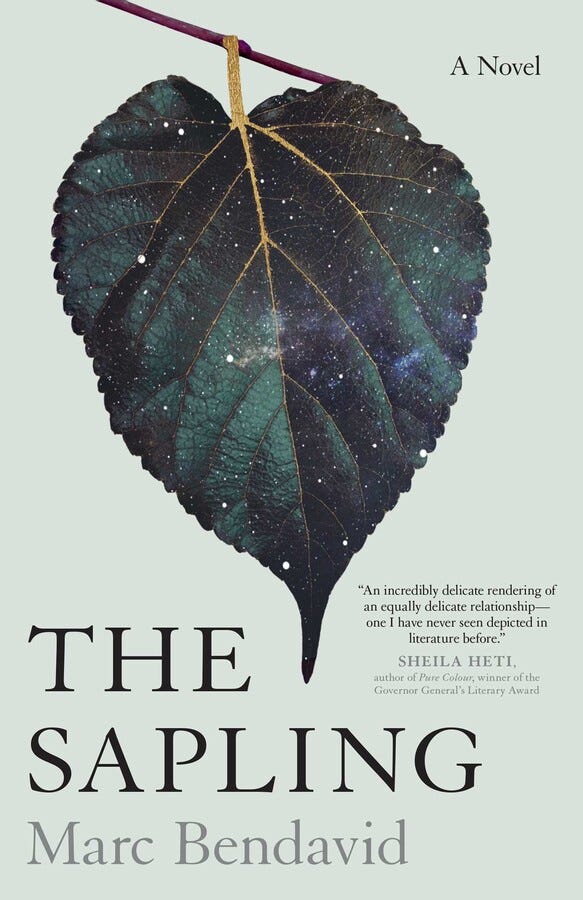
Klara is also surrounded by flowers, including the dried petals of the Jacaranda tree Marc has assembled for her in a shoebox. “I wonder if you can see into the vase itself, where the stems crisscross one another underwater; this is the sort of thing – the tangle of green lines, a game of pickup sticks suspended in time – that you would have appreciated, maybe even as much as the blooms themselves.” This description looks back to the single leaf on the book’s cover, its dark galaxy pierced by points of light. It is suspended in time by a single beige thread tied to the branch, its beige veins reaching downwards, rooting to its darkened tail. This heart-shaped leaf also contains blood vessels. The scent and vibrant colour of the Jacaranda mingle with Canadian trees in Marc Bendavid’s growth and the forest in The Sapling.
A fable follows: eleven-year-old Marc writes to God about the deaths of hens that he has collected, and the one named Hilda is a reflection on the death of Klara. As he starts to write God’s name, the tip of his pencil pierces the paper, the G disappears, and he cannot correct his mistake because he has “almost no time.” The novel tests temporal dimensions from split seconds to the many years separating Marc and Klara, and a timelessness surrounding their Platonic relationship. The hens are sheltered under the shade of a sugar maple tree, but they disappear mysteriously no matter how much Marc tries to protect them. He concludes his letter about mortality and the mystery of existence: “If you exist please tell me who’s killing the chickens.”
In the sixth grade of his special arts school, he meets his art teacher Klara Bloem whose South African accent imbues her with mystery and sophistication, but it is her laughter above all that endears her to her student. He studies the map of his days and the character of the neighbourhood surrounding his home and school where bulldozers have destroyed mature trees. “Afterward, standing feebly in place of whatever had grown there prior – were there not forests only a handful of years ago? – stood the young trees planted by the municipality, spaced at exact intervals and held stiffly in place by iron stakes: adolescent locusts and blue spruces and ashes and the purple Norway maples that looked oily and almost black at the peak of summer.” Scrutinizing the rise and fall of trees, this novel of civil elegies is also a lament for the land and its ecosystems.
Drawn to the hidden elements of plants, Marc cultivates his watermelon seedling daily. In the ontology of botany, he questions the nature of these mysterious forces: “What force directed the watermelon tendril to reach for the length of twine I had strung between the pot and the window? When the tendril – which grew straight as it sought support – finally made contact with the twine, it twisted tightly around it …. Did the plant have a spirit of some kind? Was it a being?” Tender saplings unite organically with the love shared between teacher and student. Unlike his sisters, Marc taps the maple for its sap in early spring, or he picks away at the soft part of the leaf “so that only the veins remained like a skeleton hand.” He taps the sapling of self and traces the veins of his hand that reaches out to nature and teacher in “a chattering assembly of spirits and minor deities to explain the natural world.” He inhabits the forest as much as the forest inhabits his sensitivity, and at the end of this sylvan setting he discovers gravestones of a Jewish cemetery. His infinite forest contrasts with the boundaries of art galleries with their DO NOT APPROACH signs. Transformations in the natural world serve as a way in which he “could mark time.” Living up to his name, he is a time marker attuned to lyrical silences around him, even as he is indelibly marked by his experiences with Klara.
When Klara takes her class to the Art Gallery of Ontario, she comments on masterpieces by Cézanne, Monet, Rousseau, and Matisse. Marc is especially intrigued by Rousseau’s “Scouts Attacked by a Tiger,” as his teacher points out green details in the forest patterned with a web of stems and leaves and the men in danger even before the tiger pounces. The student grows with his perception of this painting as he forgives “the leaves of grass their odd stiffness. And as I did the painting began to change, to have a depth and an energy I hadn’t noticed before.” In his Whitmanesque growth and inclusion, he finds depth, energy, and magnetism. He relates to the full moon in the painting with its magical diffuse light, which is like an anchor thrown to him, “an element of familiarity that hooked into my gut and suddenly made the rest of the strange world it came from – the scouts, the tropical forest, the tiger itself – seem possible, seem real.” Hooked and marked by Rousseau, the eleven-year-old has an epiphany that reveals layers buried inside himself and the artistic world. Klara’s lesson about Rousseau communes with his interrogation of seedlings and his scouting self in search of an identity. With Rousseau’s burning tiger, his own fearful symmetry comes to the fore in a Romantic awakening.
Over the summer months Marc travels to Europe to visit his mother’s family. “It meant trips to the beach and smells that stretched back to my earliest childhood.” Marc Bendavid’s Bildungsroman harks back to Marcel Proust’s, as he exchanges letters and backgrounds with Klara. Her artistic letter envelope contains pages of different sizes with her recognizable slanted handwriting: “the letters leaning as though a wind were trying to blow them off the page.” She sketches images in black India ink, but he doesn’t remember the details of her floating thought. Nor does he remember what he responded to them on thin airmail paper that he feeds into his grandfather’s typewriter, but he types so hard that the paper is punctured at the serifs. This typescript echoes his earlier letter to God where his pencil punctures the “G” in the hardships of delicacy. This exchange of letters belongs to a larger exchange of identities between Bloem and Bendavid. She sends him photocopied pages about a boy transforming magically into a girl. “I felt you had divined my fantasy of the boundary between us dissolving, of us taking turns being one another.” Alter egos engage and exchange “a covert message written between the lines of my letters.” Their writing between the lines ends abruptly when she retrieves all the letters she had sent him, an act as cryptic as any of the messages themselves.
Klara’s forest green envelope encloses Marc’s garden fantasy: “This fantasy of sameness even included a place where our bodies were interchangeable …. it isn’t hard to imagine how this fantasy could take root …. was I trying to blur the line during the year we were closest?” With her characteristic laughter she nicknames him Marcwass, as if he belongs to the past tense, his sameness rooted in difference. She paints the walls of his bedroom with a design of gold leaf, the décor of magic lantern, photographic darkroom, and organic garden. “Before us – glowing out of the darkness to precisely my height, like a shadow made of light – stood a sapling.” Character, nature, and décor merge in the novel’s chiaroscuro.
If Proust’s cork-lined room enters The Sapling indirectly, Milan Kundera’s The Unbearable Lightness of Being is more pronounced when Klara gives Marc a copy of the novel. Marc’s education also includes the metamorphosis of silkworms after Klara gives him a small envelope sent from South Africa containing silkworm eggs. Her instruction also includes a lesson on the prehistoric drawings of the caves of Lascaux with their various animals. Photography, photosynthesis, and bending are three prevalent processes in the novel. Bendavid introduces bending later in the novel when he moves to Los Angeles and looks back on his adolescence: the journey “is even more bewildering because of how precisely it bends time.” With Klara’s cancer and approaching death, the “new blades of grass are green and wet and long enough that they have started bending back on themselves.” Metamorphosis yields to metastasis, and time continues its insistent bend: “I felt that a piece of time was bending back toward me from the future” – invoking David Grossman’s epigraph. “Did this bend in time mean you were already dead?” Towards the end, the novel bends back on itself: “And yet I felt that this bend in time was not only folding toward me from the future but that it was also bending backward from the present, back to the years of our intimacy. That the edge of this bend in time touched the past in a place where you and I were in the forest again.”
He finds himself in a liminal space but also a liminal time – neither here nor there, neither now nor then. The “Epilogue” reinforces this twilight zone. His sense of time “bent and rippled and folded back in ways that made the idea of linearity seem like a joke.” The last line is no laughing matter, however, in Marc’s eulogy for Klara. Student acknowledges teacher: “The seeds they planted in my teenage mind have already borne a lifetime of fruit.” The bend in Bendavid makes all the difference.

About the Author
Marc Bendavid is a writer, actor, and gardener. Originally from Toronto, he now divides his time between that city and Los Angeles. The Sapling is his first novel.
About the Reviewer
Michael Greenstein is a retired professor of English (Université de Sherbrooke). He is the author of Third Solitudes: Tradition and Discontinuity in Jewish-Canadian Literature and has published extensively on Victorian, Canadian, and American Jewish literature.
He has published 250 essays and reviews in books and journals across Canada, the United States, and Europe.
Book Details
Publisher: Scribner Canada (September 23, 2025)
Length: 288 pages
ISBN13: 9781668093962
 | A guest post by
|
Thanks, Lise.
This book looks beautiful.