

The Second Greatest Show on Earth by Darcy Ingram
Henry Bergh, the Protection of Animals, and the Evolution of the Modern Social Movement.

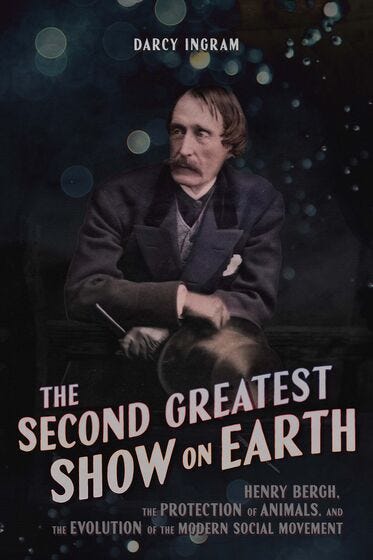
Author Darcy Ingram’s painstaking research shines through in his book The Second Greatest Show on Earth: Henry Bergh, the Protection of Animals, and the Evolution of the Modern Social Movement. Ingram’s book outlines the life story and achievements of Henry Bergh, the founder of the American Society for the Prevention of Cruelty to Animals. Ingram also discusses Bergh’s efforts in the broader context of the history of social movements, including how social movements dealt with the growing influence of the news media.
Bergh, who served as President of the ASPCA from its founding in 1866 until he died in 1888, was an enigmatic figure. The son of a wealthy shipbuilder in New York, he was attracted to the intellectual and cultural climate of Europe and showed no desire to follow in his father’s footsteps as a business owner. Bergh spent much of his early adult life travelling outside the United States, revelling in the cultural life, going to museums and theatres, or simply promenading the streets to see and be seen.
“Inspired by exposure to the work of the Royal Society for the Prevention of Cruelty to Animals in England, after returning to his home city of New York in 1865, he spearheaded the establishment of the ASPCA.”
Despite the enjoyment he took in his travels, Bergh was also haunted by the notion that as a member of the upper class, he had an obligation to give back to society. Inspired by exposure to the work of the Royal Society for the Prevention of Cruelty to Animals in England, after returning to his home city of New York in 1865, he spearheaded the establishment of the ASPCA. In performing his work as the society’s first President, he found his way of giving back to society.
Bergh’s choice of cause to champion seemed curious. Throughout his life, he had shown little affection for animals. While Bergh enjoyed horseback riding, he didn’t care all that much for dogs. Nonetheless, Bergh undertook his duties with enthusiasm, unafraid to step in and snarl up commuter traffic to deal with the mistreatment of the horses that drew passenger vehicles.
The Second Greatest Show on Earth delineates some of Bergh’s campaigns, which included efforts to shut down dog-fighting pits, to stop the practice of “swill milk” (milk produced by feeding cows brewery by-products), to end pigeon-shooting events, and to have vivisection declared illegal. Some of these campaigns were more successful than others.
Along the way, Ingram discusses the opposition Bergh encountered, the strategies he and his opponents employed, and the ways he used his “cultural capital” gained during his years of travel to advance the cause.
Bergh was seen by many as extreme in the positions he took up. He was frequently lampooned by the media and by opponents for his zeal. At the same time, he was respected in many quarters for his dedication.
Ingram’s book does more than illuminate the life of an influential man. The Second Greatest Show on Earth also places Bergh in the social context of the era. The extensive research conducted by Ingram is evidenced by the specificity of the examples he gives, the depth of description of events, and the extensive footnotes and references.
Ingram provides an even-handed portrayal of Bergh. While detailing the positive aspects of Bergh’s efforts, Ingram also acknowledges his authoritarian nature and notes that some of Bergh’s actions were motivated by a belief in the importance of maintaining social order. Ingram’s chronicle includes observations about the way Bergh’s legacy was reframed by various parties after his death, depending on the point of view they wanted to promote.
The Second Greatest Show on Earth includes illustrations of Bergh from publications of the time, excerpts from news stories, snippets from Bergh’s diaries, editorial cartoons, handbills from presentations, and other items.
Ingram’s book should appeal to readers who enjoy thoroughly researched history, as well as those interested in learning more about the early days of the animal protection movement and one of the key figures who shaped that movement.

About the Author
Darcy Ingram teaches history at Selkirk College and the University of the Fraser Valley. His research addresses the historical dimensions of social movements and governance via a trajectory that has seen him working in areas of Environmental History, Sociology, and Political Studies. Much of his current research centers on the evolution of the animal protection movement, but he also continues to work on developments within the environmental movement and on social movements and governance more broadly.
About the Reviewer
Ontario resident Lisa Timpf writes poetry, book reviews, short stories, and creative nonfiction. Her speculative poetry collections Cats and Dogs in Space (2025) and In Days to Come (2022) are available from Hiraeth Publishing in print and electronic formats. You can find out more about Lisa’s writing projects at http://lisatimpf.blogspot.com/. Lisa is also on Bluesky, @lisatimpf.bsky.social, and her author Facebook page is @lisa.timpf.author.
Book Details
Publisher: McGill-Queen’s University Press
Publication date: October 14, 2025
Language: English
Print length: 336 pages
ISBN: 9780228025825