



Skeletons’ Noggins’ Questions
To read Stuart Ross’s poetry is to have the rug pulled pleasurably from under your feet. “Last Poem” ends accordingly: “I am a biped. Each foot that punctuates each leg holds a shoe. These are my last shoes. I will have no future shoes. I look up from my untied laces. I say something aloud but don’t understand a word. I debate which direction to run, but, dearest, what’s a direction?” Looking up from his laces towards the sky, and collapsing tenses and footwork, Ross questions directions at every turn. Or the experience may be closer to slipping on a banana peel where the peel becomes a cushioning envelope to accept and insulate the poet’s skin; or the peel serves as a casket to wrap around the human skeleton. “This is the last poem. I’m jogging alongside it, writing as fast as I can, but each time I stop to read what I’ve written, I can’t read my goddamn handwriting.” The biped baffles and is baffled.
The Sky is a Sky in the Sky is divided into three sections – “The Sky,” “Is a Sky,” and “In the Sky” – sliding from symmetry to self-embedded position where Gertrude Stein’s “rose” shares space. Ross’s eponymous poem, “The Sky Is a Sky in the Sky,” shares space with Charles North’s “Day After Day the Storm Mounted. Then It Dismounted.” Instead of a rug underfoot, we find a sky hooding our lives, pulled over our eyes.
The sky dismounted and spent
the rest of its life on earth, occasionally
sliced by tornadoes and frightened
by the rumble of skyscrapers
herding their baby skyscrapers.
Long i’s spread across the city to be held in check by sibilants and grasping r’s in skyscrapers which scrape sound. If rumble leads to waterfalls in the next sentence, then the sound scrape turns to mice that “live anywhere their twitching whiskers fit.”
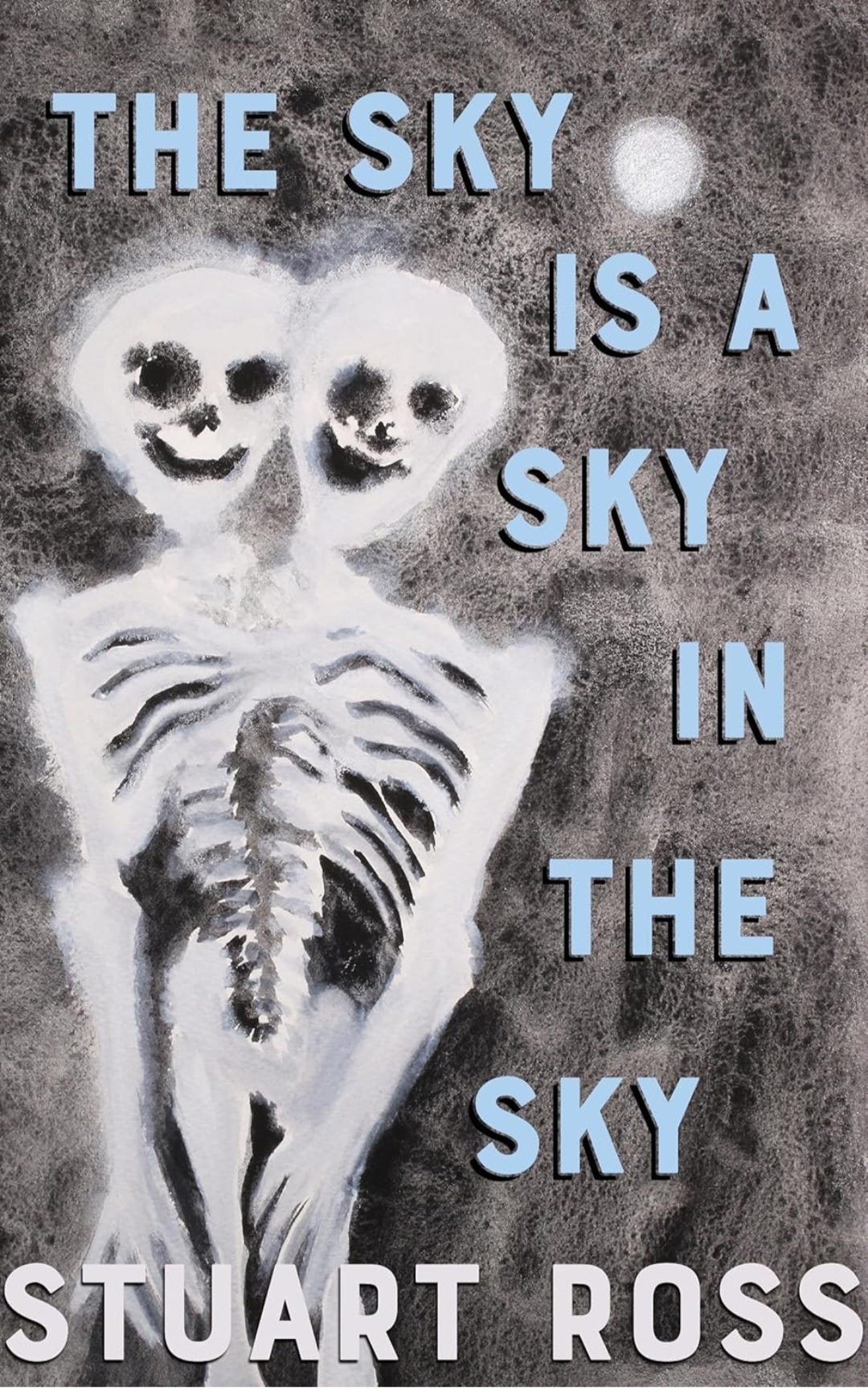
Whispers twitch from mice to birds as the sky descends from the sublime to the mundane: “how many / had become dentists? florists? strippers? / umpires? coroners?” This list is not entirely random, for dentistry prepares teeth for the coroners’ skulls and skeletons, even as florists enter funeral arrangements and strippers bare their bodies to be judged by umpires. With its internal rhymes the list enters “A meadow of questions” which “billows toward the horizon.” Ross’s questions are comic, ironic, and thoughtfully dialectic. Just as the poet is about to respond to these questions “a set of tender fingers / rakes my thinning hair.” The grim reaper’s progress arises from the meadow. Thinning hair morphs into “A shadow / is the beard of an idea,” which is “a doomed aspiration.” Gliding between abstraction and the city’s concrete, the poem examines itself: “That / tingling sensation in my pocket / is not chewed gum but a cluster / of stupid nouns that, joined at the hips, / creates a quivering language / uttered only by clouds.” While quivering echoes thinning and tingling, the nouns joined at the hip point to the book’s cover with its smiling skeletons – hip-joined, clustered Siamese twins.
A knock on the door introduces trombonist Jack Teagarden and lands us in New York. He belongs to the sky’s limit, “stars twinkling inside / his beautiful head.” Although Ross hates poems that mention “the mortal coil,” he gives us the ghost of Teagarden: “As you walk, you walk through sky, / your voice throwing shadows like / misplaced notes into the Hudson River.” Teagarden’s tender fingers caress his trombone and tumbler of brandy while his feet wander far and near. He need not fear falling, for “Our skin / acts as a protective wrapper.” His voice mounts and dismounts with John North’s.
Ross’s freefall appears in “Alternating Leg Motion,” which bipedals through interrogation: “It’s amazing, those legs beneath me. / How do they decide which one goes first / and which next?” Between firsts and lasts the order of his lines is somewhat arbitrary, but more questions follow: “How do they decide where / to carry my torso, my arms, my noggin?” This body scan slides between parts, just as noggin slides from its original meaning of cup or container to head or brain. “It’s stupid when he calls it a noggin” serves as a refrain in each stanza, but noggin also slips back to the previous poem, “The Rest of the Day of Rest”: “If men and women were less ephemeral, a sparkling bridge / would barge and bustle into the lagoon of their ancient noggin.” Noggin mediates between sky and slippery pavement where feet alternate. Questions continue the comic quest: “How do they decide which streets to haunt? Or when they will limp?” Tightly packed gravediggers haunt Ross’s streets, waiting for the final fall, whether they limp or leap “Or fold me / into a deep chair from which I will / never rise.”
The second stanza places the poet in a simple pine box, “Shovelfuls of dirt land on my noggin.” Horizontal or vertical, noggin alternates between earth and sky, grave and comic modes: “how do any legs choose which knee / to bend? Might one knee bend twice / in a row?” This absurd genuflection leads to the final stanza where the poet’s “flesh melts away,” and each leg is just bones. “My noggin’s a skull” – hence those grinning noggins on the book’s cover – Nadine Faraj’s “A Solution.” Surrealistic legs become keynote speakers at a “conference on Intersectionality / in the Motion of Alternating Legs.” During the question period (Ross’s alternation between declaration and interrogation) a young student in a wheelchair “asks why they don’t move in unison, / like my wheels.” The final line stops dead in its tracks of arrested motion: “One leg is speechless. And then the other.” Sliding through anatomy, Ross puts his best foot forward and hits the noggin on its head.
His questions range far and wide, but they may also turn parochial when his hands become manatees: “Can manatees kill you? Can you keep a manatee as a pet, teach it tricks?” These are the first questions asked by “Ayesha and Fischbaum in Miss Leibovici’s Grade 2 class when Miss Leibovici holds up the photo of a manatee.” The bewildered poet writes a postcard to the poem, can’t decipher his own handwriting, and mails the postcard in a breadbox. At school he has learned the sleight of handwriting. Similarly, grounds shift in “Hibernation” where poet and fox exchange identities. “A fox stood in the icy road, / each eye a tiny bonfire.” A panopticon of chipmunks pinpoints foxy eyes. The poem continues with clear and ominous details of the poet holding his palms close for warmth, cars weaving and spewing smoke. The fox’s eyes are so pointy that they punctuate the frigid air, and a great hiss flings the poet into a neighbour’s bushes. “I lay there until spring.” The poet hibernates and metamorphoses. When a letter arrives, he opens it with his teeth: “This is to inform you / that the Beth Radom Temple / has accepted your application / for membership in the Shabbat / Poetry Club. Please bring / your pointy ears.” All ears, the quadruped poet makes his point and joins Kafka’s ironic animal in the temple.
“O Stuart, O Zalman Nehemiah” sidesteps boundaries and genres, clowns his coffins, incorporates art into Stuart, and converts Ross into “Razovsky in Paradise” where scraping feet of a yahrzeit candle accompany the poet. He turns doorknobs and identities into other worlds to cover and uncover his tracks. In his glove compartment a manual for reading his poetry: six dead AAA batteries and a small card with the mourner’s kaddish in Hebrew. A sky-treader of sorts, Ross’s sky is in Razovsky.
CBC BOOKS’ “CANADIAN POETRY COLLECTIONS TO WATCH FOR IN FALL 2024”

About the Author
Stuart Ross is the author of 25 books of fiction, poetry, and personal essays, as well as scores of chapbooks. His most recent books are the memoir The Book of Grief and Hamburgers, winner of the 2023 Trillium Book Award, and the short story collection I Am Claude François and You Are a Bathtub . Stuart won the 2019 Harbourfront Festival Prize, the 2017 Canadian JewishLiterary Award for Poetry, and the 2010 Relit Award for Short Fiction. Since 1979, Stuart has run a micropress called Proper Tales. In the 1980s, he sold over 7,000 of his chapbooks on the streets of Toronto, wearing signs such as 'Writer Going To Hell: Buy My Books.' His poetry has been translated into Nynorsk, French, Spanish, Russian, Slovene, and Estonian. Stuart lives in the tiny town of Cobourg, on the north shore of Lake Ontario.
About the Reviewer
Michael Greenstein is a retired professor of English (Université de Sherbrooke). He is the author of Third Solitudes: Tradition and Discontinuity in Jewish-Canadian Literature and has published extensively on Victorian, Canadian, and American Jewish literature.
He has published 250 essays and reviews in books and journals across Canada, the United States, and Europe.
Book Details
Publisher : Coach House Books
Publication date : Sept. 10 2024
Language : English
Print length : 128 pages
ISBN-10 : 1552454916
ISBN-13 : 978-1552454916
