


Montreal’s Jazz Milieu
Gabrielle Roy and Oscar Peterson listened to the same music in Montreal during the Second World War. Although Roy’s first novel The Tin Flute (1945) precedes Peterson’s composition “Place St. Henri” by twenty years, some of that jazz appears in the novel’s background music and in Roy’s prose rhythms associated with Montreal’s slum district of St. Henri. At the same time as she immerses herself in contemporary jazz, she also borrows from Balzac’s realism and Zola’s naturalism and transfers their nineteenth-century French perspectives to twentieth-century Québec. Similarly, the fates of working-class citizens found in the fiction of Dickens, Thomas Hardy, and D. H. Lawrence may be found in The Tin Flute, whose original French title, Bonheur d’occasion, gives a greater sense of fleeting happiness under the harsh fatalism of Montreal’s slums.
Roy’s opening narrative lens examines her protagonist’s mind as well as mirroring her surroundings. Waitress Florentine Lacasse watches out for Jean Levesque in a kind of fatal attraction in which characters engage in a visual interplay of mixed emotions of attraction and repulsion, the jazz and jab of escape and imprisonment. The mirrors in the store where she works, as well as the mirror in her makeup compact, reflect physical features of person and place, trapping the protagonist in her attempt to escape her impoverished surroundings. These visual fields in turn reflect the battleground in Europe during World War Two.
“It never occurred to her to think she could meet her destiny anywhere but here, in the overpowering smell of caramel, before the great mirrors hung on the wall with their narrow strips of gummed paper announcing the day’s menu, to the summary clacking of the cash register, the very voice of her impatience.” Her impatient voice and the sound of the cash register meet Peterson’s speed at the jazz keyboard. A cacophony of sound, sight, and smell pervades every corner of St. Henri, as Roy traces Florentine’s eyes from the Five and Ten (where she works to support her family) to the gritty railway station carrying the men in her life to the war across the ocean. Narrator and character are hyper-vigilant: “her glance fled toward the counters of the store … just enough to glimpse the unknown man’s face in her mind’s eye.” Jean is struck by the expression in her eyes, and their visual dialogue exceeds romantic interplay because it also contains the seeds of destruction in a seedy environment of grim determinism. “Under the arched line of her plucked eyebrows, extended by a little streak of makeup, her lowered lids could not hide the thin bronze ray of a glance, cautious, attentive, and extraordinarily eager. Then she blinked, and the whole pupil showed with a sudden gleam.” Frenzied and fleeting, these visual games of jazz pertain not only to Roy’s protagonist, but also to social networks of the working class represented in mirrors of rooms and souls filled with reality and illusion.
Reading a book of trigonometry in the Five and Ten, Jean is an anomaly amongst the other customers. Rhombic forms, triangles, and black print of equations may be completely incomprehensible to Florentine, but they signal a cubist jazz of the working class during the war period. On the one hand, Roy presents a mathematical precision in her observations; on the other, she occasionally blurs the focus for psychological effect in the perpetual motion of cubist jazz. She registers the cacophony of St. Henri: “You could always hear the muffled rumbling of milk-shake mixers in tall chromed containers, like the interminable buzzing of flies caught in sticky paper; and then the ring of a coin on the counter, and, at intervals, the bell of the cash register like the period of a sentence, a small, high-speed knell, tireless and shrill.” Florentine is one of those flies caught in sticky paper of prose, while the cash register resembles its author’s typewriter, a jazz keyboard, and the shrill knell of trains passing through the neighbourhood. The stark contrast between seasons and between outdoors and indoors closes the paragraph: “Though the frost had painted its arabesques on the glass door at the front, here in the back of the store the air was torrid.” Arabesques appear in sound, sight, and psychological patterns in The Tin Flute.
“Roy’s unflinching, unsparing eye for detail penetrates the lives of each of her characters.”
Time presses in on Florentine and her family whose past, present, and future are fraught. “On her childish features, heavily made up, could be seen, briefly superimposed, the image of the old woman she would become.” The tin flute of the title is another childish feature, a cheap replication of an authentic instrument, for it plays plaintive notes and reflects a tarnished reality, a fleeting happiness, a second-hand fate or fortune. The toy instrument plays out of tune and tempo: “But it was not only this anticipation of time that flashed across Florentine’s face; the hereditary weakness, the deep misery of which she was an extension and which would play its part in the work of time, seemed to well up in her dull eyes and spread like a veil over her naked, unmasked countenance.” Interrupting her dreamlike field of vision, a military parade appears on the street: “There they marched, stalwart fellows, solid in their massive khaki greatcoats, their arms stiff, sugar snow drifting down upon them.” The solders’ vulnerability, like her own internal warfare, is subject to snowfall, a sugar coating over bittersweet realism. She recognizes some of the new recruits, “still in civilian clothes, ragged and patched, penetrated by the bitter wind.” In the wind that constantly blows through St. Henri, who by fire, and who by frost? The first chapter ends with a recap of the eye of the beholder, a second-hand sight to go along with all of the other used visions. “She had never been able to enjoy the possession of the most insignificant thing, or of a passing friendship, or even her scanty memories, except through the eyes of others.” Dispossessed of her own identity, she relies on the opinions of others to shape her destiny.
Roy’s unflinching, unsparing eye for detail penetrates the lives of each of her characters. Jean’s little furnished room in a house on St. Augustin Street observes both boats and railways, for he too lives at a crossroads between a suffocating parochialism and a swallowing by the wider world. “It could watch the passage of flatboats, tankers that stank of oil or gasoline, wood barges, colliers, all of them giving a triple blast with their foghorns just before its door: their demand to be let out from the narrows of the towns into the wide, rough waters of the Great Lakes.” After these triple blasts of jazz prose, another passage of land transportation: “It was also near the railway, at the crossroads of the eastern and western lines and the maritime routes of the great city. It was on the pathways of the oceans, the Great Lakes and the prairies.” From great city to Great Lakes, Roy’s extensive vision carries her across Europe, St. Henri, and her birthplace of St. Boniface, Manitoba. Like the other characters in the novel, Jean constantly dreams of escaping. As in Dickens’s fiction, domestic space is inseparable from the psychological landscape: “He and the house were two long-allied forces, equally unyielding” in a trajectory of trigonometry.
In addition to this horizontal cross-country plane, Roy presents vertical polarities between St. Henri’s poverty and Westmount’s affluence. The push and pull of all of these external forces parallels the attraction and repulsion between Florentine and Jean that results in their sexual encounter and her subsequent pregnancy. Although Westmount points to the disparity between the two solitudes, it has a children’s hospital where Florentine’s brother Daniel is treated so well by his loving nurse Jenny, the sole anglophone in the novel. Roy paints the ascent from St. Henri to Mount Royal as almost a religious pilgrimage, part of “the infinite travels of the mind,” aspirational journeys of escape from the slum’s oppression. Jean’s psychological state accompanies him every step of the way. “In the face of the domineering mountain he felt hatred and at the same time inklings of his own power.” With its sainted streets, Montreal’s topography contains ambiguities of sacred sacrifice at home and abroad during the war. “From St. Antoine Street there rose again the echo of those marching feet that were becoming a kind of secret texture in the suburb’s life.” Oscar Peterson too listened to that secret texture, the music from the nickelodeon that filters out from a little restaurant called “The Two Records.” The marching feet of soldiers and the city walkers in the novel create a certain rhythm. At every turn Roy captures Montreal’s secret atmosphere from Ma Philibert’s store-restaurant with its throbbing guitar to Sam Latour’s The Two Records where the owner argues about France’s “Imaginot line.” Indeed, his point of view underscores the contrast between reality and imagination in Roy’s bittersweet fiction.
Other members of the Lacasse family share in their misery. With her eleven children, mother Rose-Anna (aged 40) is pregnant at the same time as her daughter Florentine. Her husband Azarius is unable to find work as a carpenter and takes to driving a taxi, all the while remaining a blind optimist. Their eldest son Eugène enlists in the army and sends home $20 a month. Before he announces his decision to his mother, Roy prepares the scene with small details that render emotional states: “He wandered restlessly about the room, spotted a chair strewn with children’s clothes and sat down on it, crushing a little dress hung over its back.” Characters are constantly in motion before crushing news. Rose-Anna reacts to this news in giddy fashion. “The pictures of parents and saints whirled in the feeble light. In the midst of this vortex the knick-knacks on the buffet, and the raw light of a street lamp seen through the cotton curtains” participate in Roy’s psychodrama. If Eugène is drawn to the army, his sister Yvonne seeks refuge in a convent.
Emmanuel Letourneau falls in love with Florentine and provides the means of escape for her – both from her poverty and from the embarrassment of her pregnancy in her love for Jean. They dance the swing together: “A furious jazz melody with noisy saxophone filled the air.” Like that other wind instrument, the tin flute, this one fills the air of fantasy and bonheur d’occasion. Everywhere, a “burst of jazz escaped, soldiers emerged, staggering,” while Jean enjoys the rhythm of his own stride and escape. These instruments belong in turn to the larger pattern of wind in the novel, used to close chapters for dramatic effect and to swirl around St. Henri in jazz fashion. “Instead of the statuette of her childhood, which often came mysteriously before her eyes when she meditated, she saw paper money, rolls of bills peeling off one after the other, flying, twisting, disappearing in the night, carried away by the wind.”
With her meagre means Rose-Anna has to choose between buying the tin flute for her sickly son Daniel or spending money on bread and clothing. She represses her good intentions and decides on the latter course leaving the shiny, slim, and pretty flute to serve as the title of the English translation, any “bonheur” diminished by “d’occasion.” “A flute like a ray of sunshine in the hands of a sickly boy, a flute breathing sounds of happiness.” Oscar Peterson would understand this flute’s music, as Roy breathes its notes into her novel. She restores a measure of dignity to the broken Lacasse family and to a society shattered by a world war. The novel ends with a degree of uncertainty as Emmanuel heads off to war: “Low in the sky, dark clouds heralded the storm.” Buffeted by the same winds, the jittery flow of Peterson’s piano and Roy’s prose collide and coincide in the soundscape of St. Henri.
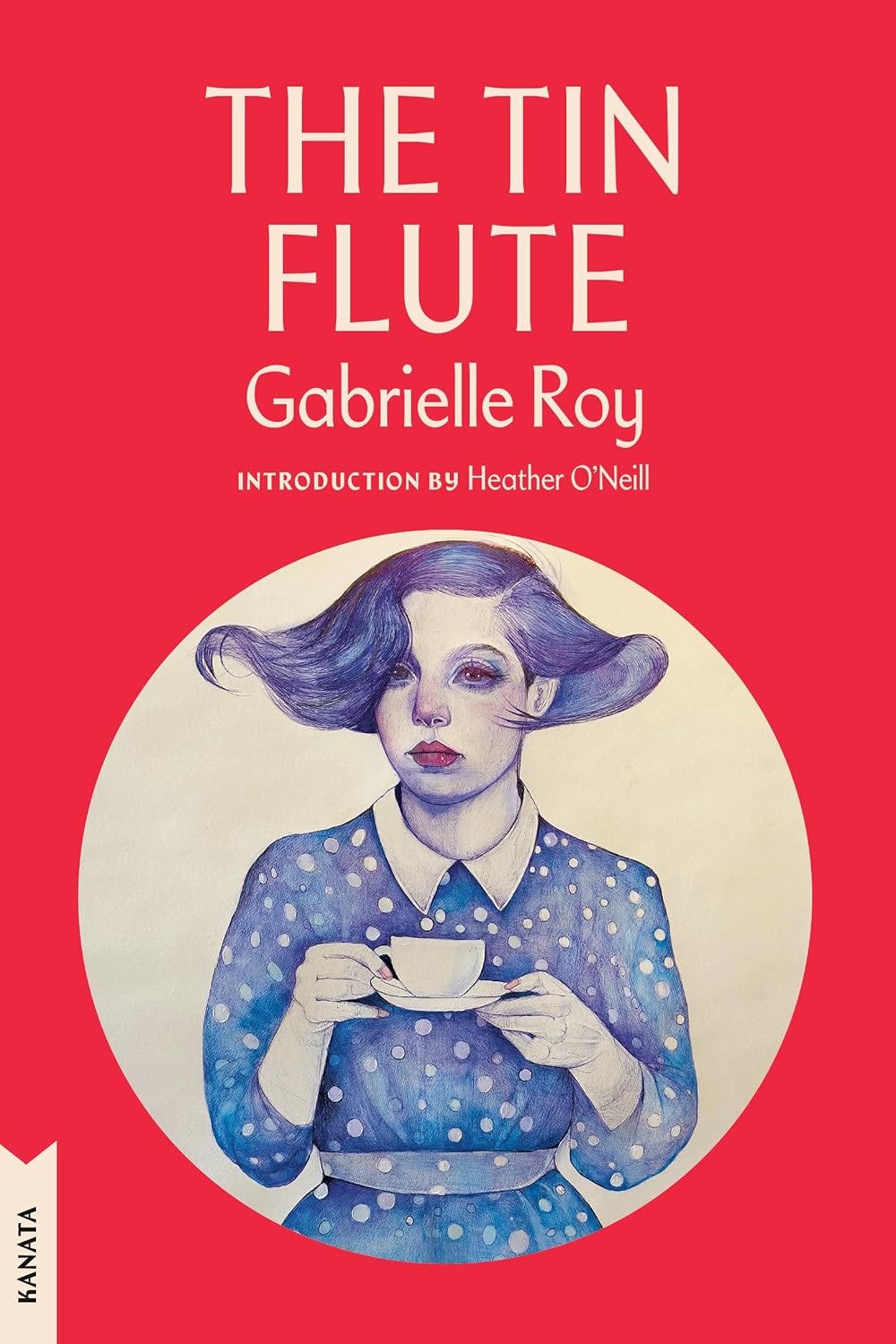
It is no wonder that The Tin Flute has been included in the Kanata Classics series. This edition begins with Stephanie Sinclair’s letter to the reader in which she warns us of racial slurs typical for that era, yet she calls the novel “one of the most significant works in the Canadian letters.” [sic] Heather O’Neill provides a somewhat choppy “Introduction” that contrasts with Roy’s expansive style: “All the characters are pathetic. Even more so because they have pride. They are all so aware of their condition. They are all so ashamed. It is a portrait of a people living in shame.” Philip Stratford’s “Afterword” offers a more nuanced appraisal of the novel, but perhaps Margaret Atwood’s assessment in “Maclean’s Magazine” is the best analysis of Roy’s fiction.


About the Author
GABRIELLE ROY was born in Manitoba in 1909. The youngest of eight children, she studied in a convent school for twelve years, then taught school herself. In 1937 Roy travelled to Europe to study drama, and during two years spent in London and Paris she began her writing career. The approaching war forced her to return to Canada, and she settled in Montreal. Roy's first novel, The Tin Flute, ushered in a new era of realism in Quebec fiction with its compassionate depiction of a working-class family in Montreal's Saint-Henri district. Her later fiction often turned for its inspiration to the Manitoba of her childhood and her teaching career. Roy complemented her fiction with essays, reflective recollections, and three children's books. Her many honours include three Governor General's Awards, France's Prix Fémina, and Quebec's Prix David. She died in Quebec in 1983.
About the Reviewer
Michael Greenstein is a retired professor of English (Université de Sherbrooke). He is the author of Third Solitudes: Tradition and Discontinuity in Jewish-Canadian Literature and has published extensively on Victorian, Canadian, and American Jewish literature. He has published over 300 essays and reviews in books and journals across Canada, the United States, and Europe.
Book Details
Publisher : McClelland & Stewart
Publication date : July 14 2026
Language : English
Print length : 384 pages
ISBN-10 : 0771028318
ISBN-13 : 978-0771028311
This takes me back to my reading fifty years ago--reminding me of many things and urging me to ponder these anew.
A lovely review!