

The Tree of Man by Patrick White
A Throwback Thursday review by Ian Colford

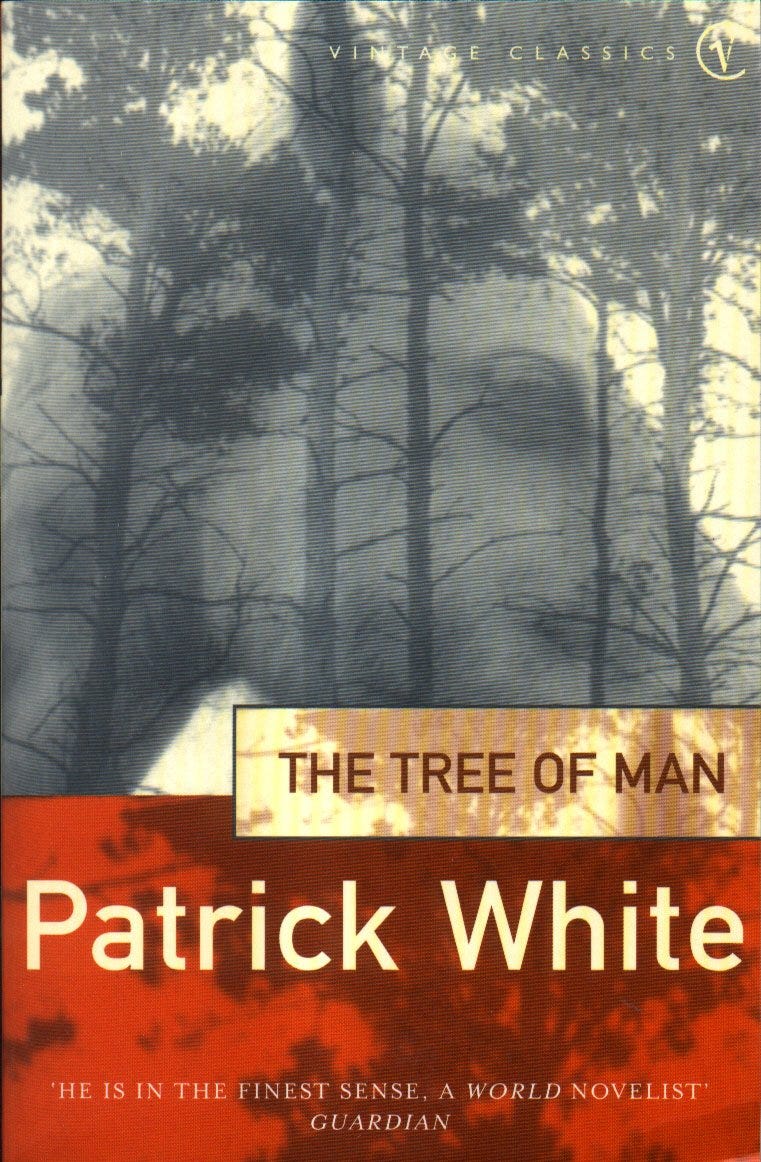
A true masterpiece in every conceivable sense of that overused word, Patrick White’s fourth novel, The Tree of Man, is an attempt by the author to chronicle an entire life story, with all manner of suffering and solace, triumph and disappointment, strength and weakness.
At some point in the early part of the 20th Century, a young man named Stan Parker leaves the town where he grew up and, with nothing but a horse, cart, dog and a few tools, moves to a plot of land that he’s inherited located deep in Australian bush country, and begins life anew. Resourceful and practical by nature, undaunted by solitude and hard work, seemingly immune to challenges posed by rough terrain and severe weather, Parker clears the land and builds himself a rudimentary house. In time, he takes a wife, named Amy, who comes to live on Parker’s farm and begins adding appropriate feminine touches to an austere, utilitarian home in the bush.
Stan Parker is thoughtful but taciturn, unsentimental, but with an appreciation of the natural world that approaches a spiritual connection. Amy, a dreamy, curious, empathetic woman, possesses a fiery temperament and is more articulate when it comes to emotions. She quickly learns however, and accepts, that her husband is unlikely to share his private musings and will rarely express his feelings.
Within a few years Amy has given birth to two children, Ray and Thelma. Ray grows into a diffident child, easily bored, constantly in need of distraction but devoted to his father and endlessly craving Stan’s approval. As Thelma matures, she holds herself aloof from the household in which she was raised. Upon reaching her teens, she develops an appetite for the outside world and, the more she sees of it, the deeper her shame at her rustic origin and the stronger her desire to erase all traces of it. Neither Ray nor Thelma have any interest in farming, and as adults both reject (and even mock) their parents’ pastoral simplicity.
White’s novel, published in 1955, covers every aspect of Stan and Amy Parker’s life together, from marriage to death, and depicts the gradual settling and suburban transformation of the land around them. Throughout the book, White’s prose is a bracing mix of bluntly eccentric exposition and magical flights of lyricism, with occasional forays into stream-of-consciousness. Though Stan and Amy dominate the narrative, White tells the story from multiple points of view, effortlessly shifting perspective from one scene to the next or even within a single scene.
For anyone familiar with White’s previous novels, the advancement in his development as a writer demonstrated in this densely written, vividly imagined, sometimes difficult but eminently rewarding tome will be apparent. This is a hugely ambitious novel filled with contradiction and wonder at the human capacity to survive hardship and find joy in the simple act of being alive, one that speaks eloquently of the transience of all things and the mystery of human connection and endurance. The novel vaulted Patrick White to the front ranks of the Australian literary world and gained attention globally. Mammoth in scope, buzzing with sensory detail, often funny and always humane, The Tree of Man is a must-read for any serious student of 20th-Century fiction.

About the Author
Patrick White was born in England in 1912 and taken to Australia, where his father owned a sheep farm, when he was six months old. He was educated in England at Cheltenham college and King's College, Cambridge. He settled in London, where he wrote several unpublished novels, then served in the RAF during the war. He returned to Australia after the war.
He became the most considerable figure in modern Australian literature, awarded the Nobel Prize for Literature in 1973. The great poet of Australian landscape, he turned its vast empty spaces into great mythic landscapes of the soul. His position as a man of letters was controversial, provoked by his acerbic, unpredictable public statements and his belief that it is eccentric individuals who offer the only hope of salvation. He died in September 1990.
About the Reviewer
Ian Colford was born, raised, and educated in Halifax. His reviews and stories have appeared in many print and online publications. He is the author of two collections of short fiction and two novels, and is the recipient of the Margaret and John Savage First Book Award for Evidence.
Book Details
Publisher : Vintage
Publication date : Oct. 27 1994
Edition : New edition
Language : English
ISBN-10 : 0099324512
ISBN-13 : 978-0099324515
What a wonderful surprise! Patrick White is one of my favourite writers, and usually unaccountably neglected. The Tree of Man, The Eye of the Storm, Riders in the Chariot, The Vivisector, are all great books. Even his lesser works are rewarding. The Twyborn Affair was the first post ‘Orlando’ account of a gender bending protagonist I’d come across, and Voss is a brilliant commentary on the drive to conquer nature, set against a more spiritual awareness of the landscape and the world around us. As the reviewer suggests in the case in The Tree of Man, Patrick White is always concerned with spiritual struggles, whatever else is going on. So great to read about someone else’s appreciation of his work. It’s been decades since I read him. He deserves rereading.
This book sounds fascinating and is right up my street for the era! I searched for it in our area library but no luck. I’ll have to order it on Abe’s Books I think. Thank you for introducing me to this author!