

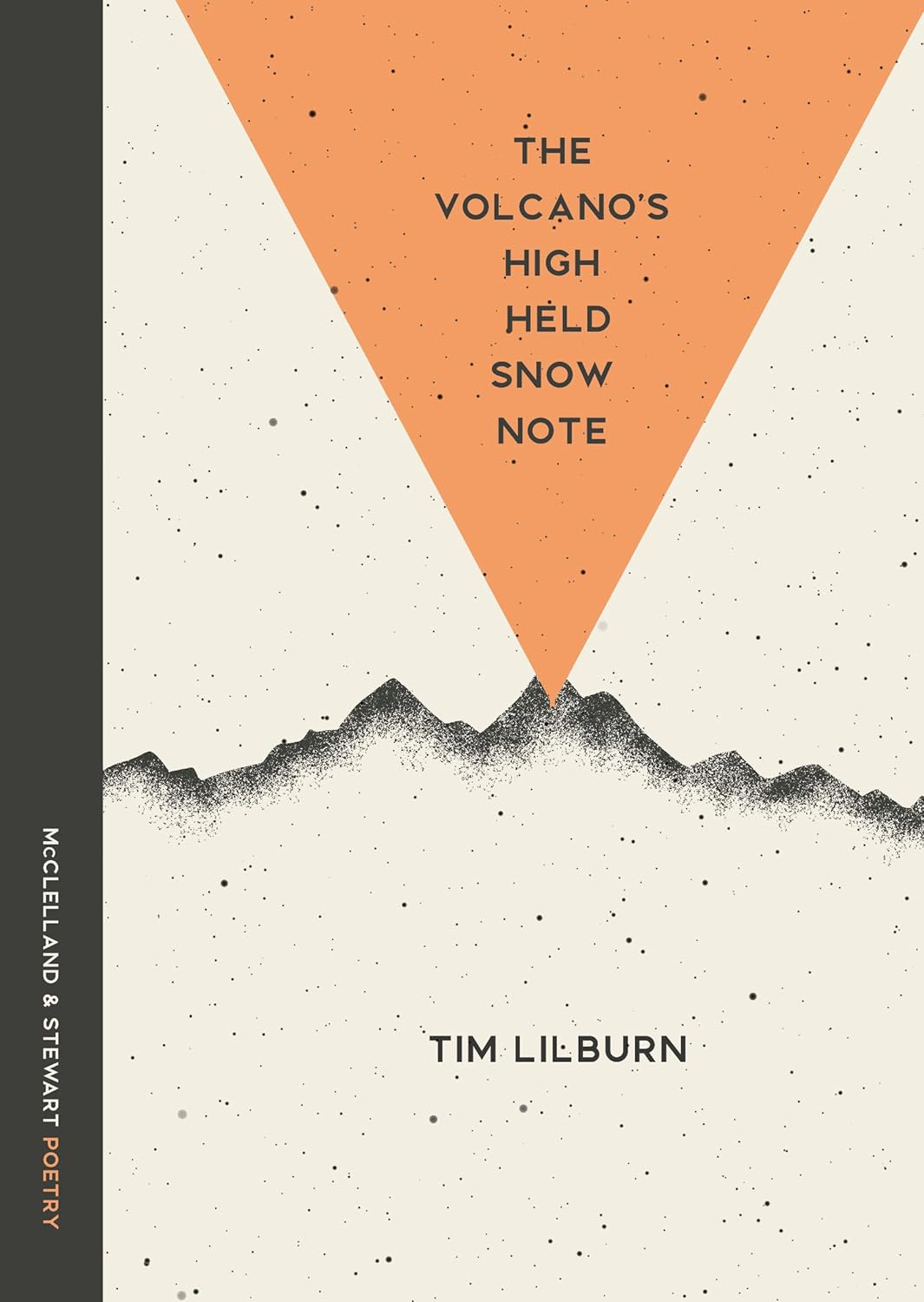
The Volcano's High Held Snow Note: Poems by Tim Lilburn
A Michael Greenstein Review

The Kabbalah in British Columbia
“… what does the mountain care?”

Robert Browning, “Andrea del Sarto” (1855)
The title of Tim Lilburn’s latest collection of poetry sounds (like) itself: an initial short “o” in volcano erupts to a series of longer o’s in its final syllable and in “snow note” which is held in check by its “high held” alliteration. This note may be held near the summit or for longer beats of breathing at various altitudes and attitudes: To hold the note is to behold it and to be beholden to it in an aesthetics of apprehension. This arresting phrase appears in “Controlled Burn Theurgy,” a poem in three scenes, the first one from the beginning of the pandemic. If theurgy is the practice of turning the soul around, then Lilburn’s poetry enacts Neoplatonic theurgy in bridging the human and divine. The poem urges and refrains streams of nature, language, and consciousness: “A stream flows out of the head of the mountain.” This mountain is a landmark on Lilburn’s horizon and becomes human in his interaction with it. The stream gathers lava and layers of pandemic in the rest of the poem: “The stream white waters hummingbirds,” their flutter sounding the surrounding air, spreading virally from the volcano’s unsung scream. “A stream out of oaks / Mouth-banked below-the- / tongue slither.” The poet banks his hyphens, and this sublingual tributary is also subliminal in its suggestion of medication during Covid.
“Inaugural / river saying, saying.” From source to mouth the river repeats its saying to flow into a longer sentence without end stop:
Worded, a stream comes out of the head

of stone cliffs

and from the red moon

bulbing from earth near the volcano

and the volcano’s high held snow note.
Stone cliffs participate in the dialogue between poet and nature, while an ominous red moon witnesses virus and volcano, bubbling as well as bulbing. “Language of stream” is the medium through which the poet listens to lines, colours, and distances. Bird, stream, and mountain are worded in the lava of language; and red moon continues its wound as “Red moonlight gash on winter Haro Strait.” This outpouring of flora and fauna turns to camouflage “stream of deer / colour of waterlogged wood,” out of sound and sight. “Language here plucked” doubles to hear in the pluck of flower and string instruments toward “Stream of whales, drift logs” in the current of waterlogged wood. These logs drift to a prayer for family members during the pandemic and the “souls’ waves.” From whale songs to souls’ waves the poem reverts to birds: “Hummingbirds’ hammering stream in mountain thought.” The mountain’s head is capable of thinking in the poet’s singing which turns from the plural of hummingbirds to “Hummingbird in armament and language” – its strength measured in hammering armament against a pandemic.
This scene ends with Edenic apple trees: “The breasts of apple trees / send light paths.” Having given thought and voice to the mountain and its inhabitants, the poet enters into dialogue with the body of landscape, so that streams flow in both directions between humans and nature. Birds and bees find succour in trees, which are palpated by the poet’s keen stethoscope. What he hears is “language’s stalking shimmer / And bees coursing to apple tree breasts.” Unseen, the virus stalks the universe while a bee-loud glade offers some remedy.
His shimmer of language enters Scene Two as he worries about hummingbirds in the cold of February: “ice spears / rattling in the feeder.” If spears belong to the bird’s armament, then rattle reminds us of the snake in the apple garden and other unseen pandemic threats. Bird plural is reduced to “one, male, locked, staring out / of creeping torpor.” Commas lock in monosyllables before branching outward – a tension in slow motion that contrasts with the usual rapid flutter of wings. Pacific Gothic creeps “in gravid darkening / perched on a stick.” Stick returns to spears, while female gravid interacts with the single male before “the fluorescent explosion window,” which enters the poet’s winter dream: “a doe / noses out a route / behind the kitchen cupboards / and forces her neck and head / through a gap.” From mountain to kitchen to doe head, the dream verges on surrealism in the gap of consciousness. The poet strokes the doe’s throat. “The new country stands quivering / Its black eye is thrown over me.” Either doe eye or eye of country, the poet is covered and wounded in its tarp and trap. “The breasts of apple trees: send light / paths.” And the stream returns as well. “The star flows / send language / as bees make an attempt at apple tree / breasts.” These breasts nurture nature in this tree-loud glade: birds breathe trees breathe birds in the unseen photosynthesis of the sublime.
Scene Three shifts from dream to prayer, as the poet sits atop a box of unsold copies of his book, “Thinking and Singing: Poetry and the Practice of Philosophy.” Unsold and unsung, this book in the basement sits “at the tail / end of prayer” and has much to recommend it. On its cover Chinese characters descend vertically to intersect with Greek words in Lilburn’s bilingual poetry and philosophy. His prayer for family and dream of a sleepy Odysseus include the eros of apple trees and snow-streaked mountain, “which asserts its rise / to roost in me.” From basement to streak and stream, rise and roost, the poet groans and shuffles his feet to repeat his conclusion:
The mountain is dark

The mountain is dark

(fire sent into fire)

Its light is dark

beaming ray of its ceremonies
The poet opens his ear from the great above to the great below, repeats his brooding darkness, and celebrates ceremonies of light beams. His parenthetic fire is contained in controlled burn, the mountain’s hard gemlike flame, the stream’s theurgy turning the soul. The high held snow note is a torch to light the horizon and listen to its voices; his encounter with the sublime wounds and heals. (Apokatastasis, apodictic, and epektatic – a Greek flotilla in Lilburn’s lexical odyssey.)
The opening poem, “Now, He Thinks,” raises questions about Lilburn’s high held snow notes. “The child puts up his hand / to stand as an ear vortexing / over rising basalt.” This initial gesture seems to imply that the child wishes to answer a question, but his act is an aural one reflected in rhyme of hand and stand, and sound of “vortexing over rising” in his climb to the sublime. “What else?” pulses through the brief poem in concert with “rising” between basalt and Mars. Another question at the poem’s centre – “Can anything more winningly blue / come his way?” – is answered in “He’s in.” The child is in the poem even as the poem resides in him. He is a notetaker of afternoons, high held notes, and Mars rising – languid time and planetary rotation. Waiting for the second “What else?”, he “hunches / near the biggest oak / and takes his time.” He stethoscopes the oak and takes its pulse through thinking. The biggest oak puts the child in his place, reducing the ego in supplication before it rises through time and attention. In pursuit of the sublime, the child’s reach exceeds his grasp.
Three stanzas of “Cold” introduce a hummingbird companion and form a sonnet for its feeder. “Matted snow with hard crust / unfolds, linen cloth, on the west face.” Long o’s enact that unfolding, paused in commas, and further arrested in crust and west. Matted prepares for mated in male, monstrous, and magical, while west gives direction, and face personifies the landscape in preparation for dialogic encounter. The scene unfolds “the male hummingbird broken / from sleep, its seal, / stilled at the just thawed feeder.” Like his weary Odysseus, Lilburn’s sleep-laden creatures awaken from sonneted sibilance of seal, stilled, snow.
The second stanza personifies snow: “Final dark, snow / breathes down between monstrous firs, / the cat door in the shed blocked by snow / and the death seven years ago of the ingenious cat.” If the hummingbird’s sleep is the first seal, then the cat’s door and death are the second blockage. The poet listens to the snow’s breathing and bird’s beating, while gargantuan trees contrast with a diminished shed; and that dimensional contrast induces a feeling of the sublime wherein inhalation becomes inspiration, view becomes vision and voice, and awe is embedded in thawed feeder.
In the final stanza the dialogue between poet and bird develops sublime meaning and moral of the fable: “I speak the magical language to the male / to warm him.” Magical language from the first two stanzas carries through to the final sentence, which points to the visual interplay among poet, sleepy bird, and dead cat that no longer poses a threat to its prey in a domestic wilderness. “Puffed, enflamed / on the dead cedar branch, his eye on me and / the door from where comes / anagogic liquid.” Dead branch contrasts with majestic firs and interacts with the dead cat, while cat’s door contrasts with the bird’s doorless feeder. Anagogic liquid feeds levels of interpretation and mountain gradation, even as the poet warms his hummingbird in “Cold.” Lilburn’s ventriloquism speaks Greek, Indigenous, and nature’s dialect to nourish moods and puff matted surroundings.
“Little Greeting” measures a smallness in two sentences that make do without verbs because of their overriding Imagism: “Angel of the cliff rock, mirabundus, / with another language.” Angel’s wings may belong to bird, tree, or spirit of place in the astonishment of Latin, the other language. This angelic creature possesses a “mind of rotting pink, / ironwood of shag bloom, / speech, rilling acetylene feather.” If rotting pink is not quite an oxymoron, then acetylene feather renders it more so, with rilling engaging rotting. A sibilance of speech forms part of the greeting, while long i’s gather at the end of the poem to greet the reader in a repeated mindset: “sent mind / of the oak, the red vein / in blue spruce in cool, dry July. / The oak, its eyes.” Eyes of oak, bird, and spirit greet and witness this audiovisual experience.
“Then” is another little greeting in two stanzas that look back to this volume’s first poem, “Now, He Thinks,” in Lilburn’s temporal rhythms and moods of now and then. “Here is where you were coming back then / pocked, black-purple Big Quill Lake, wind-accordioned.” Words water through monosyllables until elongated in accordioned – its long sound and visual ripple. A correspondent breeze harps Lilburn’s coloured lake quilled in ink. “To enlist here in the early fall / was the plan.” If “here” repeats the first word of place and presence, and “enlist” prepares for lists that follow, then “fall” is both seasonal and part of the poet’s tumbling descents. “Lodged, javelin forehead / driven, in a slope dug-out.” Lodged is a dwelling both temporary and permanent, the javelin pointing back to quill and forward to dugout. Split into the second-person pronoun, the poet is “clothed and bedded with echoing damp / and roots inches up from halitotic water.” Echoing reverts to accordioned, while halitotic carries breathing forward to “swans swaying in.” The stanza concludes in a mood of witnessing and a suggestion of cosmic sublime through sentences without verbs: “Eye houses everywhere. / Nights in the mouths of stars.”
The second stanza offers a final hyphen to go along with the earlier ones: “You’d live in the processional slough- / edge ground below a door opening upward / to Orion’s belt.” This processional is ceremonial in sound from houses to mouths and slough, as well as directional between below and upward to stars whose mouths contrast with fauna drinking at the end: “elk and deer drinking in the crusty shore, / no sickness in their bodies. That / mist coming off them.” Enlisting the mist, healthy animals partake of the mystery surrounding them, inhaling and imbibing the notes of Orion and accordion.
The shortest poem in this collection, “How It Would Be,” consists of three haiku lines alternating monosyllables and disyllabic words in Imagistic rhythm: “Wolves and silence. / Hungry star. A second or third / winter on the tip of your tongue.” Sounds between wolves and silence enter the mouths of stars and the poet’s linguistic time span, filling in the title of how it would be. This brief tercet leads to the two stanzas of “I Have Oats,” which head in a downward direction, a decline of the sublime: “Stars tendril nearer, droop. Malice.” Shooting stars drop and stop in sentences. A polluted landscape is ominous: “Two-man-height high tires, industrial, flake down / on a beach south of Campbell River.” High tires replace high tides: “three or four bolted together, green-brown bilge sways / in the troughs.” Monosyllabic numbers and colours are bolted together by hyphens that accentuate the ups and downs of sludge at river’s edge.
“Stone-voiced wind” accordions the river which is further sounded in tree and tire: “A cedar branch slide shrieking / along an eave.” The first stanza ends by guttering evening to eave to prepare for night vision in the second stanza. “I set it down: I have the farm of 3:00 a.m.; / I have the Zoharic field of weeping, dipping oats.” The poet sets the scene down in words and experience. His simple verbs are loaded: to have the farm and Zohar is to possess vision rather than ownership of property. To have and to hold are key aesthetic experiences for Lilburn who laments “how little / I have in my head,” even while he holds oaks and oats. Like his weary and weeping Odysseus, the poet is awake in the middle of the night when the mystical light of the Zohar and Zodiac have him enthralled. Amid drooping oats an epiphany of rhyming monosyllables of stone and oats: “All true. / But who to say this to?” This rhetorical question is addressed to the reader before the concluding mood sets in: “Snow cutting from the north. / Geese and moon. / Sea lions change sentries.” Snow scythes oats, the moon joins star tendrils, and sea lions change watchful guards at 3:00 a.m. An aesthetics of apprehension leans on have and hold.
The Zohar reappears in “The Massinahican Streaks Out!” which refers to Louis Riel’s lost cosmology. “Floating masses of text, coagulations, / train cars, thrown, moving at bulking speed, / bending as gusts of crows.” Sibilants coalesce, as do bulking and bending, while masses sing Massinahican, the Cree book or bible. A gathering of esoteric texts follows: “Massinahican, Zohar, The Hidden Eyes of Things, / Roberto Harrison’s Tecumseh Republic” – rivers of vision that streak out. Thought quickens and thickens in the mix of Indigenous and Greek texts whose polysyllables streak out: “Look into the pot they carry inside their quickness, / a simmer, cherry pitch of apokatastasis.” Poetic restoration occurs between pot and pitch, carry and cherry. A Sufi book of wisdom joins this surge – Fusus al-hikam. “Venus in the east” is the first cosmic direction to be followed by other cosmic pulls: “We / meet ourselves in this speed / as north Pacific beaches west of Bear Beach, breakers / knuckling on high shore walls, / fern waving part way up toward us and through us.” Streaking covers four corners from bulking speed to meeting speed through us in floating kabbalistic signifiers and cosmological occultation.
The Zohar streaks out again in “What to Do with the Coral Rose?” as the poet interacts with nature and centuries-old texts: “Some sort of / Zoharic cone-like room of branches exists in the further back of forest.” Sharing a room with Robert Browning’s “Rabbi Ben Ezra,” Lilburn’s kabbalistic cone branches and breathes from the beginning engagement with a ninth-century Irish monk: “Alright, ok, Eriugena – I wish he could or would visit / the poor sick coral rose, its pocked astral faces – wants a sticking.” This opening familiar address abruptly shifts to a lesser-known addressee, the author of “Periphyseon” mentioned in the final sentence: “I wish Eriugena would spread the food of just speeches over the / poor coral rose.” From the start, the poem spreads speeches of wisdom and music in unifying strains that interlace with the impoverished coral rose – normally a symbol of gratitude and happiness. Astral faces prepare for cosmic and dialogic elements in the rest of the poem – “unioned / (with God) cosmos (adunatio), a Port Mann Bridge breath.” He bridges Hebraic and classical roots of Percy Shelley’s “Adonais,” attuned to adunatio.
The poet sticks Vancouver’s bridge to cosmic at-onement, Hebrew for God’s name, and Kabbalah in British Columbia. The local bridge breathes under his stethoscope “joining individuated heat with the beyond- / intelligence torch” – light and life of Zohar’s radiant tree. This wisdom torch sweeps a web from nature’s secretions. After these luminescent threads, the poet returns to his opening ok: “That’s alright, fine, I would go for a little breath myself, ripple, / an absorption.” The self’s diminished breath exhales to the larger bridge’s breath and beyond to a cosmic “taste of limitlessness” through a tripled “mouth, mouth / mouth” that goes beyond dialogue: “The Periphyseon is in dialogue.” In contrast to acedia where “nothing nudges,” Eriugena’s Periphyseon is polyphonic “launched like a city / of burrowing rodents, spiritual conversation, so, thus, too, an air- / seeking assemblage crowned with rotors that / whip and nip at rising.” This spiralling surrealism reaches upward with rotors of rodents.
The poem’s final section switches from Neoplatonic text to Indigenous language: “When you speak SENCOTEN to the young, or even older deer / they stop their flight and turn to look at you.” Human being and deer have slipped behind a doorless wall with the Zohar’s Tree of Life and light from boxwood to “love-lit boxwood.” Lilburn’s “further back forest” is a “castle of web / and feather, home-heap of speech and light wind.” The wind lights, the breeze breathes, and dialogue ensues: “The animals see you. You swell from their seeing.” Home-heap of speech and swelling seeing return to the Periphyseon: “I wish Eriugena would spread the food of just speeches over the / poor coral rose.” Lilburn’s philosophy nurtures nature and spreads speech of Greek, Latin, and SENCOTEN.
The Zohar makes a final appearance in “No Untrue Philosophy Reaches –” where a red room takes over from the earlier Zoharic room. Undo the double negatives so that true philosophy reaches the special room, “tongued from a second place, thick / with covenanted mountain ranges.” Covenanted Sinai as a second place spreads to the Rockies and ranges farther west: “coastal, reached only by under-rain logging roads.” Like have and hold, reach doubles as physical and metaphysical goal in an aesthetics of apprehension, just as under-rain locates its philosophical counterpart in untrue. The natural world prepares for the supernatural: “drifting through / dripping, charcoal fir, west shore, Vancouver Island.” From that under-rain dripping, an arrival at the sublime: “a silo of ridgelines of 14,000 foot / quiet.” Nature’s immensity leads to philosophic speculation once more in a via negativa: “Nothing true / that does not reach / a metaphysics of ecstasy.” Long rhyming e’s extend vision and voice.
The second stanza picks up those long e’s of philosophy and melody: “To see or have graze your arm skin / dust of melodic orbital ringing.” Which further opens to antique texts and pilgrimages from Mazdean Iran to Ibn ‘Arabi’s Sufis of Andalusia to the Zohar. “Ibn ‘Arabi, feet afloat, touches down along the light over-boil African / north rim.” This long line mirrors the third line of the first stanza in its geographic stretch, and echoes “under-rain” with “over-boil” and 14,000 foot with feet afloat. The poem pilgrimages from British Columbia to North Africa to Spain in peregrinations of thought and thinking. After Ibn ‘Arabi we alight in Castille, “rustle of the Companions’ talk.” These Companions are the disciples of Rabbi Shimon bar Yohai in the Zohar, “their own feet on roads’ stones or inns’ stairs / or up to the ankle in garden soil / of 3:30 a.m. where they meet.” Between feet and meet, roads’ stones and earlier “minus stone,” meetings take place in the middle of the night when history regresses to biblical origins: “King David, the donkey driver, / who informs them they are the Lower Reaches / of Eden.” Lilburn’s philosophy reaches from feet to summit in the sublime encounters of minds, as he transplants Eden to Vancouver Island.
The third stanza migrates across mythologies to return home. With their own volcanic structures “Emerald cities rise and vibrate.” Broken-hearted winds sound these coloured cities and celestial earth: “Our highest in-skinned, below / bone drama-ear.” These hyphens shrink the long dash in the poem’s tilts to reach inward and rhyme ear, here, and deer – “each with their own apartment here.” Subjectivity, snowberry, and blackberries coalesce in volcanic eruption with its anagogic lava: “Trembling emanation / cooling, colouring as it passes.” This emanation ends in “exposed rock” in contrast to “in-skinned.”
The final stanza’s stethoscope breathes, beginning with “The ravens squeal to their young, / the percussive small birds.” The poet percusses nature where birds breathe trees, and the angel’s trumpet is both flower and sound of breathing astonishment. “Seraphiel / handles the great horn / of flesh and intelligence.” The verb not only alliterates with horn, but it also resonates with have and hold to apprehend a cosmic poetic. “The Eighth climate” refers to Henry Corbin’s Spiritual Body and Celestial Earth but also takes on an added measure of urgency in today’s climate. A two-year-old buck witnesses “a four-century sleep.” The final sentence offers up another bird nesting over wider meanings: “Wide leaves, floppy maple, / fallen over the dome / of the bush tits’ scrotal nest laced to the California lilac / safe from last night’s north wind.” From west shore to north wind, south climes, and easterly origins, philosophy reaches far and wide. Philosopher’s stone and rock face hold their breathing across sentences and stanzas. Between Eden and British Columbia, Lilburn’s verse erupts with molten music and metaphysics from summits’ sublime to anagogic undercurrents of birds and Zoharic trees of radiant life.

About the Author
Tim Lilburn lives in the Bowker Creek watershed in W̱SÁNEĆ territory on Vancouver Island. He is the author of twelve books of poetry, and has been the poetry editor for Grain and was one of the founders of Jackpine Press.
About the Reviewer
Michael Greenstein is a retired professor of English (Université de Sherbrooke). He is the author of Third Solitudes: Tradition and Discontinuity in Jewish-Canadian Literature and has published extensively on Victorian, Canadian, and American Jewish literature. He has published over 300 essays and reviews in books and journals across Canada, the United States, and Europe.
Book Details
Publisher : McClelland & Stewart
Publication date : Sept. 22 2026
Language : English
Print length : 104 pages
ISBN-10 : 0771026587
ISBN-13 : 978-0771026584
 | A guest post by
|
Thank you Penn for your kind comment, and thanks again to Sheila and David for your attentive reading.
I can't imagine any other reviewer so adeptly mirroring the language of landscape in Lilburn's work, Brilliant.