

The Wiki of Babel by Kyle Flemmer
Reviewed by Dawn Macdonald

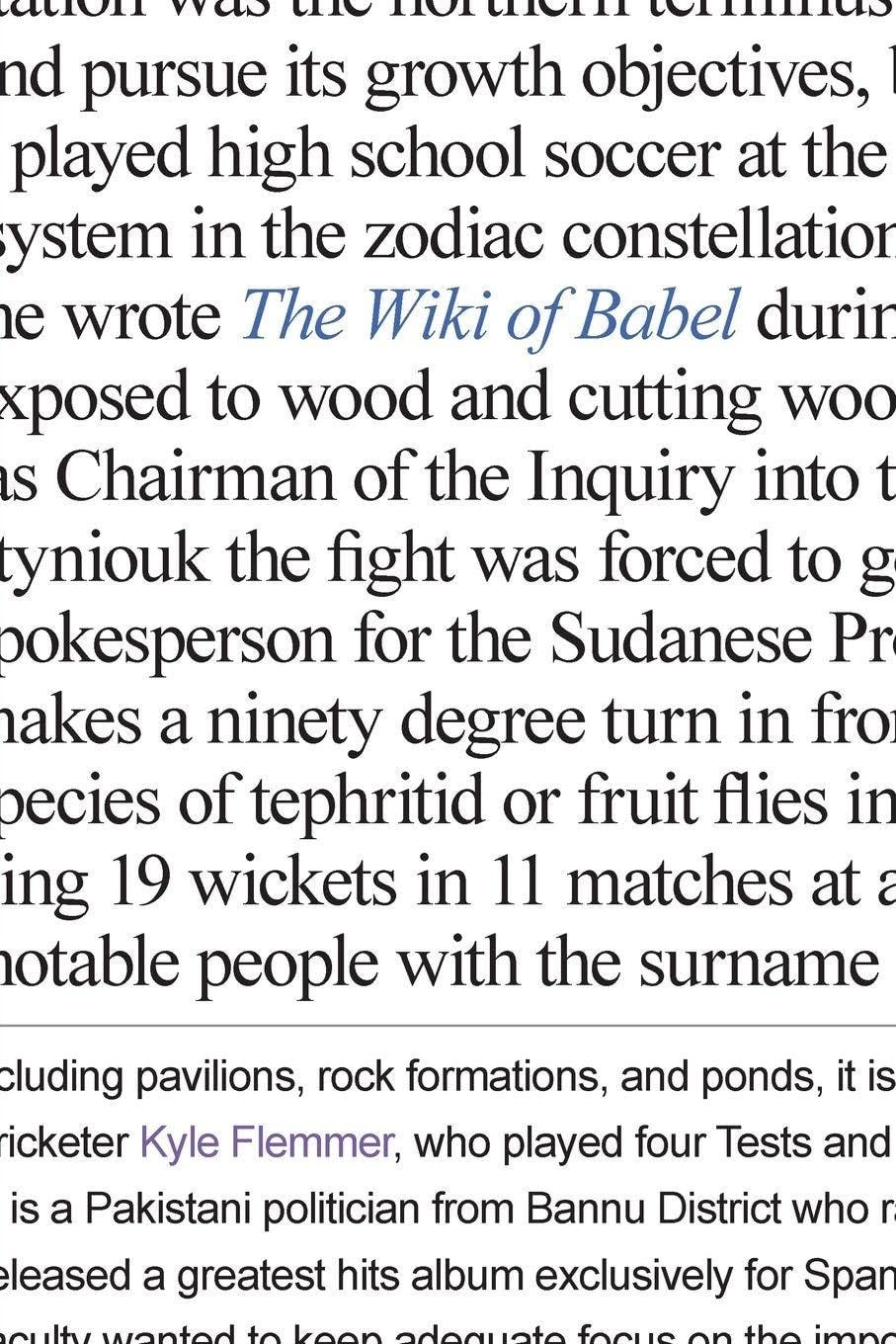
Part poetry collection, part DIY instruction manual for making your own poems, The Wiki of Babel is just the starting point for a conversation that continues off the page. Kyle Flemmer, ever the experimentalist, has devised a set of five poem-making protocols for selecting and remixing text from Wikipedia. The protocols, which involve a mélange of randomized and deterministic processes along with some degree of curatorial agency, are successful to the degree that they are generative of interesting results.
“This is a book that begs to be used, not just consumed. It’s a fun read, mind you, but why stop there?”
The book’s introduction alerts the reader to “themes of collective knowledge, information organization, and reader interactivity.” This is a book that begs to be used, not just consumed. It’s a fun read, mind you, but why stop there? In approaching a review, it feels imperative to try out Flemmer’s techniques, and in particular to discover how easy or difficult it might be to produce results that are as interesting as those included between the covers of the volume. As it turns out, moderately difficult. I certainly didn’t get marvels popping out on my first try. That’s why The Wiki of Babel counts as a poetry collection and not just a small set of activity worksheets. The curatorial eye comes into effect in selecting what to preserve, and what to throw back. Creativity is required, along with persistence and a certain ludic willingness to play along.
I had the most success with the technique called “Canadian hypertext” which takes as its starting point the Wikipedia entry for some classic work of CanLit, and proceeds by following hyperlinks to construct a meandering poem out of the words surrounding each jumping-off point. Specifically, the direction is to select seven words encompassing the seventh hyperlink, treating hyperlinked phrases as a single word; click the link and repeat. It’s deterministic inasmuch as the sequence of hyperlinks is fixed, but random to the extent that this sequence remains in flux with the dynamics of Wikipedia edits, and allows a degree of poetic decision-making when choosing where to start and end each selection, as well as deciding when to call the piece complete. The conceptual connectedness of the hyperlinks causes the poem to wander through a series of topics; so, for example, the poem for The Life of Pi moves from tigers, to colonial history, to voyages of exploration, to Antarctica, to wetlands, to birds, to legal terminology. It had occurred to me to wonder if this procedure might ever get stuck in a repeating loop, bouncing back and forth between the same two linked lines, and indeed it does—quite amusingly, at the end of the poem for Sunshine Sketches of a Little Town, where “tautology” leads to “tautologies” and back to “tautology” again.
When I tried it out, I found that not all starting choices led to fruitful results, and some quickly hit an impasse. Playing around with various titles by the Canadian science fiction writer Robert J. Sawyer, I found some of my attempts stymied by articles that don’t contain the requisite number of hyperlinks, or by links that aren’t surrounded by the requisite amount of in-line text. Some of these attempts just weren’t very interesting, as they repeatedly veered into content about science fiction magazines and awards—okay in its place, but not terrifically exciting as poetry. Other times the content felt promising—the path from the novel Flashforward led into particle physics and then optical instrumentation, including gun sights—but I had trouble selecting text that didn’t start or end with jarringly nonsensical prepositions, or introduce distracting shifts in tense and grammatical number. A bit of non-grammatical syntax is fine within this type of form, but there’s a point beyond which the whole thing looks like word salad—and an inedible salad at that, made entirely out of croutons. So when I say that I found the “Canadian hypertext” technique to be generative, I don’t mean that it made life entirely easy. These approaches are demanding in their own way. You have to really like counting, clicking around, and starting over.
To give you a sense of how this works when it works, here are the opening lines of Flemmer’s Roughing It in the Bush:
“	marketing Canada as a British emigrant’s utopia
However, it may also denote an intentional community

	common social, political, religious, or spiritual vision
	a supernatural realm beyond the ordinarily observable
	magic, telekinesis, levitation, precognition, and extrasensory perception”
The other four techniques Flemmer has developed and shared in The Wiki of Babel are also interesting to read and play around with, involving translation, the ‘random article’ feature, the “current events” page, and the charting of alternative paths between pre-chosen start- and end-points. Flemmer notes that he worked on this project during a Computational Writing residency program at Banff, which speaks to the value of that program in forwarding the development of innovative work in digital space, out of tools and materials that some might think of as anti-poetic.
Flemmer’s first collection, Supergiants, was one of my favourite books of 2025. It’s really cool to see The Wiki of Babel arrive as a provocation, as both a gift and a challenge to fellow poets. I’ll be kept busy playing with these ideas while waiting to see what awesome things Flemmer comes up with next.


About the Author
Kyle Flemmer is a writer, publisher, and digital media artist from Calgary, Canada in Treaty 7 territory. In 2014, he founded The Blasted Tree Publishing Co., a small press focused on experimental poetics and visual art. His artworks and publications have been exhibited locally and abroad. Flemmer?s other books include Barcode Poetry, Supergiants and TzAR: Pixel Art Anthology.
About the Reviewer
Dawn Macdonald lives in Whitehorse, Yukon, where she grew up without electricity or running water. She won the 2025 Canadian First Book Prize for her poetry collection Northerny. She posts weekly on Reviews of Books I Got for Free or Cheap (on Substack), as well as reviews for journals and The Seaboard Review of Books.
Book Details
Publisher : University of Calgary Press
Publication date : June 15 2026
Language : English
Print length : 122 pages
ISBN-10 : 177385674X
ISBN-13 : 978-1773856742
 | A guest post by
|