

The Wren by A.F. Moritz
Reviewed by Michael Greenstein

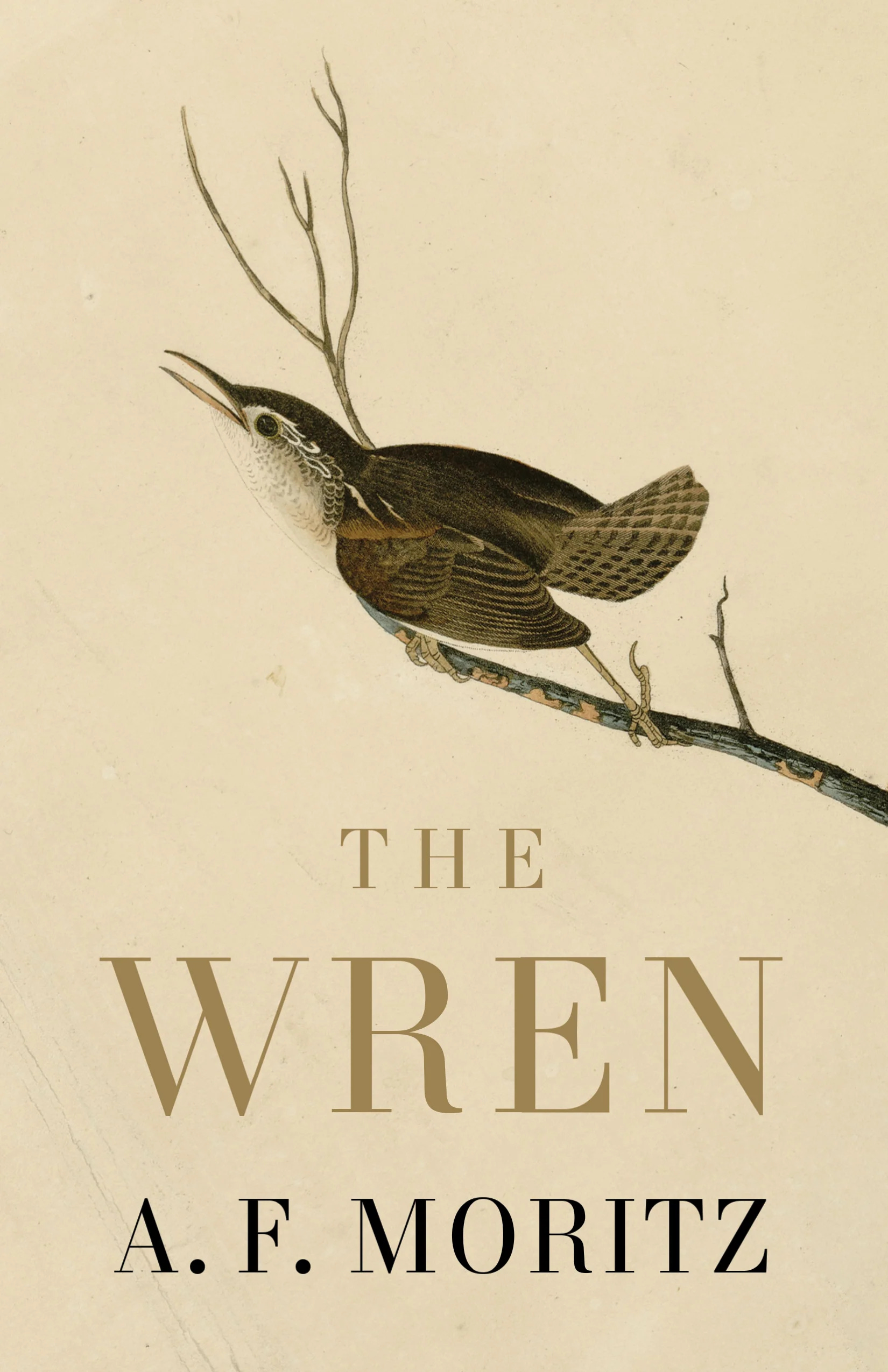
“The Wren” is an eponymous sonnet batted back to the cover of A.F. Moritz’s twenty-third book of poems. The bird utters no sound except for those provided by the throated lines themselves. A throng of monosyllables in the opening line measures its presence “In the stand of short thick stems of grass.” Sibilants and the tick of short and thick arrest the setting which stands and stems motion into stillness. Short vowels stretch to longer ones in the second line “in front of the beach and long blue inlet,” as liquid l’s initiate motion “under the line of sand birches and cottonwoods.” Quatrain and sentence end in further movement “starting a life, tremoring in chill gusts” – a trilling onomatopoeia amid oscillating tetrameters and pentameters where nature’s underline meets Moritz’s poetic line.
“Sure-footed, The Wren alights and delights.”
The next sentence relies on considerable alliteration to develop tremoring in a dance between stillness and motion: “Two feet tall, with a few twig branches and stiff / clicking leaves still clinging on from last fall.” These two feet also belong to biped bird, poet, and the measured rhythms of lines. The initial tall, paused by a comma to rhyme and rhythm with fall, contrasts with the short grass in an interplay between diminutive and larger significance. The “smallest wren” has its own still clinging to these branches in the interconnection between camouflaged bird and beige twigs. In preparation for the wren’s appearance, a skinny elm “starts” near the starting red oak in another sense of startling. These small growths look skyward from their lowly status, “poking their sky-destined tops barely above / the stand of short thick stems.” The end of the octave returns to its beginning as though we have come full circle in the discovery of a frame for the wren.
The sestet begins “From deep inside” its sheltering thicket. The commas that follow are talons that tether bird to line:
the smallest wren hops near, just to its edge,
and jerks and flutters, peering out, being glimpsed,
withdrawing again – into the thick of the doll forest
to be guessed there, its existence, the sighting of it
doubted, a legend of memories and hints.
The wren resumes its smallest monosyllables near its own edge and the edge of branches, its “j” sound caught in edged jerks, even as the assonance of near, peering, and being position its existence. The mere glimpse questions its presence in a moment’s monument and an imaginary doll forest whose thickness has appeared throughout the poem. Guessed picks up earlier gusts and doubles as guest in the empirical realm of glimpsed and sighting: poet and bird are both guests in their symbiotic relationship of observation. Moritz’s spots of thought and time are times of spotting, moments of perception that draw and withdraw in the lexicon of sparkles and splendour, and the syntax of self-examination. This bird sonnet is part of a legend within and without The Wren.
The silent “w” in write and wrong shrinks the monosyllable further in its hinted meanings. On the book’s cover the bird is tethered to a tree by its beige talons, its open beak extending bare branches that resemble antlers (antennae attuned to their surroundings). These barely coloured ties make it inseparable from the silent twigs, as if the bird were a bud or outgrowth of its camouflaged environment. The silent letter does a double U-turn in meaning within its sonnet or with respect to other poems surrounding it. And this tying together of meaning and being (epistemology and ontology) appears in the collection’s first poem, “Tieger Tieger.” Aside from its Blakean symmetry, its five tercets teeter towards a simplifying that masks complexity. The speaking animal utters monosyllables in declarative, trimeter sentences: “I came to be, I guess. / I lie in the sun, I know. / I’m vigilant always, I have to be.” The animal “being” at the beginning and end of the tercet brackets guess and know, as well as the visuals of sun and vigilant. A quiet order contrasts with the animal’s eating habits, as the second stanza stretches out the initial “came” to “came to be eating” with an element of surprise in the pounced enjambment of “eating / the children of the deer.” The violence in the innocence of children is part of the necessity of existence – “I cannot / not eat the children” – experience devouring innocence. Just as children recur in many of these poems, so the tying together or knotting of sounds and reiterated thought in “cannot / not” ring through Moritz’s verse.
At the centre of the poem the paradox of the predator appears alongside repeated verbs and iambic “I am”: “I love them. They provide me. / They are provided for me. / I eat them. I am.” The insistence of “me” and “eat” implies meat, as the stanza continues to the next: “the eating. I am the splendour / of the beautiful form / of eating them.” The beauty of symmetry lies in the inevitable relationship between predator and prey, and an ongoing peristalsis of enjambment and form: “their passing through me / from teeth to sphincter. You / are them and me.” Identities interchange in the paradox of splendour and sphincter – a tight binding of the sphynx’s mystery. The poem ties all the personal pronouns together in its own digesting form of unity and diversity.
For the most part, the poems in this collection range from a single line to a sonnet underscoring a minimalist apprehension that teases thought to ramified comprehension. In the former category, “Discouraging Assurance” contains “You have already been eternal.” The oxymoronic title introduces its paradoxical single sentence outlining the ephemeral nature of eternity, a line come and gone. That one-liner yields to a couplet in “The Classic”: “Figure your misery / without referring to yourself.” A horde of r’s darken and hasten any self-referentiality. The wren’s wry wit shines in “Attempted Retrospect” with its asterisk separating and joining two lines: “I’ve done the best I could. // * // No, that’s not right either.” That sentiment gets reflected in “Rearview Mirror,” a quatrain that backs the former poem in sound patterns: “Whatever fear and theory / of nothingness the mind concocts, / poetry adapts-adopts / into the pain of love.” Hyphen and rhyme swing thought and emotion.
The asterisk or little star at the centre of “Attempted Retrospect” constellates with its preceding poem “Légitime défense,” which accuses and defends poet and poem for going on and on, and round and round. The wren’s wisdom cycles from infinitesimal footnote to galaxy and reverses in irony: “All the sages say, though, / that the infinite circle / is inscribed in the endless ray, // and vice versa.” Wise verse peers and withdraws. This geometry and astronomy of small stars appear in “Full Moon” and “The Sun” with its “low-average star” buried in an “endless heap of stars.” The sun’s descending sublime teaches humility in chastened grandeur and mortification. In “Hence” the poet looks at stars that stretch out to invisibility and “no-relation / except within a sentimental memory / like mine.” In rhyming dialect, the poet sketches invisibility and memory, and outlines stars in his watchful eye.
The haiku of “Clematis” looks back to Ezra Pound’s petals on a wet, black bough: “Still more beautiful / than summer petals, empty / sepals of late fall.” Sibilants, liquid l’s, grasping pt of petals empty, and rhymes of beautiful petals sepals and fall contribute sound to this floral vision. “A Sentence” advances incrementally through its grammar, progression of thought, and pronunciation of long and short o’s. The continuity between mother and son appears in the absence of punctuation, the biblical “and so it was,” coordinates of “and” through so and son, and come-and-go of growth and generation. Life sentence is tied to grammatical form.
“When I Was a Child” follows the bond in “A Sentence” naturally. The poem shifts personal pronouns from its title: “To you the child you were is / the angel: bringer / of glad news, guide on bad roads.” This compact tercet divides at the colon which pauses past and present verbs and the innocence of child and angel. Hard g’s contrast with the g of angel, while alliterated bringer, bad, glad, and guide are reinforced by closing d’s in glad, guide, bad, and roads. Indeed, the b and d mirroring and mouthing in bad (like bird and bard) open and close breathing sound; and this bracketing of b and d adds to Moritz’s thought rhythms or beats of alphabet that proceed and pause in contemplative resting stops.
“Henri Bergson” underscores the philosophy of process and becoming. This ongoing process appears in “While” beginning each sentence and the progress of thought in progressive tenses: “While I was reading it, I understood it. / While I understood it, it was with me.” While most of the verbs contain halting d’s (reading, understood, vanished, returned, surrounding, ground, finished), the pushing b consonants in absorbed, became, and be add to the pace of thinking. Indeed, “absorbed” is almost onomatopoeic in the way it clings to an atmosphere of the poet’s pensées: “the ground / and the earth, the air and the space / of the stars and the place they were / coming from and were going.”
“A Prosperous Burgher” connects bird to humanity through gesture: “The plump robin tilts his head / to listen to the grass. Good hunting here. / When he arrived in April, he was svelte.” Here doubles in the act of listening to the v’s in the last line that contrasts with plump, while aspirated h’s tilt to sibilants. The bird-burgher prospers because of his listening apparatus and appetite. “The Whole World” hinges on colons and dashes to admit a song and shout after silence. “All: silence. Open / the windows: world – cricket song / and a shout – comes in.” Long and short o’s open mouth and ear. “Dream” employs sibilance and g’s to paint oneiric sound scenes: “Life made of gelatin, riding on the sea. / Many beings whose viscid surfaces / when they touch merge.” That trapping “touch merge” belongs within Moritz’s soundscape and rhythm of relationship between substance and thought, sound and scene. “Dream” stretches to “A Dream” to develop the poet’s seascape. A ship sinks, the poet is thrown into the sea where he rides a wooden ladder, clinging to slats, rungs, words, wood. He wonders if he would drown in a sweet sea of bobbing pronouns: “ – you, she, the / unutterably profound, me early / love … help … come back to me!” Buoyed by laddered rhymes, drops of ellipses, and waves of personal pronouns, he dreams the depths.
The third “When I Was a Child” poem also consists of three lines in haiku fashion: “Sunrise slants low through the reeds. / The stream so still, there’s / dust on the gold green water.” Through readings, sibilants and long o’s and e’s tilt toward childhood. The second “When I Was a Child” tells a longer story in four tercets. The first sentence stretches over two enjambed stanzas interrupted by a parenthetical question: “(how many hours // of the holy darkness of my life have I wasted that way?)” Although the question refers to the time lapse between yesterday and its following morning, the other question is why is darkness holy? Childhood’s rituals are holy in the mysteries of darkness, but the adult’s demands “that yesterday not be over” refer to years of childhood as well as the daily clock. The second half of the poem repeats the “making” of the poet from childhood to adulthood in monosyllables of sleep and wake:
When I was a child I went to sleep
with nightfall. My parents, then
the dark, made me.
Not just coercion but formation in the fashioning of childhood:
And I woke and got up
with the dawn. My body, the sun,
made me.
Oppositions of nightfall and dawn, parents and body thrust the poet into daylight.
This collection’s preoccupation with childhood is a symptom of its interests in small forms from wrens to sonnets. “Childhood” runs through five stanzas without any punctuation. Pauses and progression occur between the stanzas and a sideways syntax that brushes against the poem’s vertical appearance. Illusions safeguard the dance between adult and child. “Thank you / children / we can live.” A playful ontology gathers in the second stanza “struggling / to let be / for you / the illusion.” The hopscotch syntax between we and you continues “guarding the garden / we who know / the things we know / are illusions.” Epistemology’s little knowledge of child or wren is not a dangerous thing, as the final stanza offers an affirmation: “Yes for the / illusion you / children / we can live.”
This miniature mode appears in “Crumbs”: “Let no one despise crumbs.” The “major tiny fragments” of cookie and poem are assembled on the tip of finger and tongue “in the faint taste of the spirit even / more than before in the solid letter.” Assonance of faint taste, more before, carries the spirit and letter of the law’s composition. Fragments of before and after course through verse clusters and constellations.
Wrens peer and disappear in each poem’s process. “What I Am Doing” begins with a question “What am I doing?” The Socratic speaker oscillates between sublime and mundane dialects: “Nothing. / Only what I have to: sleeping, / eating, cleaning.” But between his being and nothingness, the poet keeps his books in order, looking, listening, and picking up things “to see them closer, touching, / feeling things.” But these ordinary things become sounds and sights, “like a clump of earth / or a push of the wind.” And the inspirational wind’s push accounts for “hearing plinks, / whirrs, whimpers, rustles” in the wren’s silence. The poet does it right: “Nothing is left to chance” among plinks and pushes. “An Artist” combines dramatic monologue and Kafkaesque parable.
“A Rational Explanation” calls upon irrational faculties. The first line – “They planned it as a garden.” – carries within it “planted it,” a distinction between process and end result, rationality and irrational surprise. The garden is a utopian possibility, an escape from “greasy cold / slop of the days.” It has a crisp clarity “on the path to ancient bowers with new leaves.” In this allegory ancient contrasts with new in bowers of inner rooms and bird cages. Oxymorons explain the legend’s “cool warmth,” fresh for a day, and you and they. Definitive lines may be rational, but they still require explanation. They enter and “went farther in.” These garden varieties are an Eden “overgrowing with no garden / or a garden tangled to ruin.” It ends with yet another possibility: “Or the garden was up ahead / at the end of their extended vagary / that kept turning up along the way / wolf’s teeth, muskrat prints, crawfish claws.” Nature’s imprints wade along with everyone in the wren’s gardens, rooms, tropes, and dialects.
Gnomic utterances in “Noticings” call to Kafka, but also to a companion poem, “The Dandelion.” The opening question – “Why should anyone pay attention / to you?” – calls attention to itself and the reader. “Attention: wise people call it the origin / essence, and end of wisdom.” Attention is a stretching of the mind, and this apprehending faculty requires a noticing of detail within the poem and across the collection. Sounds of rhymes and near rhymes attend and attune in poetic dialect: attention, origin, owing, thing, imagine, dandelion, go on, oblivion, nature, forever. Shifts in pronouns also call attention: “They say” turns to “Even you” at the poem’s centre. “But don’t imagine / that wise people can hold this or that dandelion / steadily in their hearts forever.”
Its pappus wafts across the page to “The Dandelion” along with a you-they dialogue: “You’re planted in them, self-planted, / you glorious little weed.” In Moritz’s miniatures a little lake nourishes this weed. In “June 1962, they passed it – since then / it’s planted in their universe / of spring moments, of noticings / that never again come to mind.” The poet is mindful of meetings and meanings, as the pappus crosses pages. A cricket embodies practical wisdom in its practised song of phonetic phronesis. Sure-footed, The Wren alights and delights.

About the Author
A.F. MORITZ’s most recent books from House of Anansi Press are Great Silent Ballad (2024), As Far as You Know (2020) and The Sparrow: Selected Poems (2018). Three of his books have been finalists for the Governor General’s Award; The Sentinel won the Griffin Poetry Prize. His work overall has received the Guggenheim Fellowship, the Award in Literature of the American Academy of Arts and Letters, and other recognitions. A.F. Moritz was Poet Laureate of Toronto from 2019 to 2023.
About the Reviewer
Michael Greenstein is a retired professor of English (Université de Sherbrooke). He is the author of Third Solitudes: Tradition and Discontinuity in Jewish-Canadian Literature and has published extensively on Victorian, Canadian, and American Jewish literature.
He has published 250 essays and reviews in books and journals across Canada, the United States, and Europe.
Book Details
Publisher : House of Anansi Press
Publication date : April 7 2026
Language : English
Print length : 96 pages
ISBN-10 : 148701404X
ISBN-13 : 978-1487014049
 | A guest post by
|